Front cover
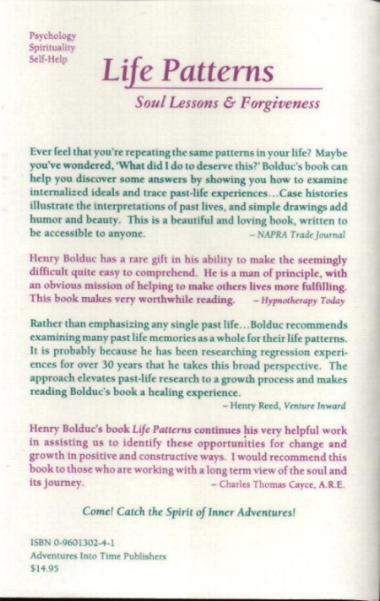

Back Cover
Life Patterns, Soul Lessons, and Forgiveness
1994, Henry Leo Bolduc
You may use the materials in this book freely. Permission is hereby granted to reprint, in any form, any materials for either personal, professional, or educational use.
Edgar Cayce Readings copyright 1971, 1993, by the Edgar Cayce Foundation. Used by permission.
All quotes used with permission.
Cover illustration by Sue Jones
First Edition, December 1994
Fourth Edition, November 2000
Library of Congress Catalog Number 94-68926
ISBN Number 0-9601302-4-1
P.O. Box 88, Independence, VA 24348, USA
www.henrybolduc.com
Manufactured in the United States of America
Chapter I Introduction
Chapter II The Patterns of Your Lives
A. Exploring the Inner Mind
B. Implications
of Past Lives
C. Learning From Our Past
D. Why We Have More Than One Life
Chapter III Working With Difficult Patterns
A. Identifying Negative Patterns:
Denial, Re-run, Extremes
B. A Positive Approach
Chapter IV Discovering Your Inner Self
A. Journal Writing
1. Keeping a Diary
2. Autobiographical Writing
3. Intuitive Writing
4. Dreams
5. Letter-Writing
6. Story-Writing
B. A Spiritual Sanctuary
C. Take a Learning Vacation: A Personal Retreat
Chapter V Self-Hypnosis and Ideals
A. Ideals: A Practical Standard of Excellence
B. Mind Management
C. The Journey Inward
D. An Ideals Inner Adventure
E. An Ideals Project
F. Notes to Remember Regarding Self-Hypnosis
Chapter VI Embracing Your Eternal Child
A. Your Inner Child Learns
B. Reflections in the Face of Time
C. Preparing for Your Next Adventure
D. Embracing Your Eternal Child —
The Incredible Healing Power of
Love — An Inner Adventure
E. Embracing Your Eternal Child — An Analysis
Chapter VII The Soul’s Remembrances
A. All Things to Your Remembrance
B. Spiritual Pioneering
C. Critical Mind or Compassionate Soul?
D. Origins of Your Patterns
E. Remembering Who You Are
F. Remembering the Future
G. Accessing the Soul’s Remembrances
1. Inner Adventure —
Procedure
2. Inner Adventure —
Exercise
H. Personal Evaluation
1. Self-Study Sheets
2. Analyzing the Life: Story Frame
Chapter VIII Soul Lessons — Edgar and Gertrude Cayce
A. Edgar and Gertrude Cayce
B. An Excellent Adventure
C. How Souls Lost
D. How Souls Gained
Chapter IX Love, Sexuality, and Spirituality
A. Gender Identity
B. Sacred Sexuality — Passionate Spirituality
C. A Life Out of Control
D. Love is the Answer
Chapter X Monks, Warriors, and other Extremes
A. Noble Causes — Terrible Consequences
B. Pattern Formations
C. Pattern Recognition: The First Step Toward
Healing
D. Evaluation from Within Chapter XI Healing the Past A.
Three Case Studies 1. Claire 2. Thomas 3. Enrique B.
To Live Life More Fully, Study Life C.
Hate is a Spiritual Disease D. Forgiveness Chapter XII
Healing the Present A.
Growth Occurs in Resolving Problems B.
A Present Life Pattern C.
Your Homework: Worksheets Chapter XIII Healing the Future A.
Envisioning the Future: Milton
H. Erickson B.
Seeing Beyond the Present: Previewing Destiny C.
Healing Your Future D.
Being Pro-Active
E. Creative Problem-Solving: An Example
F. Self-Directed Learning
G. The Constructive Mind
H. Networking from the Heart
I. A Beginning, Not an Ending
Chapter XIV Perfection
A. Seize the Day! Seize the Lifetime!
B. A Poem
Acknowledgments
The information shared in this book is gleaned from more than three decades of my own research. To the best of my knowledge, everything is accurate and authentic; only the names of individuals in the “Case Studies” have been changed to respect their privacy.
Birthing a book is a labor of love — I cannot think of any other reason for doing it. Similar to the birth of a child, there is love, conception, gestation, and — with a few labor pains — the birth itself. With deep appreciation, I thank the following people for giving so generously to the gestation and birthing of this “baby:”
To my wife, Joan Willard Bolduc, whose love of learning is an inspiration to me and to her many students. It takes a lot of love to be a teacher for twenty years. Joan recently received her Master’s Degree in Education — she is the love of my life.
To the staff of the Grayson County Public Library, my office away from the office. Priceless wisdom is stored there and it’s all FREE!
To chapter editors who helped in the gestation period: Tom Weber, Susan Mayer Bleiberg, Peggy Becker, Jody Menard, Ruby Gillion, Melanie Hertzog, Becky Grey, Roxanne Summers, Egon Frech, Frank Thomas, and Nancy Thomas.
To typists who made sense of my notes: Chris Green, Regina Harris and especially, Virginia Dimmel.
To the gifted artists who made it beautiful: Kathye Mendes, Sue Jones, Jeffrey Winchester, Julia Fierman, Veronica Reed, and Diane Coleman.
A special thanks to Baldwin L. Troutman who provided the early help, vision, and encouragement and to Marjorie Reynolds for the final editing. Most of all, Linda Hutchins helped this book at every stage, nurtured it and dedicated herself to its healthy birth.
To all the people who have attended my workshops, classes, and programs you helped me to fine-tune the work and you gave me great inspiration through your questions and experiences. You inspired this book more than you might realize.
Introduction: Patterns, Lessons,
and Forgiveness
The two most important questions you can ask yourself are:
1. What did I EVER do to deserve THIS?
2. Why am I going through this AGAIN?
When you wonder what you did to deserve THIS, you are consciously asking your unconscious mind for insight into the origins of a situation currently being experienced. Everyone realizes, deep within, that for every cause there is an effect. For every action there is a re-action. You wonder what you could have planted originally in some recent or distant past that you now reap.
The second question, “Why am I going through this AGAIN,” is even more profound. Here is where you begin to detect a PATTERN in your life. This pattern could involve a personal relationship. Perhaps in your case it is a social, financial, or business matter. What is important, in order to rectify an uncomfortable situation, is that you recognize that there is, indeed, a pattern which has been or is being established. That is the first important step.
Of course, not all patterns are in need of correction. In fact, we all have many positive patterns. Since they don’t give us any distress, we tend to overlook them. It is said that great truths can be stated simply and directly. The following is a great truth, somewhat understated. “Positive patterns are fun: challenging patterns are not fun.”
What is a pattern? A pattern is a repeating theme or cycle in our lives. It is the mode of behavior, or a combination of actions and qualities of an individual. A pattern is anything that acts as a model, guide, or stencil from which we form repeated activities. A pattern is interwoven threads that form the fabric of our lives.
Patterns can be either positive and beneficial to us, or they can be difficult and challenging. Positive patterns are like good habits. They make our lives easier, bringing joy and satisfaction. Patterns can be certain skills and special abilities such as attracting abundance and good fortune. For example, many people have a wonderful pattern for loving and nurturing.
On the other hand, challenging patterns are opportunities for growth and learning. They are not “bad,” for without challenge we would stagnate and become weak. The challenging patterns can include fears, phobias, and anger. Other negative patterns can be hatred, prejudice, elitist activities, and ego drives.
This book can assist you in the process of discovering your own patterns. It may ask some important questions, but you alone can answer them candidly and honestly. As you read further, you will find new ways to approach your study of self with practical tools like Journal writing and defining ideals. Together we will look into such spiritual methods as self-hypnosis, meditation, and past-life evaluation. You may ask what past lives have to do with your current patterns and everyday responses. The research of decades has uncovered the fact that the “roots” of our actions go far deeper than yesterday, last year, or even a long ago childhood.
The Patterns of Your Lives
A. Exploring the Inner Mind
The history of
every soul (the cumulative total of the experiences of many lifetimes, spanning
thousands of years) is recorded in the subconscious mind. Most of us do not
have conscious memory of those experiences. Even though we may not realize it,
such unconscious recall can have a direct and profound effect upon our actions
and decisions in this lifetime. If we could gain access to the record of our
past, it truly would be the adventure of our lives.
If you are
skeptical of past-life experience, just for a few minutes suspend your
disbelief, open your mind, and boldly enter through a new door and into a new
realm. Embark upon a journey of exploration —of adventure and discovery. You
will be exploring the mysteries of your inner self, where the soul’s history is
recorded.
The science of exploring the mysteries of the human soul — the part of us that is most human — is called “mysticism,” and the explorers who study it are known as regressionists. Their work is analogous to that of archaeologists, who study sites and artifacts of historic or prehistoric peoples. Regressionists, the archaeologists of the soul, dig through the strata and sub-strata of memory rather than through the records of geology. They sift through the potsherds of a broken past, discovering what may be of value and what may be discarded as unimportant or even harmful. They reassemble mosaics for a clearer view of the ancient ways of past lives.
Those explorers of
the inner mind discover the hidden dimensions of the past and display them for
present evaluation. They are the guides who can lead you on your journey. While
the primary research of the regressionist is the study of the past, regressionists
are also pioneers on the frontiers of tomorrow. They are progressionists and
mapmakers of undiscovered realms and future dimensions of reality.
B. Implications
of Past Lives
The
mysteries of the human mind have been a “dark continent” for centuries. It is
not a final frontier, however, but a vast new world — an explortum! Mind is the
pathway through time, from past to present to future. The mind is vast, and
contains an amazing paradox: every living person has a mind; yet, most people
are afraid of its potential. Perhaps they are more concerned with their darker
sides — those parts of themselves they would rather not face.
Everyone
has had faults and contradictions throughout many lives and experiences. Like
the earth herself, each soul has numerous fault lines hidden beneath the
surface. The soul also has sensitive “volcanic” hot spots which can erupt at
times of stress, and with explosive fury; nonetheless, people develop more
quickly and gain more wisdom through being challenged, rather than through
being pampered. When people realize that hard lessons are for their growth and
betterment, they become wiser.
The
experiences and lessons from past lives always influence (and often deeply)
one’s present life, sometimes in unusual and unexpected ways. In truth, we have
experienced all aspects of life everywhere. This revelation is so profound that
many would prefer to dismiss the entire concept rather than to explore their
memories. We have experienced life in both genders; we have lived lives among various
races and adhered to diverse religions. We have inhabited numerous lands and
taken citizenship in many nations.
As a result of our varied experiences, we have learned
lessons, hopefully, from those past times and places. With this learning comes
the recognition and assurance of our common bond or link with ALL humanity.
The goal of each life is to grow spiritually in such a way as to strengthen
this common bond. In this manner, all souls are strengthened and all lives on
the physical plane are enriched.
The
subconscious memories of our past lives can have both positive and negative
Influences on our current life. For example, oftentimes, a person who was
oppressed in a past life comes back to become an oppressor in the present life.
An even more wicked form of dysfunction can develop — the victim role. In this
case a person returns again and again in a futile pattern of re-runs.
Let
us consider the plight of the American Indians who were persecuted and robbed
in their past; yet, many return to re-enact similar lives. If we have once
lived as an American Indian, for instance, how can we deny the plight of
today’s Indians? Is not that very soul memory (though deep within) a living
force today?
C. Learning
From Our Past
Our past-life memories are hidden, and yet, if we want to benefit from the experiences of our past, how can we do it? This book contains scripts for “Inner Adventures,” to help you journey safely into your memories. This journey is called “past-life regression.” With proper use, it is a powerful TOOL to sever the chains of the past. Sometimes the chains are visible, and sometimes invisible. When the chains are broken, you can develop your present humanity and proceed to build your best possible future.
Before starting on this journey, you
need to ask yourself what it is that you are seeking. What questions should you
be asking? How can you benefit best from the answers? On a personal level, the
question is not WHO you were in a past life, but how you gained spiritually.
How did you gain, or how did you lose? How well and how kindly did you play the
Game of Life? Did you work to improve yourself, your family, your community?
Regression work is
the process, not the product. HOW you learned and how you used that learning is
far more important than WHO you were or WHERE you lived. What you were INSIDE
is much more valuable than what you appeared to be on the outside.
Let’s consider an
analogy. Suppose you dress in a costume for a Halloween party. Do you become
the person or thing that you are dressed as? Of course not! The outer garb is
to create an illusion — the inner person remains the real you. Thus, your
outward appearance in a past life is of minor importance. WHAT you were,
spiritually and the lessons you learned, are what is of value. The soul’s
memory is your true wisdom.
D. Why
We Have More Than One Life
I believe that,
for more than any other reason, we have been granted more than one lifetime to
learn lessons. One important lesson is that of FORGIVENESS. Most people say
that they forgive others, but the reality is that few of us really do so.
People say one thing, but often do quite the contrary. The many experiences
and lessons learned in other lifetimes enable us to forgive much more easily.
Let’s suppose, for
instance, that a person has stolen something (and we probably have all done a
certain amount of stealing in our many lives). In the present life, others —
almost always — will think of that person as a thief, even though the
individual might possess numerous other excellent qualities. People who have
stolen, for whatever reason (perhaps in desperation to keep their families
fed) are labeled thieves, and the label sticks.
Thank God we are
given a break from all that and can have a new and clean start. That new start
is a new life! We are given another chance to learn and to grow toward our goal
of spiritual betterment.
Your personal
regression history is a significant chapter in the history of humanity. Each
life contains pages of splendor and pages of travail, times of wonder and
growth, and episodes of loss. Such experiences are what life is all about!
Regression exercises are like gifts that refresh your inner memory. They are
like pieces of a complex puzzle that you carefully and patiently fit together
to see the full picture.
Earlier I stated
that regressionists are also progressionists. Regressions help you to review
your past and to strengthen your present. Progressions help you to plan for
your future. You must conceive a wiser, happier, and healthier
future before you can start building it. Everywhere, there are cynics and
critics who will try to deny you the right to change and to grow. Don’t let
them stop you! Use soul exploration to connect you with your own heritage.
Define your present life ideals and patterns. This will help you to clear a
pathway to your best possible future.
Working With Difficult Patterns
A.
Identifying Negative Patterns:
Denial, Re-run, Extremes
There
are two basic ways of working with challenging patterns. First, there is the
reactionary or defensive approach which includes denial, re-run over and over,
or opposite extremes; secondly, there is a positive approach.
Denial
Oh,
how easy it is for us all simply to deny any involvement. This approach is very
popular in the current age. We find this principle even at the very highest
levels of government, i.e., several presidents seem to have “forgotten” their
involvement in illegal situations.
Instead
of blaming our leaders, let us identify that same denial in ourselves. Let us
be observant of our own “excuses.” Let us listen to our own words, making sure
our actions are congruent with our inner selves. (This is not always easy to
do.)
When
we realize that we are involved in negative patterns, the first step is to
identify the patterns. It is easier if we choose someone else as an example, so
let us look at a young man in our neighborhood. He is an average teenager,
Interested in sports, music, and friends. Since he got his driver’s license a
year ago, he has been involved in four accidents.
He hit a dog at the time of the first accident, saying, “The dog ran in front of me, it was his fault.”
In the second accident he hit an elderly lady’s car, as she was making a turn. At that time he offered, “She was turning too slowly; it was her fault.”
The third time, when he drove into a ditch, he said, “It was the road’s fault.”
In the fourth accident he went off an embankment. While two wreckers pulled out the vehicle, he insisted, “It was the weather’s fault.”
Do you get the idea? Although there may be some truth in the explanation of each accident, the larger truth is called “projection,” a form of “denial.” The neighbors have commented on the young man’s fast driving habit. The real problem, or the pattern here, is the speed. The accidents are only a symptom of going at an excessive speed. He refuses to take responsibility and blames the problem on others or on circumstances. By living in denial he cannot change, for he has not perceived the pattern or the causal problem. Other expressions of denial can include repression, blame, anger, confrontation, etc.
Re-Run
Re-run is another interesting approach to patterns! The faces may change, the addresses may change, the dates may change, but the basic situation is the same. A classic example of this pattern is a person born into a family which is experiencing alcoholism, and who then becomes an alcoholic and/or marries one. Fortunately, AA and other 12-Step Programs have been of immense help with this pattern in recent years.
Often, this kind of pattern is associated with a “rut,” or habit, that gets deeper and more entrenched with the passage of time. When working with most relationship patterns, the re-run approach is most often used.
Extremes
We all have learned that, in the fields of electricity and magnetism, it is the OPPOSITES that attract. The same principle applies to humans as well. Perhaps you already know, for example, an alcoholic who gets sober often becomes a tireless speaker for sobriety. We all have known excigarette smokers who have become crusaders for clean air. Church revival meetings almost always include a street-gang member who has made a 180-degree turn-around to condemn street violence.
As laudable as their goals may be, there is one thing of importance to consider. Are not the two extremes just two examples of the same pattern? Two sides of the same coin? Don’t re-act to events from either extreme position. Find a middle ground of balance and moderation.
Going to an opposite extreme gives the illusion, but not the reality, of healing. It is only a form of distancing from the problem or pattern, and merely proceeding to a different one. No matter how it appears, it IS the opposite side of the coin of the SAME BASIC PROBLEM.
B. A Positive Approach
1. Analyze the situation to discover the pattern(s)
2. Research and study ways to heal the pattern
3. Surrender to a higher power
4. Work with trusted friends or support groups
There are many tools you can use in your work. Among those proven successful are: prayer, meditation, self-hypnosis, self-discipline, journal writing, and going on a personal retreat.
Some patterns are so obvious that it is hard to miss them. Others are so subtle that it takes careful observation to perceive them. Trusted friends and support groups can be helpful because they can assist us in identifying patterns we can’t see ourselves. Later in this book, you will find a number of worksheets that will help greatly in the study of your own patterns.
The POSITIVE patterns are fun and enjoyable. They make life easier. By identifying them we can develop and utilize them more fully. Again, trusted friends and support groups can help us to see our own strengths and gifts. Positive approaches can include humor, detachment, or any form of therapy a person might choose.
Whether positive or challenging, the “roots” of our patterns go deeper than our current lifetime. Our origins are deeper and our purposes greater than most people realize.
Discovering Your Inner Self
(Tools and Techniques for Understanding Your Patterns and Lessons)
Understanding comes with study, contemplation, and seclusion. I am going to offer you three proven methods of studying and evaluating your inner self, as a means of gaining a deeper understanding of your larger self. Choose the method that feels most comfortable to you. This is the way to obtain the best results. Examine the ideas and choose one, or any combination of them, or create your own innovative approach. The most important thing is actually to use a method of discovering your inner self. This is the way to understand both yourself and your patterns.
A.
Journal Writing
This is a fun, free, and enlightening method. All that you need is to set aside 15 — 20 minutes a day, and to bring a pen, and paper. To get the most out of journal writing, put your expectations aside and have fun with it. You will find that you will laugh, grasp at an illusive memory, and so piece together your patterns. Journal writing leads to active learning about yourself, your world, other people, and life.
Keeping a Journal can be a journey to self-discovery and a potent morale booster, especially if one writes about one’s feelings and emotions. It can be one of the most important tools for building a happier, more productive life, as it helps to open doors that might have remained closed — doors to the deeper inner self as well as doors to the outer, every-day world.
One of the nice things about Journal writing is that there is almost no cost involved, except that of pen and paper. If you like, you may purchase a spiral-bound notebook, or a 3-ring binder, which will make it easier to categorize your subject material. Another nice aspect of keeping a Journal is that you don’t have to undergo any special training, take any classes, or do any other preparation. You can start right now —TODAY! You simply begin right where you are in life by putting your thoughts and feelings on paper. It’s that easy.
Many people associate journal writing with keeping a diary. A diary is, certainly, one form of journal, but it is not the only one. Other types are autobiographical writing, intuitive writing, dream records, writing of future goals and ambitions, and even letter and story writing.
Keeping a journal:
* helps you to discover goals, Ideals, hopes, fears — just about everything there is about you,
* teaches you to listen better — and listening more acutely inspires better writing,
* teaches you to observe better — and observation brings vision to your writings,
* teaches you to touch life more deeply — and this depth brings more feeling into your writings,
* helps with self-honesty, personal integrity, and clarifies thinking,
* Is a safe outlet for hurt, rejection, or reaction; you communicate with the real you,
* substantiates your thoughts and experiences. Reflecting on them brings different perspectives over time,
* gives a feeling of accomplishment; Like exercising your physical body, writing exercises your mind, and
* opens a door to self-discovery by accessing your subconscious mind. Past-life insights are often revealed in writing.
Your best writing often comes through the most difficult times — from the most challenging lessons and experiences.
Patterns will begin to show throughout your life as you study your journal. Those patterns are vital to your learning and growth — they are the real lessons in your life.
Use all of your senses as you write. Use words
descriptive of what you: SEE, HEAR, TOUCH,
SMELL, TASTE. Also, be aware of the 6th sense that you will discover
inside. This is your INNER RESPONSE.
Parents, give your children a diary (with a lock) and encourage them to write in it, so that they can discover, early in life, the immense value of such creative writing. They will learn the healing power of expressing themselves through sincere expression of their thoughts.
If your language is imperfect or limited, learn to use a thesaurus. To improve your grammar, there are many books that could help. One favorite is a slim volume entitled THE ELEMENTS of STYLE, by Strunk and White, published by the McMillan Company. For a spelling problem, get a dictionary or use the spell check that comes with most word processors. If you plan to do any professional writing, use of a word processor will make editing your documents much easier and will increase your productivity.
Keeping a journal helps you to write better, to think more clearly, to assimilate the experiences of your life. In time you may return to your writing and re-live those great experiences and more wisely reevaluate the challenging times. Reading something you wrote in the past gives insight as to how your life has changed — progressed. This is part of your personal history which, often, is lost if it is not recorded. Reflecting upon the past helps to facilitate personal growth.
Finally, as emphasized earlier, don’t procrastinate. Go ahead and start your journal writing now. You will find it an enriching experience. Use the power of the pen to get a better understanding of your lessons and patterns — and yourself
Here are some suggested “story starters” to motivate you and to get you going:
“I behave just like my Mom when I…”
“A recurring dream I’ve had is…”
“The quality I admire most in others is…”
“The thing that irritates me most in other people is…”
“I find myself attracting the same kind of man/woman …”
“If I have had a past life, I would have lived in…”
“I would have worked in that life as…”
“My forefathers came to this country from…”
After you’ve written your story, let your family or friends critique It. You’ll learn how to discipline your thoughts, how to use correct grammar, how to research material, and many other useful techniques. Furthermore, you will give pleasure or impart knowledge to those who read your story. You may even get a story published. Then you can call yourself an author!
Your journal is the “BOOK OF YOUR LIFE,” a document of the real you. It is for you and you alone, unless you wish to share all or part of it with others.
1. Keeping
a Diary
In its most basic form, a diary is simply a day-by-day account of the events in your life that you would like to record for future reference. Many people in the business world or in public life keep such records to refresh their memories of past events or commitments they may have made. They often include in the diary a calendar of future engagements and so forth. The diary, or daily journal, thus becomes an important reference in their daily activities. In their private lives, people who keep journals often include such entries in their autobiographical journals.
2. Autobiographical
Writing
Autobiographical writing can be for you alone (unless you wish to share it with very special friends). Knowing that it is for your eyes only, you can feel more comfortable in expressing your innermost feelings and emotions. In times of stress and trouble, keeping this journal can be very therapeutic. The simple act of putting your thoughts on paper can give you a new perspective to your problems. Studies conducted by James Pennebaker, Ph.D., Professor of psychology at Southern Methodist University in Dallas, have demonstrated the benefits of writing about traumatic experiences. Dr. Pennebaker asked students to write for 15 minutes a day, choosing as their subject either a traumatic experience or a superficial topic. “We found those people who write about thoughts and feelings typically show significant improvements in physical health and improved function, have fewer doctor visits, and report feeling happier and healthier in the months that followed,” says Pennebaker.
Dr. Pennebaker added that although the initial effect of the writing sessions might have made the person sadder, a positive outlook and lighter mood resulted within two to three weeks, and persisted for as long as six months afterward. So, although you may feel sad or depressed immediately after writing, within a day or two you should begin to feel a sense of relief and contentment. In writing about such experiences, describe the event and your deepest emotions, but do not rationalize or lay blame. Just try to understand your thoughts.
In addition to writing about difficult experiences, you may also write about your accomplishments, your successes, your joys, and your hopes — all to your benefit. When you write about any of your thoughts and experiences, you automatically assimilate them, learn, and grow wiser. This prepares you to face similar situations in the future. So, let’s get started on this wonderful discovery of self. To make the initial effort easy, let’s begin with a small project. Later you will want to begin your permanent record, or your autobiographical journal — this can be its beginning.
Write a few paragraphs about:
1. Childhood experiences
a. Positive or pleasant
b. Negative or unpleasant
2. Present-day experiences
a. Family
b. Work
c. Travel
d. Pets
e. Hobbies
f. An influential person in your life
3. Future Plans
a. Hopes
b. Fears
c. Work
d. Personal plans
3. Intuitive Writing
If you encounter difficulty in writing about your hopes, plans, emotions, and feelings, try writing from a different level — adopt a new style. What I’m describing here is not a type of journal, but a writing style which can be used in any of the journal types. This writing style is called free-form, or free-flow. It has no rules except just to write — let the writing go where it wishes. Get out of your own way and just DO IT! Let’s examine the techniques of this writing style:
1. Stream of consciousness technique
You simply begin by writing down everything that comes into your mind, regardless of whether it makes any sense.
2. Ideals
First, sit quietly and reflect upon a problem that is currently affecting your life. Next, ask your inner mind, or your higher mind, for a solution to that problem. When you receive the answer, write down the solution in your journal. For example, experiment with this technique to connect with your higher self to ask the following questions:
a. What do you really want to do with your life, and why?
b. How would you act even if you were certain you’d never be found out or blamed?
c. How would you act even if you were certain you’d never receive any recognition or credit?
3. Poetry and prose
Often the language of the subconscious, or the inner mind, comes through in either rhyme or blank verse. If it does, work with those tools in your intuitive writing. Work with whatever tools your subconscious advises. Just follow the guidance of your intuition. Those who are musically inclined may wish to write songs.
4. Dreams
Most self-help, spiritual, and psychological materials will advise you to keep a dream journal. They also advise you to encourage dreaming by telling yourself that you will remember your dreams upon awakening. If you have an unresolved problem from the day’s activities, relate the problem to your subconscious mind and ask it to give you a solution in a dream. Tell yourself to awaken after each dream so that you can record it before it is lost. The dream journal can be kept separate from, or included within, your writing journal.
Dreams are an important part of your communication with your inner mind. Your dreams are messages to you from your subconscious; they are intended to give you guidance from your higher self. Unfortunately, most people do not recognize that their dreams contain guidance, and they forget them immediately upon awakening. Your conscious mind, which is controlled by your ego, or personality, does not recognize dreams for what they are. When you awaken, you, most likely, will be conscious of your latest dream, and think that you will remember it. But if you stir around, or get out of bed, your conscious mind may take over and the dream will be gone.
In view of the unique manner in which dreams are received, if you are to benefit from them, you must record them immediately upon awakening, or they, most likely, will be lost. Thus, you could keep a separate dream journal by your bedside, where you could make entries before your conscious mind becomes alert enough to erase them. This can be done by keeping a notebook and pencil by your bed and recording the dreams before you engage your conscious mind. If you sleep alone, or have a tolerant partner, you can record them into a cassette recorder. If you tell yourself to wake up after each dream, you may be able to record several dreams in a single night.
You will observe that your subconscious speaks to you in symbols, some symbols are universal, some are personal. You will have to learn to interpret those symbols, and you will be able to do so with practice. Go back through your dream journal from time to time and you may be able to identify trends, patterns, or other signs by which you can learn to use the messages your dreams are sending you, for surely they are messages from your subconscious.
5. Letter-Writing
Most people would not associate letter writing with keeping a journal; however, it is much akin to it. In fact, many famous people in the past published such correspondence. Thus you may think of your correspondence as a type of journal writing. If you kept copies of your correspondence, you would realize that it was actually a part of your autobiographical journal. If you like, you can use parts of your autobiographical journal in your letters.
Sometimes letter writing can be therapeutic. By way of illustration, let me give you an example taken from the experience of a friend. “Once, many years ago, I became incensed with what I perceived to be lack of proper recognition for certain work I had performed, and wrote an angry letter to the individual concerned. Before mailing the letter, I showed it to a colleague for whom I had great respect. He said, ‘Okay, you’ve written a good letter, and got the matter off your chest. Now throw it in the trash basket.’ I thought about it and agreed with him. The act of writing the letter had, indeed, released the matter from my system, and I felt better about it. Many times since then, I have remembered that advice and followed it.” The next time that you need to release some tension, try writing a letter about it and then throw the letter away.
As with any other activity, one learns and gains experience and wisdom with practice. So let’s begin by writing three letters to friends, loved ones, someone in a nursing home – anyone you know. Your letters will be appreciated and you will gain from it. But this time, put stamps on them and mail them! Even More challenging, but very productive, is to write “letters to the editor” of any state-wide or national publication concerning topics of current interest or of particular concern to you. You may be surprised at the response.
6. Story-Writing
I can hear some of you say, “Story writing!! I’m not an author. I can’t write a story.” In fact, statistics reveal that 90% of Americans think that they cannot write creatively. Well, you’ll never know unless you try. First, don’t think about writing an entire book; think in more modest terms. Write about something familiar — a few pages about your family, or your family history. Write as though you were talking to a friend; just let the story tell itself. So don’t procrastinate; sit down and do it!!
B. A Spiritual Sanctuary
Create a Spiritual Sanctuary. Find or make a special place in your home or on your land where you can go for contemplation. This place does not have to be of a certain structure — just a secluded nook, or area. Bring your favorite mementos and most cherished objects.
Learning is a life-long experience. We are in this Earth School to learn and to grow, not only during our adolescent years, but throughout our entire lives. Our goals can be to grow, to develop, to improve, to accomplish, to have adventures, and just to be kind! Learning can improve with age.
Distractions in daily life make continued learning difficult. The creation of a spiritual sanctuary will set up the environment for your continued growth. This will be your personal space — a place where you can go for quiet time, for contemplation, and for rest. There are many ways to create your space. For example, use a library, take over a large closet in your home, use the corner of a room, or find a secluded place on your property that might work for you.
If you are having a problem creating a space for yourself because your home environment is so cluttered that you can’t clear out a little area for your spiritual sanctuary, something is definitely wrong! Make your spiritual goals primary, not secondary. Learn to be still, to be sincere, to simplify your daily life, and to magnify your spiritual life. Grasp the REAL MEANING of your life and live it exuberantly.
Our spiritual sanctuaries are there for our growth. They provide a place for rest. This rest is vital for growth and learning. Following periods of great activity, we often need quiet time to evaluate and to understand what we have just experienced. This quiet time often provides us with more than just understanding. It is often a time of inspiration and the incubation of new plans and strategies.
If music is an important part of your life then, be sure to include it in your plans. If your sanctuary is out of doors then, bring chimes, drums, or a portable cassette player.
A spiritual sanctuary is your own wonderful, peaceful, and private place to explore your thoughts, your feelings, and your innermost heart. This is your peaceful place to pray and to meditate.
Have fun creating your own personal, restful, healing place. It is easy to build anywhere, indoors or out. Just make the focal point your favorite items, your mementos — anything from your life that has meaning. Decorate your space with elegance or simplicity; it’s up to you. Create beauty — bring hope and harmony, and enjoy the doing. Start with a candle or two if you wish, a gift from a friend or a loved one, a beautiful piece from nature herself — some special rock or mineral, a feather or a sea shell, souvenirs from enchanted journeys or vacations. Sacraments are any objects that are sacred to you. Bring them to your sanctuary.
Now begin to add the personal, human element. Perhaps a small mirror so that you can look deeply into the eyes of your own soul. Add to this a photo if you wish, a picture of a favorite saint or other holy person — anyone whom you hold as an ideal. Bring anything which reminds you of your real essence, of the real you, that unique, wonderful, precious you. A you that is kind, generous, and loving, the you that you truly wish to express with an attitude of reverence in the fullness of your heart and soul. Continue adding new items from time to time as your life grows, progresses, and evolves. Acknowledge and appreciate each adventure in this great school or learning center that we call the Earth School.
Your sacred place — your Altar — is for you to enjoy. It is good to come here. Come at regular times simply to commune, to relax, just to be you. Is it only your imagination that this place — this sanctuary —has made a difference in your life? Even if it is only imagination, there is wisdom in accepting that there may be more to life than some would openly admit.
This is the place to contemplate your spiritual friends, your loved ones, your guardian angel, your protectors, those that may not be visible to the outer eyes but may be seen by the inner eyes. Do the inner eyes see more clearly? Do the inner ears hear more acutely? Does the inner heart feel more deeply? Your friends in the Spirit Lands may wish to come to visit you in your sacred sanctuary. If you will it, they will come.
It is always good to connect with loved ones from the past and even into future time. Just build your sanctuary! Just do it! They will come.
Bring your journal to your spiritual sanctuary so that you may record your heart’s memories and your soul’s visions in your peaceful, quiet space. (Your spiritual sanctuary may become the place where you always engage in journaling.)
Important things to remember are: practice silence — don’t talk about it; do it. Be joyous — being spiritual does not mean being somber, morose, or withdrawn. It does mean to live your life fully and thankfully.
We have examined journal writing and the spiritual sanctuary and we can see how the two of them could act separately or together to work for your growth and learning. Let’s look at a third way, a personal retreat.
C. Take a Learning Vacation:
A
Personal Retreat
Take time out for a personal retreat away from your daily routine. I like to describe this experience as a spiritual adventure. Others call it a “weekend get-away.” It is a meditative “outward bound” for the “inward bound.” The rewards may be life-changing. The cost involved may be as small or as large as you choose to make it.
About thirty years ago, after graduating from high school, I contemplated what my life’s direction and vocation might be. Although I had a good job working at an apple orchard, I knew that it would never be my career. I decided to take a few days out of my busy schedule to go on a personal retreat. A friend in New Hampshire owned a small mountain lake completely surrounded by woods - a winding trail was the only access. It sounded like the perfect place to go. Because I did not own a tent, I brought a tarp to construct a temporary “lean-to” shelter. I carried in my sleeping bag, books, paper, and toilet paper. I brought no food because I had read that the American Indians fasted when they went on “vision quest.”
Originally, I planned a four-day weekend retreat. The first two days passed slowly — too slowly. I read, built a campfire and seriously wondered why I had decided to do such a “boring” thing. I probably would have given-up and returned home, except that I had told people about my adventure and I didn’t want them to think that I had “chickened-out.”
The next two days were more productive. As I meditated, used self-hypnosis and prayed for guidance, I began to list what I wanted to do with my life. Then I wrote what I did NOT want to do. Slowly the realization came that, with work and dedication, I could do just about anything! So what did I really want to do? What interested and excited me the most in life?
In the process of writing the things I most wanted to do, the answer became obvious. After reading The Search for Bridey Murphy, by Morey Bernstein, I had been conducting experiments in past-life exploration for a couple of years, this work was very exciting, but what could I do, realistically, with such information? Then I remembered reading about Edgar Cayce, from Virginia Beach, Virginia, who spoke about past lives. Slowly, a thought started to form, “Why not go to Virginia Beach to learn more?” Although Mr. Cayce had died the year before I was born, I knew that an organization of people was carrying on his work.
A thought was born, a spark was ignited in the chasm of my brain! An inner prompting, a plan or action was formulated on the shore of that secluded New Hampshire lake. This was not some blinding vision nor did trumpets sound in the sky, but a real direction was now evident: “Travel! Go to that Cayce place.”
Perhaps the thought and the plan would have come to me in spite of taking a retreat. Perhaps a few days of fasting were unnecessary — who knows? But I did gain something. I made a decision to take a new road — and certainly one less traveled!
Within a few months I was on my way to Virginia Beach to become a member of the Association for Research and Enlightenment. Now, three decades later, I journey the same pathway. I continue to reach out through presenting workshops and educational programs around the world for the A.R.E. OUTREACH is my mission!
You also can take a personal retreat — your own inner quest. Plan your spiritual adventure now. It does not have to be a trip to the woods. Do what is comfortable for you, yet will allow you the opportunity to explore your inner self and to receive any messages that you may be given. Whatever kind of retreat it is, should it make you more comfortable and more willing to take the spiritual adventure, do it. You might choose a safe motel that is secluded, with no distractions, or go to a cabin in the woods, or to a hotel on a secluded beach, or to the house of a friend who is away for a few days. Your expenses may be increased but the important thing is that you go away and explore your inner being.
Perhaps your experience will be as mine; perhaps not. Nonetheless, your
spiritual retreat can bring you various benefits. You can:
* connect with your innermost
self,
* be given valuable guidance — a
dream, a vision or a plan of action,
* enjoy the beauty and splendor
of nature,
* receive insight into what is
REALLY important in your life, and
* experience solitude, rest, and
quiet reflection.
Best of all your spiritual adventure can cost very little; yet, it can give you
high-yield returns. You could choose to do as I did, keeping things simple and
easy. Choose a safe, secluded site (not during hunting season)! Bring what
you already have, or borrow from friends:
- a tent or tarp
- sleeping bag
- pen, paper, toilet paper
- knife, matches, drinking water
Leave the electronic
gadgets at home. This is a spiritual adventure, an inner quest.
Although most people
are aware of the importance of building their minds and bodies, few are aware
of the greater importance of building their spirits. Though often neglected,
spirit is the life essence — the vital living force.
Eventually, each person must stop and re-evaluate life. Sometimes a tragedy triggers such a situation. It is better not to wait for circumstances to propel us onto a higher path. Specifically choose a spiritual adventure or exercise. When that is accomplished a larger view is presented, an inner guidance is heard, a deeper purpose is realized. Such profound revelations guide us to our spiritual destiny. Pivotal or transformative events can bring positive change and betterment.
In the time of the American Indian, a “vision quest” was practiced by
the young men. Sadly, there is little recorded history of the importance of
spiritual exercises and quests for the young women. It is even more ironic
that, today, women are more interested in building their spiritual lives than
are men. Perhaps this is a natural balance, or perhaps women have grown wiser
while men have become more distracted. In any case, women can now take the
great journey — the holy quest — as equally as men. Perhaps they will be even
more dedicated in purpose, richer in ideals, braver in discovery. EVERYONE has
the God-given right to become a spiritual seeker, and to experience the
adventure!
After my own youthful quest, another decade passed before I located a
book that gave practical information about how the American Indian approached
his spiritual retreat. That book, THE SOUL of the INDIAN, by
Charles Alexander Eastman (Ohiyesa), was first published in 1911 “to paint the
religious life of the typical American Indian as it was before he knew the
white man.” In 1980 the University of Nebraska Press reprinted that small but
immensely valuable book.
Eastman
wrote powerfully yet poetically:
“The worship of the ‘Great Mystery’ was silent, solitary, free from all self-seeking. It was silent, because all speech is of necessity feeble and imperfect; therefore the souls of my ancestors ascended to God in wordless adoration. It was solitary, because they believed that He is nearer to us in solitude, and there were no priests authorized to come between a man and his Maker.
“There were no temples or shrines among us save those
of nature. Being a natural man, the Indian was intensely poetical. He would
deem it sacrilege to build a house for Him who may be met face to face in the
mysterious, shadowy aisles of the primeval forest, or on the sunlit bosom of
virgin prairies, upon dizzy spires and pinnacles of naked rock, and yonder in
the jeweled vault of the night sky! He who enrobes Himself in filmy veils of
cloud, there on the rim of the visible world where our Great-Grandfather Sun
kindles his evening campfire, He who rides upon the rigorous wind to the north,
or breathes forth His spirit upon aromatic southern airs, whose war-canoe Is
launched upon majestic rivers and inland seas
— He needs no lesser
cathedral!
“That solitary communion with the Unseen which was
the highest expression of our religious life is partly described in the word bambeday, literally
“mysterious feeling,” which has been variously translated “fasting” and
“dreaming.” It may better be interpreted as “consciousness of the divine.”
“The first bambeday, or religious retreat, marked an epoch in the life of the youth, which may be compared to that of confirmation or conversion in Christian experience. Having first prepared himself by means of the purifying vapor-bath, and cast off as far as possible all human or fleshly influences, the young man sought out the noblest height, the most commanding summit in all the surrounding region. Knowing that God sets no value upon material things, he took with him no offerings or sacrifices other than symbolic objects, such as paints and tobacco. Wishing to appear before Him in all humility, he wore no clothing save his moccasins and breech-cloth. At the solemn hour of sunrise or sunset he took up his position, overlooking the glories of the earth and facing the “Great Mystery,” and there he remained, naked, erect, silent, and motionless, exposed to the elements and forces of His arming, for a night and a day to two days and nights, but rarely longer. Sometimes he would chant a hymn without words, or offer the ceremonial “filled pipe.” In this holy trance or ecstasy the Indian mystic found his highest happiness and the motive power of his existence.”
Eastman continues to explain that when the individual returned to camp, he (or she), must again enter the vapor-bath (sweat lodge). The sign or vision given to the seeker was usually kept private or personal, unless instructed otherwise. Occasionally, at the end of his life, a man may discuss his original vision-quest. Eastman wrote, “Sometimes an old man, standing upon the brink of eternity, might reveal to a chosen few the oracle of his long-past youth.” Obviously, I didn’t wait as long to reveal to you my “vision,” or decision to travel. Nonetheless, the passage of time has proved my original guidance to be both wise and productive.
Of the three methods presented for gaining guidance to the inner self,
any or all of them may be compatible with your needs as you begin to
contemplate, to evaluate, to test, and to understand yourself — your lessons,
and your patterns. Your life and how you live it are of the utmost Importance.
Learning and growing are necessities. I urge you to take action to understand
yourself better and to come closer and closer to finding your eternal being.
Engage in your own vision quest.
Self-Hypnosis and Ideals
(Inner Adventure)
A. Ideals: A Practical Standard of
Excellence
The evaluation of ideals is an important part of our
work with patterns. Patterns reflect our Ideals of the past, and our current
ideals create future patterns.
Recognition of the need for ideals offers an invitation to explore
your mind, your reasons, and purposes for living. We use our Ideals to evaluate
important things in our lives. Often, this is done unconsciously. At an inner
level we weigh circumstances, decisions, and goals by our ideals. We ask
ourselves, “Is it in line with my Ideal, or against my better good?”
The motivating force behind - and actually, in the forefront of - our
actions is our ideals which might change and grow as we mature. Ideals are on
physical, mental, emotional, and spiritual levels, and their development is in
accord with our learning on each level.
Sometimes we seem to have opposing ideals. For example, a spiritual
Ideal might be the decision to meditate for an hour daily, simply for the
benefit of the spiritual balance which it brings. On the other hand, a physical
need requires us to work long hours at a job in order to earn enough money to
feed our families, and to pay our bills. Both are valid and positive ideals.
The solution might be to compromise and to allow less than an hour for
meditation, but also to take some time out from the heavy work schedule. Other
valid solutions might exist as well. In either case, the ideal governs how we
invest our time and our energy for what we deem to be the expansion of Self.
The central force in life — the over-riding principle, the guiding
light — reflects our ideals. The vision of ourselves that surpasses our
ordinary selves, our pattern of excellence, and our highest purpose, all indicate
what we hold as IDEAL. Personality is a reflection of ideals and character.
The Edgar Cayce readings helped to express this concept by advising
people to maximize the virtues and minimize the faults. This does not mean to
look only for the good while pretending the faults are absent, but rather to
focus more fully on the good that it may grow still more. The ideal is a
conception of you in your perfection.
Kahlil Gibran, writing in one of the most widely known and beautiful
books of our age, The Prophet, delivers the same concept:
“Of the good in you I can speak, but not of the evil.
You are good when you walk to your goal firmly and with bold steps.
Yet you are not evil when you go thither limping. Even those who limp go not backward.
In your longing
for your giant self lies your goodness: and that longing is in all of you.”
Gibran also explains how we may have conflicting goals and purposes.
“For a divided house is not a den of thieves; it is only a divided house.” He
proceeds to suggest the importance of establishing an ideal, which he likens to
the rudder of a ship that keeps your life “on course.”
Cayce’s source focused often on ideals, reminding us that the real
ideals are within,
and that there is a great difference between being good, and in
being good for something. He counseled people to find self, first. Know
in whom and
in what they
believe in order to make their lives constructive. Know what you believe and why you
believe it. Begin with self, for Self is the best help.
There are few rules regarding what constitutes an ideal. Ideals are as
varied as the people who hold them. Living your ideal is different from having an
ideal. The living requires work and commitment. Stand firmly for your ideals.
Someone has said, “If you don’t stand for something, you’ll fall for anything.”
Set a higher ideal than everyone expects of you. Set the highest ideal you can possibly set
for yourself.
There is, moreover, a difference between goals and ideals. A rather big
difference. A goal is what we wish to achieve; the ideal is the motive behind
it. We might have goals of developing psychic ability, or managing our stress,
or overcoming insomnia — things we strive for. Now, why do we want those
abilities? Do we want psychic ability to be able to show off to our friends, or
to help humanity with the gift? If we want it to gain foresight and to help in
our spiritual development, fine; but, if we merely flaunt this ability it can
prove to be a major stumbling-block in our lives. The reasons we want things are
of the utmost importance. They are vital clues to our ideals.
Cayce’s source stressed that ideals are not to be confused with goals.
An ideal may be a principle or a person whom we use as a model because he or
she lives according to the principles we wish to strengthen. Find self
first. Know in whom and in what you believe, the source cautioned.
One might choose Mother Teresa or Elizabeth Kubler-Ross as an ideal of a life
to emulate. Another might choose Jesus or Ghandi to emulate or to learn from.
Some might even choose a favorite relative.
One might select a basic physical goal, such as losing weight with the
motivation of looking better, improving one’s general health, or protecting,
specifically, the heart and vital organs. Such goals might, in the long run,
serve a higher spiritual ideal if we wish to maintain good health in order to
pursue our own higher growth, and to be more productive in terms of sharing
that growth with the world. Similarly, those with mental ideals might pursue
further education in order to develop their minds and to avoid stagnation.
Many people develop spiritual ideals by meditation and prayer, by
communion with their higher selves, or spirit guides. There are many levels of
ideals. There are personal ideals, community ideals, national ideals, and
planetary ideals. Who could deny the validity and importance of working toward
world peace, or ecological and environmental balance, as a commendable
planetary ideal.
In this first guided session you can focus on your personal Ideals.
Keep in mind that your ideal is the central motivating force of your life. It
is your vision of yourself that surpasses the ordinary you. It is your pattern
of excellence, your highest purpose.
First we formulate our ideals and then apply them to our lives;
therefore, study your ideals and then seek to apply those principles. To
“apply” means to use, or do, utilizing whatever is available to you. Jesus
said, “By their fruits ye shall know them.” That means that you shall be known
by your actions and your works - not by your version of your life story, or
your prospectus, or financial statements - but by what you do. First, search
out with whom or what you have placed your ideal, and then put those ideals
into action.
Cayce’s source suggested that if we spiritualize and visualize purposes
in the manner in which we desire things to be done, we shall have them done!
Then the source advises, recommending the use of hypnosis to aid in applying
the ideals: “(this) ... may be best done by suggestive forces to the body
through hypnosis....” (3483-1) and “ . . .In other words, put the body under
what is commonly called hypnotic influence to bring about the normal condition
of the action of the body itself….”
(4506-1)
Self-hypnosis, by itself, can do very little for you except to bring
you to your natural level of relaxation and comfort. What is beneficial is what you do while
at that level! It is the Program, or the series of suggestions and
visualizations, that brings accomplishment and success.
Self-hypnosis is just the first step in an entire program! In the same
way, reading this book is a first step.
To gain fully, you must perform the activities — complete the tasks, do
your work of self-improvement. Reading alone does not do it, but application does.
Hypnosis has been called “Mind Dynamics,” or, by Dr. Herbert Benson,
“The Relaxation Response,” and several other things; but basically it is
Self-Hypnosis, by which means we bring ourselves to a natural level of
relaxation.
This process of self-hypnosis is shown in the diagram, “A Model for Self-Hypnosis.”
We can simplify self-hypnosis by dividing it into four component parts. The
first part is the train engine, or the Relaxation, the first step in
self-hypnosis.
In relaxation, there are four levels of brain-wave activity. The normal
waking level is called beta. The alpha state is the beginning
of self-hypnosis and the beginning of meditation; it is the level at which most
people remain while in hypnosis. If, however, they have been working with
relaxation techniques for some time, they probably will move to the next deeper
level, called theta.
The alpha level is completely natural. We each experience this level at
least twice daily: as we go to sleep at night, and as we come out of sleep in
the morning. In effect, this means we have all been in self-hypnosis. Research
shows that we may enter alpha several times throughout the day as
we become engrossed in a book, as we daydream, or as we watch television.
Statistics now show that, two thirds of the time, people watching television
have entered into an alpha state. Why is this?
Television uses what may be termed “electronic” hypnosis. It uses,
primarily, visual images (visualization), and spoken words of suggestion. This
combination makes it the perfect medium for hypnosis, for it engages both right
and left hemispheres of the brain simultaneously.
This is only one example of how hypnosis is already in our lives,
oftentimes without our awareness of it. Each of us experiences alpha which
leads to deeper level theta, which is deep hypnosis, deep meditation,
and also sleep. Furthermore, at every ninety-minute cycle, most of us move into
the delta
range, the third and final level of the deep sleep mode, or
“quality” sleep time.
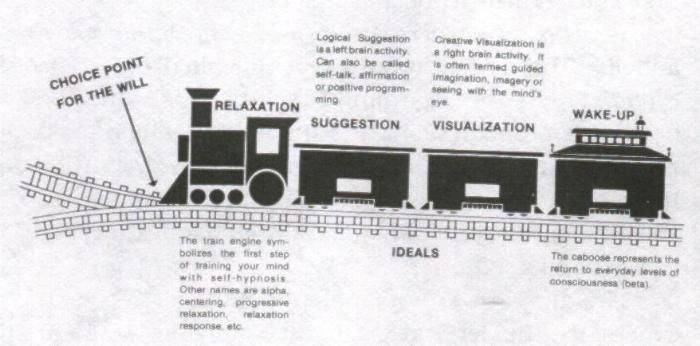
It is important to emphasize here that self-hypnosis is not, in itself, an end, but rather the primary tool to help you to reach your natural alpha level of relaxation, which, in turn, enables you to be receptive to suggestion and to visualization exercises. The two latter terms are represented in the diagram by the two boxcars: Suggestion (the left brain activity of logic) and Visualization (the right brain property of inspiration and creative genius).
In the model for self-hypnosis, the two boxcars
represent the right and left hemispheres of the brain. This is the real work of
any self-help session, to utilize a full brain approach, thus enlarging your
mind’s potential.
The left brain is associated with linear, logical
thought. It covers information, analysis, details, grammar, and language. It
recognizes the parts of things, and processes items one by one. For example,
studying the various components of the train model is a left hemisphere
activity. The left brain remembers complicated sequences of actions and it
works with established rules, bringing form and order to our work.
The right brain perceives the whole picture; it recognizes
the forest (not the single trees). It sees an overall design or a larger plan,
usually by means of pictures or emotions. The right hemisphere responds to
rhythmic patterns of prose, poetry, or song. Most of all, it is fresh,
innovative and creative, bringing a new vision to our work.
When scientists have found it necessary to dissect half a brain because of a tumor or the presence of some other condition, they have found that the healthy half of the brain has taken over the tasks of the impaired half. There is much debate regarding the workings of the human brain but, for simplicity’s sake, study of the two hemispheres enables us to understand the different functions. There are many books on the market which deal with creative visualization. There are also many books about positive suggestion and its benefits, as well as the use of affirmation and self-talk in our lives. Unfortunately, there are few books which can instruct us as to how we may combine both hemispheres and so empower the mind to build our lives the way we want them to be.
When you begin to make your own tapes for self-hypnosis, be sure to
include exercises for both hemispheres — the left-brain “positive suggestion,”
and the right-brain “visualization.” During this session you will guide
yourself into alpha level, then proceed with those suggestions and
visualizations you wish to reinforce. After the session, wake-up procedures
are vitally important — just as important as those which allow you to enter the
self-hypnotic state.
Self-hypnosis is not sleep. People only appear to be asleep;
actually, the person is fully aware of everything that is going on. You will
be in complete control at every level of your mind to accept, or to reject, anything.
You will be aware of everything that is going on, and you will remember
everything.
Some have asked, “Why, in stage demonstration, do people return to
their seats unable to remember all the crazy things they did on stage?” This
behavior was not caused by the hypnosis itself. It occurred because of a
suggestion given by the stage entertainer to the volunteers, so that they would
not be embarrassed by anything they had done once they returned to their seats.
Hypnosis does not create amnesia, nor anesthesia. They result from
suggestion. When suggestions are given to any person, that person must accept them
in order for them to be effective. It is just as possible that the individual
may reject them.
Now let us proceed to the topic of wake-up procedures. Wake-up procedure is actually a “coming out” procedure. The term “wake-up” is, however, the way most people think of it.
While experiencing self-hypnosis, some people progress
into a sleep mode. If you find that you have a tendency to fall asleep —
especially when using your tapes at night — sit up during the process. This usually
will solve the problem. Remember, the greater benefits of self-hypnosis
exercises (suggestions and visualizations) are best derived while fully aware
and not at a night-time sleep level. In other words, while you are aware in
alpha, and only
while aware, can you repeat the suggestions mentally, and actively
perform the visualizations. Nothing, of course, is wasted in sleep; but when we
use self-hypnosis, taking a more active part in it proves to be much more
effective.
Excellent courses in self-hypnosis are being taught, but the word “hypnosis” is seldom used. Why is this so? Surveys have shown that many people have a negative reaction to the word, but not to the process. They enjoy the relaxation, they enjoy the process, and they do very well with it. They retain a negative reaction to the term, however, because of the strange connotations it has garnered by dramatized and fictionalized misuse. The very word “hypnosis” frightens some people. Even today, if you have a headache and have to choose from two remedies on the drugstore shelf — one labeled Acetylsalicylic Acid and one labeled Aspirin — which would you choose? Probably the latter, because it is much less intimidating than a remedy with “acid” in its name; yet, Acetylsalicylic Acid and Aspirin are one and the same. Aspirin is the same substance marketed under a different name. We are all aware of the importance of marketing in our society. There are brand names and there are generics. You might say that “hypnosis” is the generic term for all the off-shoot catch phrases.
A book called Self-Talk, for instance, is geared toward
the business sector. It expounds the techniques that hypnotists have been teaching
for years, but under new terminology. There is no mention of the word
“hypnosis,” not even in the appendix. The author is simply marketing the same
principles in a new package. This is good marketing practice. If people have a
negative reaction to one package, why try to reeducate the masses? Why not
just re-package?
B. Mind
Management
One of the most familiar expressions from Cayce’s forty three years of
readings was: Spirit is the life; mind is the builder; the physical is the result. Everything
we have made or built in the physical world began in someone’s mind. Somewhere
in time, everything started in someone’s imagination. Mind is the builder.
We all have had this feeling of consciously wanting something and pushing our lives in that direction. Another part of us pushes — at times — in the other direction, toward our subconscious desires. We are not robots; we can program our lives the way we want them to be. Because we are human, however, there is a time lapse from the programming to the manifestation into our reality. For some, this gap could be a few minutes or a few days; for others, it could be a few months, or even years. It is very different for everybody, and much depends upon how much we really want it subconsciously. Often, our want is at a superfical level.
The value of
self-hypnosis is that it enables us to unify our subconscious desires with our
conscious desires. As the diagram illustrates, with both subconscious and
conscious pushing the will together in the same direction, our life is guided
in the direction we want it to go. Although this model is a simplified version, it
does explain the integration of conscious mind with the subconscious.
Without even realizing it, the conscious mind and the unconscious desires sometimes
work against each other
—
pushing in opposite directions.
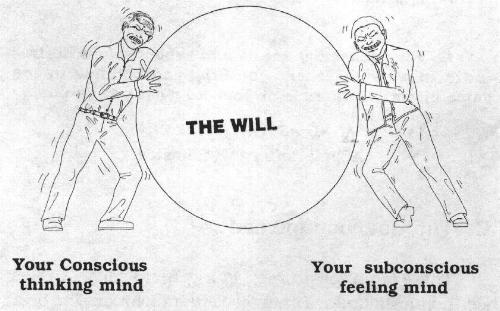
The result is a lot of effort with
little accomplishment. The will to
succeed is stuck. Sadly, your goals and
desires may not be congruent with your words and actions. Using self-hypnosis,
you can synchronize your (known) conscious purposes with your subconscious
(hidden) patterns.
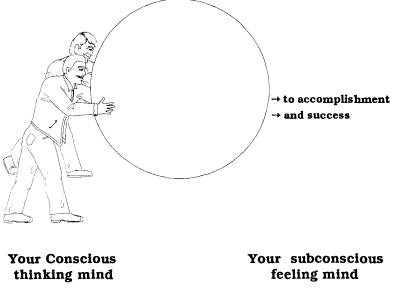
As your
conscious ideals and subconscious desires unite to work together — pushing and
building in the same direction, there is no limit to what you can do.
MIND AS
THE BUILDER
Artist: Jeffrey Winchester
C. The
Journey Inward
There is no “best time,” in a general sense, to use self-hypnosis tapes. Timing is very individual. The best time for you is at the high-time of your day. Pay attention to your circadian rhythms, or biological clock. If you reach your peak at around 10:00 a.m., that would be the best time for you. It might not, however, be practical if — for instance — you must be at work at that time. In that case, you will have to determine another time when you can profit best from the tapes. They may be used as often as you like.
What is the difference between self-hypnosis and meditation? The levels are the same, alpha and theta, but there is a difference. In meditation we generally open ourselves to guidance coming to us at the conscious level from a higher level of consciousness, the subconscious or superconscious. Symbolically, we open ourselves to guidance and to inspiration from our own higher mind, which is an eternal and everlasting source. In self-hypnosis, we focus the conscious mind and use it as a tool to instruct and to guide the unconscious in the direction that we consciously want our lives to go. The difference lies in how we use the alpha and theta levels, and not in the levels themselves. Meditation can be likened to a telescope looking out into the vastness of space. Self-hypnosis can be symbolized by a microscope focusing on a specific goal or objective.
If this is your first time working with self-help or
self-hypnosis programs, you may wish to read, first, about the field.
Self-hypnosis is a safe, 100% natural and direct way to improve your life. My
book, Self-Hypnosis
- Creating Your Own Destiny, can help you to gain a deeper
knowledge of this science and the art of hypnosis.
The art of self-hypnosis
concerns timing, tone, and delivery — not going too fast nor too slow, being too
forceful nor too meek. The inner mind responds very differently from the
conscious mind. It contains profound depth and wisdom; yet, it works slowly
and requires clear, simple questions or instructions. It has a natural
simplicity and honesty, and is uncomplicated in its approach. Speak
s-l-o-w-1-y, very slowly, less than half your normal pace; even slower is
best. Some people say they don’t like the sound of their own voices on cassette
tape. Paradoxically, the very apparatus that you don’t like is the very tool
that will help you. It may sound ironic, but you could work with your cassette
recorder, in the privacy of your room, and practice speaking differently. If
you have a high pitch, speak lower or deeper. If you mumble, begin to speak
distinctly. If you normally speak in a monotone, add life and enthusiasm to
your voice. Do whatever is necessary to improve the pitch, modulation, and
speed of your voice. In just an hour or even less you will have improved the
quality of your voice.
The good news is that you TRUST your own voice more
than you trust other voices. As you learned to improve your voice in the DOING (not
just reading about it), so also you will learn best about self-hypnosis — in
the doing. Theory is fine, but there is no substitute for practical experience.
You are ready now to make your own self-help,
self-hypnosis tape. Get a cassette recorder with a good microphone and a blank
tape. To record, find a place where you will not be distracted for about half
an hour. First, read the following script aloud and make any changes,
deletions, or additions which suit your personal preferences. Now read the
script slowly into your cassette tape. Use your watch and time the one minute
pauses for one FULL minute. The inner mind needs that much time to process the
question and give you the information requested.
In time, when you become more proficient at making self-hypnosis tapes, you can add the sound of a grandfather-clock ticking in the background, or the soothing music of one of the “Old Masters,” or the gentle sounds of the “New Age” genre.
Once your tape is completed, find another quiet time
to enjoy using your tape. Self-hypnosis relaxes the body, builds the mind, and
energizes your life in amazing and wonderful ways. It is a “win-win-win”
activity with great benefit to be gained and no downside. Remember to breathe
deeply throughout the session, for deep breathing is one of the oldest and
most effective methods of relaxation.
Use your tape more than once if you wish, perhaps as
often as once a week during the coming month. Keep a journal or diary, and
log-in the results. Describe whatever you receive: what did you see, what did you
feel, what did you hear, what did you perceive? For some people, the
information is fleeting, as in a dream. For others, it comes clearly and
strongly. There is no right or wrong method for receiving and processing
information; whatever you receive is correct for you, and will improve over
time and with experience and patience.
You may use your tape for yourself and share it with
friends and family. (Better still, teach them to make their own tapes!) If you prefer, you may
also read the script aloud to loved ones. If
you, or they, do not like the word hypnosis, then you may substitute any other
appropriate words you prefer. Some term this kind of work a “guided reverie,”
an “inspired meditation,” or a “working dream.”
In fact, let’s term the following scripts an “inner adventure” which allows you, or others, to experience the session without pre-conceptions or pre-conditions. It is simply — and profoundly — an inner spiritual adventure. You can experience as much of the adventure (or as little) as YOU wish.
Be
gentle with yourself, be kind to your mind! Whatever you
receive in your session is a gift from your subconscious mind. If you accept
and welcome that gift, then, surely, more will be given another time. If you
criticize your inner mind and negate or belittle your gift, you limit your
potential.
TRUST
is the key to the door of spiritual growth, and APPRECIATION makes the opening
easier. BE THANKFUL for all that you receive and you will gain and grow as you
journey the spiritual path, both by clarifying your Ideals and by experiencing
other sessions yet to come!
D. An
Ideals Inner Adventure
(Begin
to record your tape here)
As
soon as you are ready, ask yourself to close your eyes. If you take a deep
breath, you can feel your body relaxing. As you slow your breathing, you let
your mind relax.
Begin
by comparing your mind to the surface of a quiet pond. My voice can be as a
breeze whispering in the trees along the shore. The pond remains smooth and
calm, even though things go on beneath the surface. There may be much
happening beneath a still surface. The gentle surface conceals an extraordinary
depth. Reflect upon nature, its beauty and elegance.
(Pause, one minute)
Now it is easy to dissolve this image and to form another — perhaps a stairway leading down — you can see yourself leisurely descending. The stairs are covered with a thick, plush carpet, a carpet that is like a cloud beneath your feet. Perhaps there is a brass handrail or a walnut banister. The stairs lead you to a ballroom with sparkling crystal chandeliers, or to a comfortable room with books and crackling logs in a fireplace. And while you are here, the outside world will stay outside. You can take a few minutes and notice just how good you feel here.
(Pause, one minute)
You
can do anything you want to do. You don’t even have to listen to my voice,
because your subconscious hears with new awareness and responds all by itself.
You
are now learning to recognize the feelings that accompany inner relaxation. You
may experience a light, medium, or deep level of relaxation; you choose what is
best for you. Your body may feel heavy or it may feel light, or it may seem to
be asleep so that it doesn’t feel anything at all. It may float up, or it may
sink down, or it may very pleasantly drift. It may do whatever you wish.
Perhaps your body feels as if it has gone to sleep even though your mind seems
to be awake. Of course, you don’t have to concern yourself with that.
This
experience is for learning and growing. Of course, you may go very deep — and
safely. Your inner mind is aware; it knows when it needs to respond and it can do
so in just the right way. It already has gained more awareness.
If I count from ten to one, then you may go deeper — more in perfect harmony — by picturing yourself descending a flight of stairs, or going down in an elevator or on an escalator — any pleasant image that you wish ten… nine… eight… seven… six… five… four… three… two… one.…
And if I count from ten to one again, you may go twice
as deep, enjoying a pleasant, comfortable feeling — any sort of feeling that
you wish ten, nine, eight, seven, six,
five, four, three, two, one.
As you relax, take a deep breath, and slow down, you
may go even deeper. As you enjoy the comfort, you will note that there is less
and less importance to my voice. You may find yourself drifting in your own
ideal, joyful place of relaxation.
(Pause, one minute)
Now we can begin a series of exercises using Creative Imagination and Positive Affirmation. In your mind, now, you may begin
constructing a box. This box may be of any size, any shape, any dimension, any
color, or any material that you wish.
Make an easy-off lid for your box. I will be
quiet now, so that you may construct your box. Then, when I begin to speak
again, you can take a deep breath and go deeper. Build your box now.
(Pause one full minute, or longer)
Take a deep breath and go deeper.. .more in perfect harmony. Now, open the lid to your box and carefully place in this box all of your cares, all of your concerns, all of your worries, your hopes, your expectations, your fears. Place them safely in the box —whether actually or symbolically, full size or in miniature, or even written on little pieces of paper. Whatever you choose to do is correct for you. And as you place all your concerns safely into the box, I will be quiet.
(Pause, one minute)
Now,
when you are ready, gently close the lid on your concerns. And, as you put the box aside, the following words echo deeply, within
your mind:
“An ideal is a central motivating force in life. It is
a vision of self that surpasses the ordinary self. It is a pattern of
excellence, the highest purpose, character, and integrity.
A goal is something to be achieved in life. An ideal
is much more important; it is the deeper, underlying reason related to the
goal. An ideal is often private and sacred — the most positive, and often
hidden, motive and purpose.
An ideal is a standard or measure to assess activity.
It is a long-term investment in life.
(Pause)
Now,
I am going to ask a series of questions that you can answer from deep within.
Allow the answers to come from deep within and accept the information you are
given:
What
do you REALLY want to do with your
life?
(Pause, one minute)
What are you doing in your life that is working well?
(Pause, one minute)
What are your greatest strengths?
(Pause, one minute)
How would you act, even if you were certain you’d never be found out or
get blamed?
(Pause, one minute)
How would you act, even if you were certain you’d never receive any
credit or recognition?
(Pause, one minute)
What are the strongest POSITIVE PATTERNS you have noticed in your life?
(Pause, one minute)
What are the most CHALLENGING PATTERNS you have worked with?
(Pause, one minute)
Whom do you hold as an ideal? — It can be someone living or someone from the past. What is the signifigance of that person to you?
(Pause, one minute or
more)
And now, just imagine that you are wearing a T-shirt which can have a message printed upon it. In a moment you to write or print a specific message on the front of your T-shirt, a short sentence or a few words in answer to this question:
“What was your mother’s message to you?” (Note: If you
do not know your biological mother, substitute a person who filled the “mother
role.” In other sessions, the father may be substituted for the mother). “What
did she say, or convey to you countless times, in countless ways, whether
spoken or unspoken?” Write that message to you on the front of your T-shirt.
(Pause, one minute or more)
Now, on the back of your T-shirt, write or print your
answer. How do you respond to your mother’s message? Write those words on the back of
your T-shirt.
(Pause, one minute)
Now, your mother’s message on the front of your T-shirt
can give you insight into HER ideals for you —her fears, her hopes, her
concerns, her prayers for you.
(Short pause)
Your answer on the back gives you insight into your
ideals, your purposes, your direction for self.
(Short pause)
Remember those messages that you may bring them back
with you later. Remember ALL the information that you have been given here
today — the gifts from your inner guidance. You may wish to leave the cares and
concerns safely in the box. You may return to them later, whenever you wish.
You have done so very well here today. I will count slowly from one to ten. At the count of ten you may open your eyes and be wide awake.
One: coming
up slowly.
Two: remember
what you have been given here today.
Three: total
normalization at every level of your being.
Four: you
may wish to move hands, or feet, or neck.
Five.
Six.
Seven: coming
up to your full potential.
Eight: revitalized.
Nine: re-energized.
Ten: open
your eyes and wide awake now.
Wide
awake!
E. An
Ideals Project
Now that you have experienced the IDEALS inner adventure, it’s time to
recall and to utilize the information received. In the process of writing, you
will probably recall even more of the information. This may sound odd, but
it’s true. Technically, it’s called “writing to learn,” and it helps people to
get more out of their experiences. It is thinking on paper! In the writing,
you will discover interesting connections and will observe new processes; your
understanding will broaden, you’ll ask questions, and then proceed to answer
them yourself! So let’s get started. We’ll call this an “I-D-E-A-L-S” project!
And you’ll remember it with this anagram:
1. Identify the ideal
_________________________
2. Describe the situation, and challenges
_________________________
3. Explore possible solutions or actions to
strengthen the ideal
_________________________
4. Act upon the information; what can you
start doing?
_________________________
5. Look for results: imagine them already
accomplished
_________________________
6. Save the information for future analysis
and study
_________________________
When you answer the questions and work with the material you WILL have
found an IDEALS solution!
Writing, speaking, and listening are the important tools for learning. Take
time, every day if possible, and write in your journal or diary. Write any
inspirations that come to you concerning your ideals. Sometimes the greatest
inspirations come as a fleeting thought, or are triggered by an event. Grab
that thought - it may be exceedingly valuable to you.
What did you receive or perceive in the session that surprised you?
F. Notes to Remember Regarding Self-Hypnosis
1. The best way to learn anything is in the doing of it. You will learn
far more by making your own tapes, for instance, than by using
commercial tapes that someone else has made. Of course, you may purchase or
borrow commercial tapes from bookstores, pharmacies, libraries, and by mail
order to learn different approaches to the subject.
2. Next, I
recommend that you study the excellent material from the Edgar Cayce readings
under the titles of “Suggestive Therapeutics,” and “Mind: The Builder.” I also
suggest that you study books by and about Dr. Milton H. Erickson, on whose
methods the Neuro Linguistic Programming (NLP) courses are based. Erickson was
the first to teach that all hypnosis is self-hypnosis.
3. Incorporate
what you learn from Cayce, Erickson, and your other readings into your own. self-help,
positive programming tapes. Soon, people will notice important and profound
changes in your life and will ask you (directly or indirectly) the reason for
those changes. When you start to radiate new light, people always notice it!
Explain to them about self-help tapes and show them how to make their own. The
goal is to learn personal empowerment, not power over others.
4. A course in hypnosis is another option toward achieving personal transformation. Many community colleges offer such courses at a modest cost. Atlantic University in Virginia Beach, VA., offers excellent certificate courses on the subject of hypnosis. Remember, all you need for this study are high ideals and a sincere desire for personal improvement. Even a small amount of time invested now pays off later in big dividends.
5. The most
exciting and inexpensive way to learn hypnosis is to start a small study group.
It is easy, productive, and fun. Simply find a friend or two, and
start an informal study group. Meet once a month, or once a week, at home, or in a library
conference room. Often, meeting rooms are free when meetings are open to the
public. You may place free announcements in your newspaper calendar section or
on radio community bulletins. New people will hear of your work and will attend.
Here are some tips for starting your hypnosis study group:
(a) A
small group of even two or three people working together is more influential
than two or three dozen people working alone. Meeting together on a regular
basis produces great accomplishment.
(b) Your
group may have a different moderator each meeting. Start with the study of traditional
areas of hypnosis and branch out into the more innovative and newer methods.
This is a “learn as you study and share” approach.
(c) An
established group can invite guest speakers. Occasionally, you may ask a professional
in some related field to speak. Most are pleased to do this. Soon you may start
to guide sessions for individuals or for the entire group itself. Of course,
this is a bit harder at first as you realize that you are all amateurs and
still learning. But “amateur” comes from the root-word meaning “love:” that
is, you love this study and this work.
(d) In
your love of learning, you begin to reach out and to inspire others — helping
others to help themselves. Then, as the months fly by, you and your group will
begin to realize that you have educated yourselves in a personal and profound
manner. You have “drawn-out” what was already there deep within yourselves; and,
having brought it out, you’ve shared your light with others.
(e) From
the seeds of small study groups (as Christ explained about the mustard seed) in
time and with patience — with care and nurturing — the great plants of
spiritual fulfillment grow. Your study group may not enlighten the entire
planet, but it will bring light to illuminate your own area. It is said that If
you wish to plant for days, plant flowers; if you wish to plant for years,
plant trees; but it you wish to plant for eternity, plant ideas. And IDEALS.
Begin now to search inward for your highest self!
Embracing Your Eternal Child
(Inner Adventure)
A. Your Inner Child Learns
Almost all researchers, teachers, psychologists and
parents agree that most of our patterns and behaviors are linked directly to
our youth. Even the first few months and years of life have profound bearing on
the rest of our lives. With this understanding, you can glimpse how important
this chapter will be for you in understanding the foundations of your current
life.
How did you do with the Ideals Inner Adventure? If you
have not made and used your tape, please do so now. If you received only a
little information, please wait a few days and use your tape another time. If
you received valuable insight and information, USE that in whatever ways it can
help you. Write the information in your journal, sketch the messages on your
T-shirt.
We have come a long way together and have learned
much. Learning comes in two ways: ACTIVE and REFLECTIVE modes. Participating in
the exercises in this book helps you to accomplish both.
ACTIVE LEARNING is in doing things, and is often called “hands-on” work. Examples are in the making and using of your Inner Adventure tapes, going on a retreat for a weekend, or involvement with a study or support group.
REFLECTIVE LEARNING takes place when you pause for a
few moments (or a few days) and ponder what you are learning. Journal writing
and withdrawing into your spiritual sanctuary are reflective exercises. Rest
and silence are vital to learning as it helps in the assimilation of
experiences. Pauses and spaces are very important In the same way that spaces
between the words on this page make it easier to read the words, and to
comprehend the thoughts. (Aspacemakesitmucheasier!)
Sometimes our active and reflective learnings overlap. Learning is not
always sequential; it is erratic and comes in leaps and bounds. There are quiet
times of rest and reflection mixed with active times of challenge and
endurance. There is a rhythm to the process of learning. Learning is growing -
and, often, growing involves pain and anxiety.
Although pauses and rest are necessary, in a general sense, growing is better than not growing, good learning is better than not learning, and wise-action is better than stagnation. Dilemmas and challenges can lead to resolutions. Even failure can bring valuable learning. Difficult lessons may later produce profound accomplishment. It is possible to learn from all of life’s experiences. Even tragedies can lead to growth. Adversity need not be an end; it can be a beginning. As humans in the continuing saga called “life,” we learn and grow in numerous ways. Perhaps the best metaphor for our many grades and classes would be a school — a vast School of Life. This school — let’s call it Earth School — is like a vocational school in practical learning and application. There are rules, there is some theorizing, but, primarily, it is a place of experience and activity.
In our metaphor,
this school is unique because we are all students AND teachers, at different
levels of learning. Those who graduate go on to further realms. The rest of us
continue to learn - hopefully! To me, the very fact that we are enrolled
suggests that we still have something to learn — or to teach.
Many people ask,
“What is the purpose of this Earth School?” I feel that we are here to EXPERIENCE life - all of life,
with its benefits and its struggles, its highs and its lows. Our courses blend
blessings and challenges, struggles and successes, grand opportunities and subtle
simplicities.
For example, a few
students may be engaged in a philosophical debate: “Is the glass of water
half-full or half-empty? It might seem a ponderous question for some, but other
students drink and enjoy the glass of water. They ponder not how full or
not-full it may be; they wholeheartedly drink of the cool, refreshing water.
Those are the students who live the experience; those are the adventurous ones.
The most adventuresome students choose a self directed course of study. True education means to “draw out” what is already within oneself. When we go deep into our own minds, we can discover our hidden talents and abilities, our patterns and potentials. This course of study can be very rewarding, but it requires self-discipline and courage.
Self-education has
no bounds or limits! Each day becomes an adventure in learning, with
discoveries which can bring pain, but also joy! Our world is an unlimited
opportunity for the self-motivated and self-determined student. Travel in this
world may well be one of the most valuable lessons in Earth School curriculum.
Venturing beyond what we know challenges our courage, values and adaptability.
It offers adventure and invitation to mystical experiences.
When you travel
upon this wondrous Earth, be sure to go to the sacred places where other
students and teachers from times past have built centers and shrines. It will
help to connect you to your ancient past — and open possibilities to your
future. Take pilgrimages to the holy centers of humanity and see the wonders
created by nature. Wander in reverence throughout the lands, among the peoples,
and fully ENJOY the adventure.
B. Reflections
in the Face of Time
In times of reflection, study the lives of spiritual leaders, saints and mystics: perhaps they can be as mentors to you through their writings and examples. Though their legacy is of courage and strength, you may also find that their lives were fraught with struggle and pain. Hurt and suffering may have been a necessary ingredient — or even the catapult — to spiritual heights. This pattern is a common factor with holy women and men throughout time, and from all lands and civilizations. Spiritual courses hold little — if any — personal glory in a worldly sense. Certainly, after their death some spiritual leaders are recognized and revered, but during their lives the opposite is more often the rule. For every recorded life of a spiritual leader (whether in story or in legend), there could be hundreds who lived, did great works, and died virtually unknown. Though history may fail to record their lives, it IS stored and recorded in the deep memory of that person, and within those people who were touched, helped, or healed by that one. The lesson — love and giving — is what is most important, not necessarily a paragraph in a history book.
Perhaps those
spiritual leaders were just too far ahead of us, and of their time. Some
challenged the political establishments of their era. Others questioned the
temporal religious powers, and were branded as witches or heretics. Though the
spiritual path be a lonely and desolate trek at times, there are sublime
moments of enlightenment and wonder.
As challenging or as easy as your spiritual journey may be, it is the
BEST course to help you to graduate from Earth School into the University of
Eternity.
C.
Preparing for Your Next Adventure
In this Earth School, perhaps you are ready for your next lesson, your next homework project. This assignment is to help you to make a better connection with your inner child. There is, deep within you and within every other person, a timeless aspect — your eternal self. This part of you reaches far beyond the boundaries of time. Each person also has an inner quality of wisdom and strength, beyond the limits of present time and location.
This Inner Adventure will assist you in making a
stronger connection with those parts of you that are already within, and will
draw them out for your benefit. This is not a session to work with
psychological problems or to heal a “wounded” part of your youth. Did you have
a happy childhood? Not everyone did; and sad to say, some people have no
pleasant memory to their early years.
This guided adventure begins with remembering a time
when you felt safe and comfortable. If you cannot find such a time in your
memory, just imagine how wonderful it would be IF there had been such a time.
Essentially, you are using your constructive
imagination to bring a feeling of safety and comfort — this feeling allows you
to open yourself, to start trusting yourself and your inner guidance more
carefully.
Use the guidelines from the previous Inner Adventure
for making a cassette tape of the following script. After completing the
session, fill in the analysis sheet that follows. Write in your journal about
the insights and information that come to you, or from you. Even if the insight
might be subtle, be sure to log it in; if information should flow in abundance,
be thankful.
The Inner Adventure is designed for your personal use, but you may also read it to friends, to loved ones, or to a study group. Remember to time all pauses for one FULL minute (or more). Read the script slowly at one-third the usual rate of speech. Read it distinctly.
D. Embracing Your Eternal Child — The Incredible
Healing Power of Love — An Inner Adventure
Before we start, make yourself comfortable so that you
can relax and be at ease without distractions for about 40 minutes.
We'll begin the exercise by taking two full minutes
for you to relax, allowing you to use your favorite method of relaxation. If
you have worked with Edgar Cayce’s material, you may wish to use his head and
neck exercises. If you’ve done any Yoga or deep breathing exercises, use those.
If you have a favorite method of self-hypnosis, use it. If you do not have a
favorite method, I suggest that you just remember a time when you really felt
safe and comfortable. If you don’t remember a time like that, just imagine how
wonderful it would be if there had been a time when you truly felt safe,
comfortable, and at peace.
(Pause full two
minutes)
Now, with your eyes
closed, it becomes easier and easier for you to become more and more aware of a
number of things that could often go overlooked or even unnoticed. Thoughts,
feelings, sensations, impressions —just remember now to breathe deeply and
smoothly, for deep breathing is one of the most ancient and also one of the
most effective forms of relaxation there is. So remember to breathe deeply and
smoothly throughout the entire exercise. Just allow yourself to drift
pleasantly and easily. You don’t have to think, or to move about, or to make
any sort of effort. You don’t even have to try to listen to me, because your
subconscious is here and can hear every word. You are about to enter a magical
realm — please leave all doubts safely behind — then proceed.
As you take another deep breath, just experience the feeling of letting
go — just letting go. Becoming more in perfect harmony, more centered with
every breath you take.
Can you remember being a child and going to school?
(Pause) If you recall a pleasant, happy memory, your mouth automatically forms
a little smile. A smile comes easily and naturally with the memory.
As a child, did you dream? Can you dream here again,
as when you were a child? Perhaps in the dream, you may be walking along the
shore by the water’s edge with your bare feet in the sand. Feels cool, but
good. Feel the warm sun shining on your skin; there is a cool breeze that
balances the warmth of the sun. And there go the sea gulls. Are they laughing?
Spontaneous joy and laughter. And as the dream continues, you also
continue to go deeper and deeper, softly into the season of gentle dreams.
Perhaps you may remember a special song or a tune from your childhood, and that
song or tune echoes deep, deep within. Don’t analyze your responses, just allow
the tune or music to return pleasantly.
(Pause one minute)
If you don’t recall a favorite song or tune from your
youth or childhood, perhaps you can recall the tune and words of “Row, row, row
your boat, gently down the stream.”
(Pause one minute)
The melody takes you even deeper within, deeper into
your dream. And there is another dream within the dream. The dream of your
eternal self, your eternal child. That carefree, innocent part of you — the
part of you that is eager to learn, eager to experience, eager to grow, eager
to love, to be loved. Connect now with your inner child, that joyful,
wonderful, innocent part of you, and I'll be quiet while you enjoy this
experience.
(Pause one minute)
You may now even wish to communicate with your inner
child, or to embrace this child and to experience the incredible healing power
of love.
(Pause one minute)
Your child may even wish to give you a gift, something
tangible or intangible — a word, a phrase — I don’t know what your gift will
be, but receive the gift now from your inner child.
(Pause one minute)
Hold your gift close, in fullness and thankfulness.
You may even wish to wrap it around your heart so that you may keep it always.
Thank your inner child for your gift.
Now as the dream progresses, you can continue to walk
along the water’s edge. In the innocence of the child are the wisdom and
strength of the universe.
Now the dream beckons you to a river — the river of life — down through the shadows of millions of yesterdays flow the waters of a life everlasting. Now when you’re ready, you may float upon the waters of life. And you go to the very source — to the headwaters, the wellspring. Notice the air. It may be rarefied, but it leaves you with a feeling of wonderment. There is excitement here - and strength and wisdom, for this is the abode of your higher self, the very highest aspects of your being. Here is your holy woman or your wise man within — the sage, the counselor — the friend who watches over and helps you, guides you, and protects you — your most special and wonderful friend. Greet this holy man or wise woman within. You may wish to communicate with your mentor — so I will be quiet while you do so.
(Pause one minute)
You may even wish to embrace your wise counselor or
mentor. Permission is given, and once again, you experience the incredible
healing power of love.
(Pause one minute)
This wise being also has a special gift for you.
Receive your gift now from the holy man or the wise woman.
(Pause one minute)
Receive your gift in fullness and in thankfulness.
Wrap it around your heart also, if you wish, so that you may bring it back with
you. Now bid farewell to this spiritual being, with the understanding that you
may return here at any time you desire.
And now the dream fades and melts into the river of life with its everlasting waters, and brings you into your very own home, or dwelling place. It feels good to be here — to be back. In your home or on your land, you may wish to create a special place, a sacred place for rest and repose — of relaxation and peace. How do you do this? First, simply find a favorite place, a certain area or section that has a special meaning to you. Then, perhaps you can bring a candle or two, but even that is not necessary. Bring, perhaps, a shell that you once found — or someone gave you — from the seashore. Bring a special rock, a mineral or crystal. Bring a feather — bring anything you wish to your sacred place.
(Pause
for one minute)
Surround
yourself with the sacred objects of your life or reminders of other lives.
Those sacred objects are called sacraments. Bring a picture of a friend or a
loved one — a memento from some enchanted time or place — from a special
vacation, perhaps. Bring a picture of a holy person, a sage, or a special
healer. Bring a mirror so that you can look deeply into your soul. There are no
rules; there are no regulations. When you create a family altar or a home
temple, you bring whatever your heart inspires you to bring. Bring the gift
that you Just received from your inner child. Bring also the gift that you
received from your inner counselor. And if you wish, you may bring a loved one
or a special friend to your sanctuary — Angels may come also. If you build it,
if you will it, they will come.
(Pause
for one minute)
This
private sanctuary is where you come to reenergize — to center yourself, to
focus on your ideals. It feels good to come here. It is a place where you take
time to enjoy and to have fun. So I will be quiet now, so that you may envision
- or mentally create - your sacred sanctuary.
(Pause for one minute)
And just imagine that this is already accomplished —
that you already have built your sacred and special place. Now the dream melts
into another dream — a dream within a dream — which is in yet another dream,
the dream we call “life.” For is life not a dream?
And as you begin coming back from the dream, walking
along the water’s edge, the songs of your youth echo deeply within. And
it’s sometimes hard to realize when one dream ends and another begins —just as
when one life ends and another begins. In just a short while after you end this current life, this life itself may seem like just a dream. What you perceive
as reality may become nebulous and vague. Reality melts into the dream as
dreams create your next reality. Even more amazing revelations may dawn in some
future life. If you experience a regression in that life, you may wonder
whether you are “just imagining” the current life.
Now it is time to begin returning to this interesting
dream we call the present day — our current reality. Bring yourself up slowly.
Bring back your special gifts. Bring back with you all that was helpful. Let
the dreamer awaken. Just take all the time you wish.
E. Embracing Your Eternal Child — An
Analysis
Writing the answers to these questions will bring further
insights:
Now that you have completed this Inner Adventure, what
are your feelings?
What did you bring back that can help you?
What did you process? What are your reflections?
Write what you’d like to investigate further. Would
you like to talk to parents or any grandparents for confirmation of
information?
What will you now DO with the information and insights?
What message and gift did your inner child give to
you?
What was the message and gift of your mentor?
Will you actually build a home sanctuary or keep it at
a symbolic level?
What did you receive in this session that you didn’t
expect to receive?
The Soul’s Remembrances
(Inner Adventure)
A. All Things to Your Remembrance
As we approach the beginning of a new century —and a
new millennium — a grass-roots revolution is taking place in human
consciousness. It is a peaceful revolution in human potential and spiritual
vision, a revolution in healing the whole person — beyond what we experience in
the physical and mental realms —which reaches into the heart of a deeper
reality. As a part of this revolution, brave new plans are birthing, old
institutions are dying, entire nations are turning, and people everywhere are
growing. Change is everywhere; almost everything, as everyone, is experiencing
profound changes. What was once feared is now open to the light of day.
My work is an exploration deep into the very soul of
humanity itself. I feel fortunate to be a part of this healing revolution. I am
a past-life researcher, and as such, I would like to share my unique
perspective of a quest for discovery.
When I began this strange and wonderful career, the title of “past-life researcher” did not exist. My early goal to be a priest was nurtured as I grew up in a Catholic family, even as was my sister who has been a nun all of her adult life. We both were imbued with the idea that we could help humanity in a spiritual way. As a teenager and an avowed television watcher, I decided that the life of a detective was for me. Although that goal was never achieved, I have discovered that I am actually a detective of sorts, investigating clues, which involve the mysteries of time and of the soul. I sincerely pray that my work helps others to grow spiritually.
In spite of a thirty year search, I still have much to
learn. In fact, it seems that my search is still just beginning. The secrets of
the ages are not revealed in the blink of an eye in cosmic time. During those
years I have gained much insight through exhaustive testing and research.
Certain peak episodes have been experienced which I would like to share with
you.
The belief in past lives is centuries old; but, the
methods of testing and exploring this belief are modern. Edgar Cayce, probably
the greatest psychic of modern times — if not of all time — gave life readings
for hundreds of people. He is credited with hundreds of psychic readings in
which he stated that each of those people had all experienced numerous
lifetimes, and most would return again and again to the physical world. In a
few readings he said that a certain soul had reached a proper state of
development and need not incarnate again.
While in a psychic trance
he stated repeatedly that we are far more than merely physical beings who possess
a sense of identity or ego. He reported that we are immortal, spiritual beings
who, from time to time, temporarily inhabit a physical body in the Earth
plane. He suggested that an evaluation of one’s past lives would enable one to
make better progress in the current life.
B. Spiritual
Pioneering
Modern hypnosis now presents us with a relatively new
method to explore the “inner space” which includes the heart, the mind and the
uncharted sanctuary of our deeper selves. Past-life researchers, using a “mind
awake, body asleep” state of consciousness, work to bring out Information and
emotions that are already in one’s mind. Hypnotists are not magicians; we put
nothing in, but simply draw out what is already there. That information may
come from the present life, a past life, or even life seen from a future
perspective.
Bringing a past problem or pattern into awareness is
the first step. That way it can be encountered honestly and released, solving
the problem or changing the pattern. In some cases this can be accomplished in
one or two sessions. Often, multiple sessions are required to achieve
complete success.
People vary widely in their responses to initial
regression experiences. The secret is in the level of trust. For some, the
vision is clear. Emotions and feelings are strong; even hearing and smelling
are acute. Pictures unfold easily. For others, it is like looking through a
glass darkly. It could take several sessions for some to accept themselves fully.
In those sessions people
begin to fit together the jigsaw pieces of their puzzled pasts. But even most
importantly, they discover the positive patterns of their own pasts, their
eternal gifts, and the wonderful talents waiting deep within which they may
not have recognized. There is far more depth to the human mind than we can
possibly imagine.
Past-life memories are like gifts from the inner mind,
or pieces of a puzzle. Regressionists work like Sherlock Holmes. They are
meticulous detectives who search and assemble the clues of time and place. As
disciplined detectives, they decipher and decode the territory of mind and its
long-term memory. With time and work, one may fit the pieces of the past
together to form a full picture.
Such insight does not “prove” a past life (or lives)
to anyone but themselves. Attempting to verify the authenticity of past lives
is like trying to prove the existence of love. Most people would agree that
love exists; yet, how can it be proved? Can you explain why you love someone?
Which of the five senses can you rely upon for evidence? If you cannot prove
the existence of love, does this stop you from experiencing it? Furthermore,
is it necessary for you to believe in love in order to share its rewards? Of
course not! The real question is not proof, but spiritual evolvement. Love,
like past-life memory, is simply to experience and to enjoy — to study, to
learn, to utilize, and to grow.
Our research is controversial because the implications
are so profound. If, in fact, we do live numerous lives, then our present
actions and insights take on far more importance in long-term reality. Many are
not ready for this responsibility. Thus, it is much easier for them to discount
the entire concept. Avoidance requires little effort; it is always easier to
discredit than to study and to learn.
C.
Critical Mind or Compassionate Soul?
There is good reason for skepticism in all fields of
science and discovery; but, equally essential is the need to be open-minded.
Debunkers always have decried those who assert that they have lived before as
someone famous. In my three decades of active regression and past-life
exploration, not once have I encountered a person who reported being
famous (or infamous) in a past life. The recalled experiences are, most often,
those of common people performing everyday activities and leading normal lives.
Authentic past-life exploration is the study of the
history of individuals, replete with the events, struggles, accomplishments,
creations, foibles, and adventures of humanity. Everything in human experience
comes to light in regression. The soul may have grown during terrible times, or
stagnated in the best of times. The interrelationships among people can be the
driving force that connects all events. The greatest discovery is that, at the
level of mind, all people everywhere are interconnected, and all are similarly
connected to God.
Although numerous therapists in the mental health field are rightly impressed with the healing aspects of regression therapy, for me, it is still, primarily, a work of the soul and spirit — one of demonstrating God’s great love for humanity. The immense popularity of past-life regression has been realized because people are discovering important new answers to ancient queries. The mind stands ready to yield great secrets, if relevant questions are asked. Each mind is like a time capsule — a vast treasure trove of wonder, experience, and expression.
Who can benefit from regression or progression? Anyone
who has ever asked those two questions which beg for answers: “What did I do to
deserve this?”,
“Why am I going through this again?”, questions which, up until now,
have been purely rhetorical. Today, using modern hypnoregression techniques, we
may begin a search for the answers to those questions. The search requires
vision and foresight. It can reward us with great insight and understanding. In
my own search, I have gained knowledge and experience, and have attempted to
refine my own skills and techniques toward the purpose of helping to guide
others in their quests for discovery. It is a work of great responsibility, requiring
total integrity for mending hearts and minds, and for healing ancient wounds.
Reading about new possibilities gives knowledge;
studying gives purpose. Applying knowledge, along with purpose, brings
wisdom. Wisdom can be gained only through experience — not in a classroom, nor
from books — but only in real-life lessons of “Earth School.”
Beliefs once held as absolute truth in the past have
changed as new knowledge is revealed. Unfortunately, there always will be
those who, out of fear, ignorance, or foolishness, distrust new discoveries and
resist change. Often, the very people who most loudly demand proof are those
who adamantly refuse to see the truth when it is there before their eyes.
As we continue this great work of discovery, we must acknowledge all those pioneers who have gone courageously before us. It is with their spirit of adventure that we must strive to trace the pathways of the mind and to advance our understanding. Brave new trails are being opened into the heart of our deeper reality. I encourage you to venture deeply within your mind, to explore the highway of the soul. Approach the unknown with respect, high ideals, and trust in God.
D. Origins of Your Patterns
You may ask, “How can I learn from my past if I don’t
remember it?” Or, “How can I learn from my mistakes if I don’t recall them?”
Good questions. We could just as easily ask, “How are you linked to your
ancestors even though you don’t remember them?” Or, “Where do our instincts
come from?” Those questions could continue, but to what advantage? Those who
accept the continuity of life need no further proof. Skeptics will continue to
live by their codes of skepticism. Each is entitled to his or her own reality
system.
The reality of past lives is not the most important
question; the application of what is learned from the subconscious is of
primary importance. How can this study help us to become happier, healthier and
wiser individuals? How can this research lead us to the realization of our
unconscious patterns, our talents or our shortcomings?
For myself, the work with past lives has been the most
productive work over a lifetime. I cannot predict what it will or will not
bring to you. If you acknowledge and appreciate whatever you are given —whether
a little or a lot — then you open the door to more. For some people, the inner
mind gives only a little at first, almost as a test to see what they will do
with that information. In subsequent sessions, more and more is given.
With a few sessions completed, major patterns
will begin to surface or will come to light. You will soon recognize those
patterns as habits or beliefs from deep within yourself. Regressions are like
spiritual evaluation sessions. They allow you to chart or to measure your
progress in the Earth School continuing educational program.
E. Remembering Who You Are
Assuming that you have completed the chapters on
IDEALS and EMBRACING YOUR ETERNAL CHILD, and have used your tapes, you are now
ready for your third Inner Adventure - THE SOUL’S REMEMBRANCES. Here is an
inner adventure that can bring fuller understanding of your higher self; the You that
encompasses numerous lives and countless experiences.
The adventure progresses — there is a quickening and a
feeling of excitement each time we take the sacred journey, deep within, to our
stored memories. This is not a journey over distance or time, but a journey
through the dimensions of your being. The pathway is TRUST, the purpose is
forgiveness through enlightenment.
Regressions respond to the rhythmic beat of your
ancient heart — they are the true “roots” of your deeper self. Progressions are
the fruits of your tomorrows —even though those fruits are still buds.
Progressions are the history of your future. They are your road to spiritual
recovery: A HEALING JOURNEY.
F. Remembering
the Future
Throughout history, people have been fascinated,
tantalized, and awed by life’s greatest mystery: death. The inevitability of
death and fear of its unknown aftermath bring apprehension and dread to many.
What happens when one dies? What becomes of one’s identity, one’s personality,
one’s ego, when the transition is made to the state of death? Many people fear
that at death their identities will be annihilated and that the consciousness
of being a unique individual will be lost forever. This mystery and the
concerns that it causes have prompted virtually every civilization —from the
ancient Egyptians and the early Eastern religions to those of modern times —
to try to answer this question, hoping to provide comfort and reassurance to
their followers.
Most religions teach that there is an existence after death, but not all agree on its form. There is no way to prove (or disprove) their teachings; belief has always been a matter of faith. In modern times, however, in spite of skepticism, and even hostility in some cases, several enlightened researchers have been making efforts to unravel this mystery and have had encouraging results. There are many documented cases which suggest that individuals have re-entered the physical world with memories of a past life. There are also thousands of documented cases of what is known as a “Near Death Experience,” in which people have been pronounced “clinically dead,” but then returned to their bodies reporting startlingly similar experiences, all suggesting that there is an existence beyond the material plane.
What can we do to improve our lives and to prepare
better for the death experience and the life beyond? Hospice is a highly
respected international organization of professionals and volunteers who
assist people through the process of dying. In my training to be a hospice
volunteer, I was taught that most of us wait until our final days to evaluate
our lives. Sadly, at that stage it is too late to make many changes. Thanks to Dr. Milton H. Erickson, along with other
pioneers and innovators in healing and hypnosis, people can now evaluate their
lives while there is still time to do something constructive.
During the next guided exercise a safe, spiritual
environment is created for maximum accomplishment. The exercise will take you
on an extraordinary journey of discovery and enlightenment. It begins with a
review of short-term present life events, and then proceeds to explore
long-term, past-life memories. The past and present are assimilated through a
dialogue for application and betterment. You are then guided safely to
pre-view the future of your present life. Future insights or prophecies are
“probabilities,” or “possibilities,” based upon your current ideals and
directions. Future potentials can always be changed by your actions, decisions,
and free will.
You also can choose to envision the events and
circumstances that lead to your death, and even rise above the death experience
itself. From this unique perspective, you honestly and wisely can evaluate the
gains and losses of this lifetime.
Objectively studying your death experiences (both past-life and present-life future) allays any fear of death and teaches the “continuity of life.” Self-hypnosis, used spiritually, is one of the safest approaches to soul exploration — past, present, and future. This is an enriching adventure of self-discovery and spiritual purpose.
The following 14 steps will help you to understand the
regression and progression procedure. Then, make your tape. You’ll need an hour
length tape, or a tape that has 60 minutes on one side. Use your tape only
about once a month, as you need ample time to assimilate the meaning and
lessons of each session.
G. Accessing
the Soul’s Remembrances
1. Inner
Adventure — Procedure
This Inner Adventure begins with Age Regression
exercises from your current life. Then you will proceed to a past-life that is
pertinent and meaningful to your current work with Patterns. You will analyze
the Soul Lessons and then complete the Forgiveness exercises.
Next you can explore present life in the future. If you
wish to continue, you may progress to the death experience, not in a macabre
manner, but as a healing and helpful exercise.
There are 14 basic steps in past-life exploration
sessions. The depth level of self-hypnosis varies with each individual, as does
the pace and timing. Everyone responds with his or her own temperament, style,
and experience.
Here are the steps.
Each step flows naturally into the next:
1. Self-Hypnosis — entering your own relaxed, receptive, 100% natural level of mind. This experience belongs to YOU. You do the real work. You are in control. You accept or reject anything you wish.
Begin with progressive relaxation, relaxing first the
head, then the rest of your body in sequence, working to the toes. This method
first relaxes the head and mind — the rest of the body follows easily. As you
count down, you easily reach your natural level of relaxation. This is the
Alpha state; there is no hurry, so don’t rush.
2. Present-life
Regression — you recall or process pleasant memories from your life,
if possible. A few individuals have no pleasant memories. In this case one
could recall youthful memories of family, friends, or of going to school.
There are two common types of recall: detached and
total immersion. To illustrate each, you might recall stubbing a toe. In
detachment you might say, “I remember that I stubbed my toe.” In Immersion you
exclaim, “Ouch! I stubbed my toe!” — you relive the event.
Detached narrative is more frequent. Some people
respond in both detached and immersed modes as they process information.
3. Prenatal
Regression — you recall the time just before birth.
4. Blue Mist Experience — here you experience the dimension between your current life and a previous life. Many perceive it as a “blue mist,” others as a light of varying shades, yet others as a mist of different colors. Any way you perceive it is correct for you. Most people experience peace, detachment, and timelessness; a timeless place in a place-less time.
You may bring all things to your remembrance as you
journey upon the “avenue of the heart.” This is a spiritual exercise, not an
intellectual one. You’ll find much satisfaction and accomplishment in working
with your emotional and spiritual memory.
5. Entering the Past Life — with your eyes closed, you mentally
look down at your feet and note what you are wearing there, if anything. If you
perceive several kinds of footwear, you may be trying to process several lives
— choose one.
If your perceptions are predominantly visual in that life, you’ll SEE your feet. If more kinesthetic, you’ll FEEL what’s on your feet. If you’re more auditory, you’ll HEAR inner promptings or information.
Going slowly up the body, “What are you wearing? How
does it look? How does it feel?”
6. Processing the Life — TRUST what you are now given, what you
receive or perceive. Let the story tell itself; just “step aside” and allow the
information to come in its own way, at its own pace.
There is no foretelling what life you will relive, nor
your race, religion, gender, or personality. Each person has had many lives
and has been different characters in each of them. Some have been notable and
some notorious. Most were as ordinary as we are in our present life. Specific
dates, places, and names are not as important as the major events of a life.
More feeling and emotion are associated with significant events than with
details of time, place or “coins of the realm.”
Simple open-ended questions prompt a wealth of
information and clear memory. i.e. “What happens next?” “What’s going on now?”
“What are you doing?”
7. Death
Experience — a safe and positive way to complete the life’s memory.
You detach from any physical pain or discomfort and view the actual death with
calm and detachment. You may respond with curiosity and interest as you look
down upon your lifeless face and body. Now comes a realization of spiritual
immortality.
Some souls seem to linger for a while without knowing
quite where to go or what to. Some go to a light, others have departed friends
or family waiting for them. Some reported that after just a few days the
lifetime started to seem as if it were just a dream. One woman drifted to her
far-off childhood home, hoping to resolve childhood conflicts with her brother.
Her spirit was seen by the brother, but he could not hear her.
8. Soul Lessons — the lessons learned from
your deep past are the most important reasons
for this work. The reasons for a life may be unclear, but the lessons and
patterns profound. You may discover talents and values you have not recognized
or appreciated. Many find reservoirs of generosity, patience, service, or other
qualities for which they rarely give themselves credit. They come away with
knowledge that builds understanding and self-esteem. Names and dates are only
the bones of the past; soul lessons are the lasting gift of life.
9. Forgiveness
— release anger
and grief, allow spiritual and emotional traumas to heal with those exercises.
This is a time to experience love and gratitude for past-life relationships
with friends and lovers. Especially forgive those who have hurt you, or that
you have hurt.
Mentally look into the eyes of each person from that
life and send love and forgiveness. You bless them, release them and let them
fade.
Take plenty of time for this important step, there is
no rush. You may hold an inner dialogue to integrate past-life self with
present-life self. Some people desire to give themselves a specific activity or
task to help in forgiveness of self or of others. Any way you wish to do this is correct for you, as you are guided
by your ideals and higher wisdom.
10. Return
through Blue Mist — bringing back with you something special, a
gift, a lesson learned, or a positive pattern realized.
11. Protective
Suggestions — you retain in your conscious mind only that which is
important, helpful, and beneficial. On rare occasions someone may choose to
pass through a “veil of forgetfulness” and not bring back any conscious memory
of the life.
12. Return to
Present - Onward to Future — returning to current
time and place; or, you may progress ahead in time. It is possible to gain
valuable foresight in processing the present-life future, even evaluating the
present life from the perspective of going beyond its completion. Patterns,
lessons, and opportunities of the current life are examined. Future progression
exercise is optional, included only if you wish to do it.
13. Wake-up
Procedure — suggestions for total normalization, adapted to your
own pace and well-being.
14. Discussion
and Evaluation of Session - you were encouraged not to evaluate the
information as it unfolds, but rather to save all self-analysis for discussion
after the session. Treasure the gifts you were given from your deep memory;
discuss your experience with close friends or loved ones.
In discussing the information, you may find that the
door to your memory is still open. It is possible that more material from the
past life may come to light at this time. For some, the door remains open for
days or weeks. They may dream or daydream about the life. Keep a diary or
journal of those memories for further insight and understanding.
If you fell asleep during the session, then learn from that
mistake. Next time, use your most energetic part of the day to do this
important work, even to the point of sitting up or kneeling in an uncomfortable
position.
With time and patience, as you study your past-life
lessons, you can analyze your patterns and help solve problems in your current
life. Each regression session is a sacred experience — a true vision quest. The
experience is uniquely personal and different for everyone. Evaluate the
learning for yourself by using the “Personal Evaluation and Self-Study Sheets”
at the end of this chapter. Then, and only then, should you accept the validity
of your own experience. Most of all, ENJOY your adventures through time. Experience the sheer JOY of discovery.
Alter you experience your regression sessions, whether
guided by self or another, you can begin the process of synthesis:
(a) First
you observed the session or felt it or heard or perceived information and
experiences and feelings.
(b) Now,
you transcribe the information into a journal, diary, or onto the appropriate
sheet at the end of this chapter, entitled, “Analyzing the Life.” Who were the
people? What did they do? What did you do, when — in time — was the general era
of your experience? Where was the location? What did you learn? What was the
lesson? Whom did you forgive?
(c) Now
you define and compare the information. Evaluate how it applies to your
current life.
(d) If
possible, you might investigate that specific era of history. Check your
library for historical materials and other books related to
that time or place.
(e) Finally,
decide how you feel about the life itself. Do you recognize it inside you? Is
it plausible, or even probable? What can you do to use this memory in your
current life?
The time that you use now to apply those vital steps
will be well spent. It will be exceedingly worthwhile, rich and valuable.
You will notice the evidence in the positive results harvested in the
months and years to come.
Also, feel free to talk. Share your memories and
experiences with trusted and loving friends. Avoid discussing past-life
memories with skeptics and disbelievers; you will find this an exercise in
frustration. Share only with your dearest and most positive friends.
2. Inner
Adventure — Exercise
(Read at about 1/3
your normal pace)
Before we start, make yourself comfortable in a place
where you can relax without being disturbed for about an hour.
Now that you are ready, just look forward or upward;
you may focus you eyes on a spot or you may choose not to focus your eyes. I am going to count down slowly
from ten to one. With every descending number, just slowly blink your
eyes, as if in slow motion, with every number.
Ten, that’s good, do it nice and slowly.
Nine, that’s good
Eight (2 second pause)
Seven (2 second pause)
Six (2 second pause)
Five (2 second pause)
Four (2 second pause
Three (2 second pause)
Two (2 second pause)
One.
Now just close your eyes, and I'll tell you
why we did that exercise. We are going to do an exercise called
progressive relaxation, where we simply relax the different parts of your body
sequentially. That was just to relax your eyelids. Right now, isn’t there a
feeling of relaxation, or a comfortable tired feeling in your eyelids?
Whatever the feeling is, just allow that to multiply, to magnify, and to become
greater. This is something that you do; nobody else can do it for you. So just
take your time, and don’t be concerned if there is any little movement in your
eyelids. That is called REM, or rapid eye movement, and it is a perfectly
natural part of this experience.
Now, just allow that feeling of relaxation to move
outward, as in imaginary waves or ripples, to the entire facial area. Just
think about relaxing the face. Feel the relaxation going on outward to the
entire head area, relaxing the head. Now let the relaxation flow down to your
neck, to your shoulders, down the arms and into the hands, relaxing that entire
area.
Take
a deep breath and fill your lungs with relaxation, and allow that relaxation
to flow to the solar plexus, to your spine, slowly down your spine to your hips,
to your legs, your feet, and all the way out to your toes, filling your entire
body with relaxation. Now, just slow down a little bit and mentally examine
your entire body. If there is any area that is not completely relaxed, then just
allow that part to catch up and to become as relaxed as the rest.
(Pause a few
seconds)
Now
allow yourself to slow down just a little bit more, then a bit more, and I am
going to count downward once again from ten to one. This time, with every
descending number, just allow yourself to slow down, becoming more still, more
centered, with every number, and at the count of one, enter your own
natural level of relaxation. I'll count more rapidly now — ten, nine, eight,
seven, six, five, four, three, two, one.
You
are now at your own natural level of relaxation, and from this level you may
move to any other level with complete awareness and may function at will,
because you are in complete control at every level of your mind. This is
something that you want. It is here and it is now.
(Pause a few
seconds)
Now
let us begin by comparing your mind to the surface of a quiet pond. On the
surface everything looks peaceful and still, but below the surface there is
great depth and much is happening. Think of my voice as a breeze
whispering in the trees along the shore. (Pause briefly)
Not everyone realizes his or her full capacities, and
you have to discover those capacities in whatever way you wish. Your subconscious mind can
listen to me and, at the same time it can also deal with something else. Perhaps you can
remember as a child in school, gazing out the window while the
teacher was talking. (Pause) Maybe you recall walking with a friend and talking to that
friend at the same time. Two separate things, yet happening at the same time.
Your subconscious mind is here and can hear every word. You are in a place where you
can let go safely. Just relax.
You may take a deep breath now, and you will notice
that a drifting might occur. You may feel light, you may feel heavy, or you may
feel that your body is asleep, although your mind is alert. There is less and
less importance to be attached to my voice, and more and more significance to
be given to your own inner reality, to your own inner experience. Stored deep
in your subconscious mind are wonderful memories of other times and other places.
Your subconscious mind can call upon and access those memories, memories you only
thought you had misplaced. Experiences that you only thought you had mislaid.
In due time, in your own time, your subconscious mind will reveal those memories to
you in a dream, or a daydream, or sometime when you are not especially thinking
about it. You may experience those memories of other times and other places.
By looking deeply into the recesses of your mind, you
can see your vision and hear the voice of your heart. With this insight, comes
new growth and new understanding. Later, you can apply this knowledge to
understand yourself and the world better. In a moment now, we can begin a
series of exercises that will lead into memory recall and future possibilities.
You may begin by moving yourself backward in time,
going back now to a time when you are about 15 years old. You are about 15
years old now. Choose a pleasant, happy memory of that time, if possible. You
will find it is very easy for you. Choose one specific memory or one
specific event you wish to process from the time you were about 15. Note what
is happening. (Pause) What are you doing? What do you see or feel?
I'll be quiet now to give you ample time to enjoy
your event. You may hear voices, you may see or sense other people. The images
may be in vivid color as in a cinema movie, or they may be black and white, or
only vague outlines. You may hear memories whispered in your inner ear, or you
may only sense the memory. It really doesn’t matter how you perceive the
memory, just let it happen. You are about 15 years old now. What is happening?
(45 second pause)
Now take this memory with you as you continue to move
backward to the time you are about four or five years old. Again, choose a
pleasant, happy memory, an impression, an episode, an experience in your life,
then focus on that memory, look at it clearly. See what you are wearing; become
aware of any people around you. Look around and listen to what is going on. Reach down
deeply and feel it. You are now four or five years old. What are you doing?
(Pause) What do you see or feel, or even hear, as you are about four or five?
Again I'll be quiet while you process your experience.
(45 second pause)
Take
that memory with you also as you continue going back, very quickly, through the
years of three, two, and one, moving on through the time of your birth and
going to that very safe, warm, and secure place where nothing can harm you. A
place where you feel surrounded, protected, and loved. This is a good place, a
place of development and growth. (Pause)
Now
you find that you can go on beyond this, going into the Blue Mist; the Blue
Mist surrounds you and protects you. The Blue Mist is a time of inner peace, of
quiet movement, of gentle sounds and easy rhythms. It is a time of renewal, and
a time of great patience. The Blue Mist is a time without measurement, a place
without distance or boundaries: a timeless place in a place-less time.
The
Blue Mist is really the avenue from the heart to the infinite. Even though
you are so very comfortable and happy here, a part of you longs for something
more. A part of you longs for activity and experience, and this longing grows
to become a great desire. This desire guides you to look toward the horizon,
or through a long tunnel, or to walk down a long corridor. You perceive a light. You realize that the light is good, so you
begin going, growing toward the light.
You travel toward the light, not on the pathway of the
head or the intellect, but on the pathway of the heart and feelings. For
through the avenue of the heart, all things are revealed to you. Soon you come
into the light. The light comes in through the top of your head and fills your
entire being with light. The light heals you, it surrounds you and protects
you, and you feel the life energies throughout your entire being.
You take a deep breath now. You go beyond the Blue
Mist and find yourself at a still earlier time. You look downward and place
your feet firmly on the earth in fullness of strength. This happens quite
automatically, without any effort or forethought on your part. Simply allow it
to happen.
As you step firmly onto the earth in fullness of
strength, mentally look down and note what you are wearing on your feet. What
do you perceive on your feet? (Pause one minute) Going slowly up your body,
note what you are wearing. How does it look or feel? Feel the texture, see the
colors. (One minute pause) TRUST the impressions that you receive, even though
it might seem like imagination, at first.
Do you have anything on your head? (Pause) Do you have
anything in your hands? (Pause) What gender are you? (Pause) What are you
doing? How do you feel? Let the story tell itself.
(Pause for one
minute)
Now in your mind’s eye, slowly look around the place where you are standing, and make a mental note of what you see. Look around and note what you perceive. Again, I'll be quiet while you make a complete turn, looking in all directions about you, making a note of the important things that you see. Process the information and record it so you can bring it back later.
(Pause one minute).
Note your home or dwelling place. (one minute).
And now, you may look for other people, or a time when
you feel yourself near or with other people. Make a note of the people, your
impressions, and feelings. Perhaps there is someone special, someone with whom
you have a close bond, an affinity, or a strong connection.
(Pause one minute)
Now look for some vehicle of transportation, something
you might have ridden on or in, something that feels familiar when you sit in
or on it. Or note anything that others are using for transportation. Make a
note of the methods of transportation.
(Pause one minute)
At this time you might also wish to taste some food. What are you eating? Can you smell the food cooking? Can
you taste it? Make a note of it; record the information.
(Pause one minute)
Now, if you listen carefully, you may hear your own
name being spoken by a friend or someone calling out to you. What do they call
you? What is your work or profession? What are you learning?
(Pause one minute)
As you look for clues, can you tell what land this is?
Perhaps you can perceive what century or what period this is. Record this
information. (Pause)
Now move to the time of an important event in your
life, a significant episode. Note what is happening. (Pause) What do you see
or feel? (Pause) Do you hear any sounds, or notice any smells? (Pause one
minute) Move now to the next important event or another significant time in
that life. What is happening now? (Pause) What are you doing? (Pause one minute)
You may move now to the event and circumstances that
lead to your death, and to the death experience itself. Detach yourself from
any physical pain or discomfort but note the events and the death experience,
itself. (Pause one minute) As you pass from that life, you may float safely and
gently above your body and above the life, going to that timeless place and
placeless time where all things are revealed clearly in all their fullness.
From this higher perspective, what were the lessons
you learned from this life? (Pause) How did you grow? (Pause) What could you
have done better? (Pause) What brought you the greatest happiness or
fulfillment in the life? (Pause) What caused the most sadness or hurt? (Pause)
What did you learn or accomplish in that life that can help you in your
present life? (Pause)
In light of those new discoveries and understanding,
please relay a message from your past-life self to your present-life self. What
does your past-life self wish to communicate to the present-life self? (Pause)
In return, give a message from your present-life self to your past-life self.
(Pause) What does the present you say to that part of your past? (Pause)
What task or activity could you perform in your
current life that would help to heal and to balance that life? (Pause one
minute)
Now look into the eyes of that past-life self from
your present eyes and send your blessings, your love, and your compassion.
(Pause) Bless that part of you and let it fade. Look also into the eyes of
everyone you saw, those you have loved, that person who was special to you,
and send love. And as you do this important step, as you bless them and send
them your love, release them, let them fade. As they fade, let them go as they
bless and forgive you. Let the veil slowly drop. Allow the curtain to close
slowly. Allow a full healing of that life and that time. (Pause one minute)
Now as you prepare for the journey back, you will
bring back with you only that which is helpful and beneficial for you in this
life. Bring back something holy or special — a gem of wisdom, but only what you
want. You may release other feelings, memories, or impressions now, and retain
in your conscious mind only that which is important, helpful, and beneficial
for you to retain at this time.
Now slowly you return through the Blue Mist, traveling
on the avenue of the heart, where all things are revealed to you through that
warm and safe place where nothing can harm you — returning through the levels
of your mind and bringing back the information that you have recorded. Slowly
come back through the years into what we call the present life.
Now move forward in time to five years from now. (Give the current date.) What is
happening now? (Pause) What do you see? What do you feel? What is going on? (Pause) Now move forward to ten years from now. It is now ten years later than the current year, trust the
impressions. What are you doing? (Pause) What is happening?
(Pause) Move on forward to the time of an important
event in your life beyond 2010. What are you doing? (Pause) What is happening?
(Pause one minute)
The final exercise is optional, only if you wish to do
it. You have full understanding and realization that death is merely the next
step in every life. With this understanding, if you wish, you may move to the
events and circumstances leading to your death. What are the events and
circumstances that lead to your death and the death experience? (Pause one
minute) now as you review your present life from beyond death, what was a
pattern or lesson of this life? (Pause 30 seconds) How did you gain or grow in
this life? (Pause 30 seconds) How did you lose, or what could you have done
better? (Pause 30 seconds) What brought you the greatest happiness or
fulfillment? (Pause 30 seconds) What caused you the most sadness or hurt?
(Pause 30 seconds) What were your greatest strengths — what worked well? (Pause
30 seconds)
Remember this information so that you may bring it
back with you in order that it may be of help and betterment in your eternal
journey, in your evolution through time and timeless time.
It is now time for you to return to what we call the
present time, this day and this place. As you return, realize that you have
done very well. You have opened in trust and thankfulness. In a little while, I'll count from one to ten. As I count, reorient yourself fully into the
present, and at the count of ten you will be wide-awake, refreshed, feeling
better than before.
I'll count very slowly:
One, stepping firmly and fully into the present.
Two, feel total normalization at every level of your
being.
Three, feel the life energies returning to your extremities.
Four, you may wish to move your hands, feet, or neck.
Five
Six
Seven, coming up to your full potential.
Eight, reenergizing.
Nine, Revitalized, and
Ten, slowly open your eyes. You are wide awake, wide
awake. Welcome back!
Now it’s time to synthesize the information you
received. Gather your subconscious memories and put them into written form. The
process of writing them will help to open even more impressions and feelings,
and it will sharpen your recall. You could draw or sketch scenes or objects
that you saw.
Later, when you can evaluate that information, you can begin
the process of slowly and wisely changing your behaviors. Changing behaviors
will change patterns. Take realistic steps, proceeding from a place of strength
based upon your new-found knowledge and guided by your ideals.
H. Personal
Evaluation
1. Self-Study Sheets
Note: Use
extra paper, or you may list questions and your answers in a personal journal.
1. Session
date. Who guided this session?
2. Write a little about your
present-life memories processed in the session.
3. How did you perceive the “Blue Mist”
or the time between lives?
4. What did you have on your feet? What
clothing were you wearing?
5. Describe your home or dwelling
place.
6. Who were the people involved in the
life?
7. What was a major event in your life?
8. Another significant event?
9. What was a method of transportation?
10. What was your occupation or activity?
11. Describe the circumstances leading to
your death, and the death experience itself.
12. What
happened after you died?
13. What
were the most important lessons from that life?
14. What
talents or abilities did you refine or develop?
15. What
made you the happiest or gave the greatest fulfillment in the life?
16. What
caused the most sadness or hurt?
17. What
could you have done better?
18. Did
you visually bless the other people in the life and forgive them?
19. Did
you hold an inner dialogue with aspects of your eternal self?
20. Did
you give yourself a forgiveness task? If so, explain.
21. Which
pattern(s) were you working with in the life? What were the origins or “root
causes?”
22. It
is not crucial, but interesting, to see if you can recall a probable time frame
and geographical area of the life lived.
23. Were
there any people in that life whom you recognize in your current life? What
were their roles then, and now?
24. Was
that life one that you had knowledge of before the session?
25. Were
you able to apply the lessons and patterns of that life to your present
circumstances?
26. Is
there anything you would like to write or sketch about the future?
2. Analyzing the Life: Story Frame
Synopsis of the life (briefly explain the life):
How did you gain or grow in that life?
How did you lose, or what could you have done better?
What can you bring back from that life that will help
you in your current life?
What are your opportunities for forgiveness?
What specific tasks can you carry out in your current
life that will help to heal or to balance the memory?
Which
recurrent themes or patterns reflect in your current life?
Soul Lessons —
Edgar and Gertrude Cayce
A. Edgar
and Gertrude Cayce
“Who
and what is thy pattern?” (Edgar Cayce reading 357-13)
Of all the people who have been instrumental in the
study and application of patterns and soul lessons, Edgar Cayce is outstanding.
Mr. Cayce’s story is so amazing that no single biography can explain the full
scope of his life and his work, It is probable that if you were to read every
available book about him you would begin to gain only an inkling of how
important his work is, and how it will continue to illuminate the lives of
countless future generations. (There are over three hundred books about Edgar
Cayce and his work, but he wrote none of them himself!)
With no medical training and little formal schooling,
Edgar Cayce, while in self-hypnosis, astounded doctors with his holistic
healing techniques and perplexed scholars with his pioneering work in the highest
realms of Mind. He diagnosed medical problems and prescribed remedies while in
trance. He was able to do so without seeing, or even knowing, the individuals
concerned. While in trance, he needed only to be given the name and address of
a particular individual, and would give a discourse (called a reading) on the
condition of that person. Not only was he able to describe with great accuracy
the physical condition of the person’s body, he was able, while in this state, to
look into the future and the past. In many cases, he related present physical
ailments to events which had occurred in past lives.
Edgar Cayce was born in 1877 in Kentucky and spent his
boyhood years on the family farm, where the fresh air and open spaces agreed
with him. While still a child he developed a strong interest in the Bible and,
in his preteens, resolved to read it completely through once every year for his
entire life. He had a strong Christian faith and he drew upon the inspiration and
guidance he found in the Scriptures, along with prayer, to aid him in
discovering and in attuning himself to God’s will.
In his youth, Cayce’s life was a simple one, typical
of that of most boys of his generation. Occasionally, however, his unusual
psychic gifts became manifest. For example, one day, while he was alone in the
woods and reading the Bible, an angel appeared to him in a vision, told him
that his prayers had been answered, and asked him what he desired. He replied
that he wanted to be able to help people, especially children. This desire to
help others was the driving force in Cayce’s life, and, when giving readings,
his primary concern was that the information be accurate and that it be beneficial to the
people for whom they were given.
Edgar Cayce’s special healing gifts were used first on
himself. At the age of fifteen, while playing ball at school, he was struck in
the spine by a ball. The blow left him acting strangely for the rest of the
day. That night, after having gone to bed, in a trance-like state he told his
parents what had happened and what to do to correct the problem. They complied
and the next morning he was normal, but he had no recollection of anything that had
occurred since he had been struck.
In his early twenties, Cayce lost the use of his
voice; for over a year he was able to converse only in a whisper. Local medical
doctors were unable to help him. A traveling stage hypnotist was able, through
hypnotic suggestion, to give some relief, but it was only temporary. Eventually
a local man, who had taken correspondence courses in hypnosis and osteopathy,
guided him into trance. While in trance, he described the cause of his problem,
and explained in a normal tone of voice that it could be corrected through
certain specific suggestions. The recommended suggestions were made, and when
he awakened, Cayce’s voice was normal. He remembered nothing that had taken
place while in trance.
This experience led him in 1901 to begin giving
readings for other people. He continued those readings, typically twice a day,
for the next 43 years, until his death in 1945. The complete significance of
his work is yet to be appreciated to the full extent. Even so, he is now
recognized as one of the most amazing men of the twentieth century. Initially he was very reluctant to use his exceptional ability.
Cayce’s intuitive healing of his own injury opened the
door that led him to be a guiding light and an incredible channel of healing
for others. Of the millions who are familiar with Edgar’s work, few know the
vital role that his wife played. Gertrude Cayce was born February 22, 1880, and
died within a few months of her husband on Easter Sunday, 1945. She is revered
and remembered by those who knew her for her absolute integrity and
dependability.
Gertrude Cayce was a devoted wife and mother, as well
as the strength behind Edgar’s work. He would never have achieved what he did
were it not for this remarkable woman. She carefully avoided the glare of
publicity and drew no attention to herself. During the forty-three years that
Cayce gave readings, she guided most of them; her job-description was
“Conductor.”
As conductor, she saw to it that he was comfortable
and made certain that no one touched his body or passed anything over it while
he was in trance. Edgar was totally open to suggestions at this time, and it
was Gertrude’s responsibility to review the questions that individuals had
submitted in writing, and to read them to Cayce at the proper time. Gertrude’s
working title has changed today, but the responsibility of such work remains
the same. Rather than “conductor,” today she would be called a “guide” or a
“facilitator.”
In the early days of Cayce’s work, the position
Gertrude later assumed was abused by various conductors who would tag on
questions at the end of a session, asking for tips on such trivialities as
horse races or other competitive sports. Unscrupulous doctors inserted long
needles into Cayce’s entranced body to see if he faked trance. Edgar was not
aware of anything while in this hypnotic state, and he began to emerge from it
with terrible headaches. Those headaches became even worse, and when Cayce
learned of the ridiculous requests being appended to his sessions, he
abandoned the work and moved to Selma, Alabama.
In Selma, he opened a photography studio. When one of
his sons, Hugh Lynn, suffered a bad burn and, temporarily, was blinded, he
turned again to the readings. He trusted only Gertrude now, and when they
realized what a good team they were, he decided once again to give readings for
other people.
The Cayces’ last living son, Edgar Evans Cayce,
revealed a part of their story to me in a personal interview. Edgar Evans
Cayce related how patient and accepting his mother was, and that, after Cayce’s
bad experiences with other conductors, his mother became the sole conductor for
her husband.
Mrs. Cayce always screened people’s questions. Only
inquiries of the highest and purest nature were allowed. Gertrude obtained more
than seventy of her husband’s readings for herself, the earliest involving her
search for the cure of her tuberculosis, followed by readings of dream
interpretation, the clearing of skin rashes and eye problems, and once a
reading for healing following a serious fall down a flight of stairs. Edgar
and Gertrude Cayce’s lives were a tender love story of trust, integrity, and
faith utilized to make manifest the love of God and man.
Gertrude was expert at making do with little, and many
times they lived in extreme poverty. But Gertrude had a strong character, loved
her children and husband deeply, and devoted herself to keeping the family
together.
Edgar Cayce now had a conductor in whom he could trust
implicitly, he grew and evolved into a dynamic and powerful channel. And yet,
there was something missing — the necessary stenographer, for at that time tape
recorders were unknown. A young woman was hired who quickly became a part of
the family.
Gladys Davis and Gertrude took an immediate liking to one another
and remained lifelong friends, both of them dedicated to Edgar and his work.
Subsequent life readings explained their previous connection in past lives. Now
the team was complete: channel, conductor, and stenographer. Together they made
a strong, harmonious working unit, and for many years their work was a beacon
of light to humanity, especially throughout the dark years of World War II.
Gertrude remained the unsung heroine of Cayce’s work, humble and quiet in her
perseverance and support.
The Cayce readings point out that Edgar Cayce’s
abilities were not unique to him, that we all have the potential to accomplish
what he did. There were apparently two sources that he accessed to obtain his
information. The first is the subconscious minds of all humans. They are
interconnected, and what is known to one is accessible to all. The second
source was described as the superconscious mind, or the level of mind at which
each individual soul is aware of its relationship to God, the source of all
knowledge and wisdom. Attunement to the superconscious makes this source of
infinite knowledge available to all.
Cayce tells us that, at the superconscious level, we
can gain access to the Akashic Record, a chronicle of everything that has ever
been thought, said, or done by everyone who has ever lived. The Akashic Record,
also referred to in the readings as the Book of Life, or the Book of God’s
Remembrance, can be thought of as the revelation of the Creator’s
all-encompassing wisdom and knowledge. According to the Cayce readings,
contact with both the subconscious and the superconscious is possible for all
minds, making the infinite wisdom of the superconscious available to each one
of us.
To communicate with those levels of consciousness, we
need the ability to put our egos aside and attune ourselves to God, the
universal source. In Edgar Cayce, this ability was developed much more highly
than it is in most people (the readings attribute this ability to his many lifetimes as
a healer), but the sources that he drew upon and the information he obtained
are available to everyone.
Edgar Cayce’s greatest contribution to mankind is the
collection of 14,306 transcribed readings which spanned a time period of over
40 years (1901 — 1944). They are now available for research and study at the
library of the Association for Research and Enlightenment at Virginia Beach,
Virginia, where they are indexed under more than ten thousand major subject
headings. The readings began as physical, or health, readings, but eventually
expanded in scope to encompass the range of spiritual awareness. Most of the
readings were for individuals, and thus deal with specific personal questions
regarding physical, mental, vocational, and spiritual life. Some of them,
however, are discourses on topics such as reincarnation, Bible interpretation,
ancient civilizations, world affairs, and others.
They
teach that there is a oneness of all force, and that force is God. God is
Light, Life, and Love. Humans, all of us, are spiritual beings, children of
God, with a continuity of life that has existed and will exist throughout
eternity. The sojourn in the Earth plane embraces the concepts of
reincarnation, balance, and grace. The readings tell us that all questions can
be answered if we but seek the Spirit within, listen to what the Spirit tells
us, and trust that Spirit for the proper information, guidance, and healing. So
while Cayce is remembered primarily for contributions as a healer, his
philosophy extends to our entire physical and spiritual lives.
Cayce’s
readings emphasize that we are spiritual beings, and that all healing comes
from within; the body contains the wisdom to heal itself, and will do so when
given the environment and the opportunity. What is the source of this healing?
The readings state that the body’s innate ability to heal itself is the direct
result of the manifestation of the Divine Spirit within it. This assertion
makes sense when we consider that healing is a universal property of all
creation, and takes place constantly and naturally in nature.
Cayce’s
readings stress that a proper motivation and the establishment of a spiritual
ideal are most important in our lives. The readings tell us that we can
understand our bodies best in terms of three-dimensional concepts, reflecting
a three-dimensional world in which we live. We have a physical body, a mental
body, and a spiritual body. Each is a separate part of us; yet, they are one
and the same. The Cayce readings compare the relationship of those three
bodies to that of the Christian Holy Trinity - Father, Son, and the Holy
Spirit. Scientists are also recognizing that no line can be drawn between
psyche and soma, between mind and body.
Cayce’s work touched upon the soul in all its varied
aspects, and in the entire body of Cayce’s work, those readings pertaining to
how souls gained or lost are the most insightful and helpful in our study of
patterns. Edgar often counseled that individuals pattern their lives after the
Master, Jesus. He was a great advocate that people should access their own inner
guidance and information, referring to: “. . . that may be obtained from their
own subconscious." (Reading #254-46) He
advocated numerous methods for recalling past lives, but often reminded people
to maintain a balanced purpose and to keep their ideals clear throughout such a
search, and not to become side-tracked or begin to abuse the gift of recall.
Among Cayce’s practical methods for recall was the
active use of the imagination: that is the image storage and retrieval faculty
of the mind — not an imaginative warehouse of fantasy resembling a Disney
movie. Cayce told how visual images and even odors would hearken back to
past-life memories, and how most of our deepest fears have their roots in the
distant past.
Cayce often advocated the study of various periods of
history which were of particular interest to a person. Where would this
interest originate if not from one’s heredity or past memories? The study of
scenery and painting can be used to open memories, as well as the sight of
certain monuments. Drumming, chanting, or music may stir feelings or echoes of
ancient memory. The slightest recognition of past familiarity may be an
avenue to past recall.
B. An Excellent Adventure
One of Cayce’s most popular methods advocated the use
of travel. He instructed some people to travel to specific sites and locations
in order to open their deep memories. Children often experienced spontaneous
recall triggered by an event or an artifact from history. Some subconsciously
named dolls or pets with a name used in a past life.
Dreams and meditation were major sources recommended
for past-life recall. Physical stimulation such as massage also could trigger
past memories buried deeply in the muscle and bone. All of those methods may be
used to gain an understanding of how the past can heal the present.
In addition, the reuniting of loved ones and the
subsequent recall of past-life relationships may rekindle the experience of
love in a former life. Love, sexuality, and spirituality all are linked to our
past lives. (Those topics will be discussed at length in a later chapter). In
some cases, Mr. Cayce’s readings counseled people not to attempt the recall of
certain lives or particular memories. His word of warning to one individual
was: “As to the experiences in the earth, these have been many and quite
varied. Many of these are not well even to be known to self, and thus have they
been blotted from the book of thy remembrance...” (Reading #5231-1) Cayce
often counseled that where there is a past, leave it behind, and begin where
you are today.
What Cayce’s source did advocate, and often, was
to minimize the faults and magnify the virtues found in each past and present
life. This should be the purpose and practice of each individual entity.
This study of how souls gained and lost in previous
lives might easily constitute a book unto itself. For an introductory
understanding, we shall touch briefly upon this aspect of Cayce’s material.
Should your interest be aroused, then, you may go straight to the “source” for
further study.
C. How
Souls Lost
Let us consider the issue of how souls might have lost. There are about 350 life readings discussing how persons lost in previous lives. The following list is not comprehensive, as it was compiled before the computer ROM disk was available; but it is still valuable in giving us the direction and focus of the Cayce perspective. This list was compiled a few years ago and is available at the A.R.E. Library under the heading, “Soul Retrogression.”
I have listed twenty-four categories in alphabetical
order:
How souls lost:
1. Anger (15 people)
2. Condemnation (37 ")
3. Contention (14 ")
4. Disappointment (8 ")
5. Fear (21 ")
6. Grudges and hatred (66 ")
7. Materiality (67 ")
8. Misapplication (24 ")
9. Oppression and overbearance (19
")
10. Persecution and prejudice (5 ")
11. Resentment, rebellion, and revenge (23
")
12. Self-aggrandizement (166 ")
13. Self-gratification/fame or position
(42 ")
14. Self-exaltation (17 ")
15. Self-indulgence (58 ")
16. Self-pity (2 ")
17. Selfishness (94 ")
18. Sex and carnal desires (28 ")
19. Spite (2 ")
20. Stubbornness (5 ")
21. Suicide (4 ")
22. Vengeance (12 ")
23. Will and Willfulness (13 ")
24. Zealousness (6 ")
As you analyze this list, a few topics may rise to
your attention, as they certainly did to mine! I wondered what was meant by
“materiality,” and discovered the following: “It may be said that the entity
gained materially, though did not wholly advance spiritually or mentally....
Learn the lesson well, that an entity may indeed be rich in this world’s goods
and poor in his hope with his Maker.” (Reading #3084-1)
“Misapplication” sounded intriguing, and Cayce’s
source gave a clear view of its definition: “Lost in taking sides and becoming
so one-sided as to cause both wrath and madness to destroy the mental abilities
of application of truths known.” (Reading #97-2)
A sizeable stumbling block for many people is what
Cayce termed “self-aggrandizement”: that is, demanding for self without due
consideration for others. It is a concept difficult to explain, and for many
to comprehend. Cayce was asked to define the concept in simple words: "Thus ever
is will the factor in the application of what the entity has done or may do
regarding the development of self in relationship to Creative Forces or
energies. Simply, all depends upon how sincere self is as to its spiritual
ideal — as to whether it is to indulge in the exaltation or gratification of
self — self s own ego — or whether the soul or entity holds God as its ideal.
If these influences are for self-indulgence, self-aggrandizement,
self-exaltation without consideration to others, they become stumbling stones."
Note the linking of one’s will and ideals to this
question. Cayce encourages one to use “constructive and creative thinking,” and
to “think of others,” and this such attitude bring peace, beauty, and divine love.
As you, perhaps, noticed, part of the above list (How
Souls Lost) represents behaviors and faults. Mistakes and faults are within the
person; the fault often lies in how certain attributes of character or
certain actions taken were used or misused.
Consider suicide, for example. This question is very delicate
and is one of interest to many people, especially since Dr. Kevorkian
began offering assistance in the death of individuals with terminal illnesses. The following quote implies that it is the reason for the action, not
the action itself, that is crucial. "The entity lost through this
experience.. to the detriment of self, to the low dreg that of taking life in
a way to satisfy self; not in defense of principle or of self, country, or
position;...” (Reading #369-3)
With this solemn admonition, we shall leave the list
of “losses” and proceed to the subject of how souls gained.
D. How Souls Gained
In 77% of all Life Readings, the source clearly stated
how souls had gained in their previous lives. There is such a wealth of
valuable information in this study that we can only hope to gather insights.
Perhaps someday a more comprehensive study will be made by available by another dedicated student.
A small sampling of how people were told that they had
gained in previous lives follows: in the creative arts, in beauty, music, and
entertainment, in not finding fault, in being a truthful keeper of records, in
defending others, in love of story and adventure, in forgiving and being
forgiven, in speaking and acting, by teaching, nursing, and in home, marriage,
parenthood, and an involvement with nature.
The
ideal is an important part of structuring a future life: “This will only be answered in self according to what it seeks as its ideal in such in its next
appearance in the earth.” (Reading #3611-1)
As
important as the goal and concept of the ideal is in Cayce’s work, it is also
strongly stated that people cannot impose or force their ideals upon others. Example:
“In the name then Harry Wortham, the entity gained, the entity lost, the entity
gained in the setting of the ideal and lost in the trying to impose the same
upon others. Be all ye should to everyone but impose not upon any. Rather be
imposed upon than to impose.” (Reading #5253- 1)
Finally,
the greatest areas of gain and growth take place in patience and service to
others. The good we do for others is remembered always, for: “...
the soul never forgets. For it is from the beginning and will be to and through
eternity.” (Reading #5346-1)
My
research is based on 1,436 readings wherein the Cayce source stated how “the
entity gained,” approximately 350 readings of how “the entity lost,” and 322
readings where “the entity gained and lost.” Cayce practiced what he taught
regarding the concentration on one’s virtues and how one had gained, rather
than getting stuck in how one lost or could have done better. Not only do
Cayce’s readings illuminate a person’s past; he is careful to remind
individuals of the future lifetime they are now building and preparing! Even
though we may not see the fruits of our service and guidance to others in this
lifetime, the seed is planted and will manifest in another lifetime.
For
Mr. and Mrs. Cayce, I hold the greatest respect and appreciation because of
their own lifetimes of patience and service to humanity. Based upon the research
and study of my thirty years of experience at the Association for Research and
Enlightenment, I can state emphatically that, to me, Edgar and Gertrude Cayce
were the most important pioneers of our century. Their fame was achieved not
in the political or financial arenas, not as big-name media stars or the
well-connected glitterati, but as kind and patient healers in a world
desperately seeking aid and succor.
This quote contains wise counsel for all: “For He the
Lord of light, the Way, the Truth, the Bright and Morning Star, the Lily of the
Valley, the Rose of Sharon awaits — as has given His angels charge concerning
thee — that thou walkest in the light. Be patient: for in patience, in waiting
on the Lord, in being kind and gentle, do ye become aware of His presence in
the earth. Not unto vainglorying, but be ye joyous in the service that would
make of thee in thy temptations —in thy trials - as one that would be a bright
and morning star, a hope to thy fellow man, a prop to those that falter and
stumble, a refuge to those that are troubled in body and mind!” (Reading
#640-1)
Love, Sexuality, and Spirituality
A. Gender
Identity
There are many levels,
degrees, and interconnections between love, sexuality, and spirituality. This
chapter is more about soul lessons and forgiveness than it is about specific
behavior patterns. While patterns will play a major role in the discussion of
those topics, for now let us explore one of the most promising and dynamic
aspects of life — LOVE.
Love
means to console rather than to criticize, to hold rather than to withhold.
Love is to look deeply into the eyes of the beloved — and with time to see
there the reflections of past love and the vision of a continued future love.
Love is to speak honestly together — even while the words are still forming —
spontaneously, exuberantly. Love focuses on what builds, and builds. Love builds;
trust builds; passion builds.
In
walking the pathway that we call a lifetime, one encounters different views,
different tests, different wonders. The path winds gently through the seasons.
We meet other travelers, sometimes stopping to share a meal, a story, a smile.
In their magical moments, lovers experience the enchantment of being together
in the most intimate ways: the joy of living, the pleasure of coupling. The
heart’s memory bridges the gap between dimensions known and unknown.
During
private sessions with my clients, questions concerning relationships arise more
frequently than any other topic. This is because love, sexuality, and
spirituality are in the forefront of our needs and experiences as humans.
Sadly, all of those questions about relationships do not reflect positive or
effortless experiences with others. Take a look at the current divorce rate
and you will understand. Even so, divorce is not the real issue; It is only a
symptom. Often, divorce is viewed as a failure, yet it can be a success, a true
“graduation” — if the individuals involved are willing and able to heal and to
forgive.
Later
on in this chapter, I shall share a case study of the difficult aspects of one
individual soul’s lessons and the work with forgiveness. His case is an example
of a destructive pattern wherein he dragged others down with himself. But
first, let us consider one of the most pressing questions of our time: gender
identity.
In
my research, I have noted that some people are concerned about having lived as
a member of the opposite sex. It surprises them that virtually everyone has
had lives in both genders. Regression work gives balance and meaning to this
part of their larger selves.
Children
often play at acting out different roles in their innocent games. When parents
observe this play, they may experience wonderful hints of past life memories
emerging. Past-life patterns — strengths, talents, and problems — reveal
themselves early in the present life. Young girls frequently will act out the
masculine part of themselves, and young boys, the feminine. It is natural,
healthy, and beneficial. With puberty and hormonal action, the sexual urges
find direction.
In a reading in July, 1935, Edgar Cayce’s source
advised the need for a positive pre-teen sex education for all young people.
His material was so revolutionary in its time that many would not accept its
message. The overall theme of the Cayce readings is “wholism,” that is,
healing the entire person. The reading stated clearly that problems with sex
manifested in adulthood stemmed from “... the lack of education in the young
BEFORE their teenage years!” (Reading #826-6)
The test of time has proved this theory to be correct.
Sex education has now become a standard part of the school curriculum. The need
persists, however, for better education with a focus on the
spiritual aspect of the body — as a temple of God — rather than a mere emphasis
upon bodily hygiene. The more we learn about our sexual nature — especially if
we are able to learn in the positive context that sex is healthy, vital, and
alive - the more whole and happy we become. With further knowledge of this
subject there will come a better understanding and the potential for growth, as
we apply this knowledge.
The fear of discovering another of our past lifetimes
as having been lived in the body of the opposite gender may manifest as the
fear of becoming homosexual. Recent genetic research negates that fear. Gender
urges, research reveals, are established long before birth. The genetic codes
are clearly established and verifiable within the physical body.
In fact, past-life sessions may be an enormous asset
in becoming less fearful of childhood memories and inner experiences. Many
women have memories and dreams of having been men, just as many men have
memories of having been women. Those early stirrings, vague memories, and odd
feelings may be very confusing if one wonders whether one might be normal. This
is, indeed, a far more common experience than one realizes.
Regressions
bring balance to one’s self-image and often result in healing at the sexual
level. Past-life regressions emphasize that an existence as a member of the opposite
sex then has
little to do with the gender that we are now. It is significant only in the memory’s experience,
and not in the experience of the physical body. Each life is a new beginning.
We learn and find wholeness by living lives in both genders.
In
all of my research, one of the most intriguing discoveries was that in the more
than 14,000 readings that Edgar Cayce gave, only a very few people had been of
the same gender throughout all of their past lives. One of those
people was a housewife, aged forty-nine years, who requested of Mr. Cayce a
physical reading and a life reading, in 1943. She asked about her former lives
in the earth plane. The reading told of her present life abilities as a teacher
and instructor of young people while pinpointing the problems that she was
experiencing regarding her husband’s interference with her work:
“...
we find ... a very exceptional entity ... innately and manifestedly ... a
leader, a teacher, and an instructor for the young.... it would be well not to
allow the idiosyncrasies of ... the husband ... to prevent the entity from
fulfilling those abilities that are a part of the manner in which the entity
may fulfill those purposes for which it entered this sojourn.”
The
reading continues with an admonition that this woman keep in mind, “... the
business that ye entered the earth to complete...,” and advised her to teach
physical education to girls from six to fourteen years old “... as to their
posture, their accent, their hairdress, their manner of clothing, their manner
of study, their manner of adding consistently to the play, to the rest, to the
work, to the activities that bring and keep the well balanced life; taking time
to be holy in its correct relationship to sleep, to work, to play, to
recreation, to study, and to application
The
reading continued: “... The sojourns of the entity in the earth have been quite
varied. Almost in each experience the entity has been an instructress, but in a
different manner of presentation. For here again we find an entity every whit
woman, not having changed its sex in its experiences in the earth. No wonder
the entity doesn’t understand men, nor men understand the entity. They cannot
think in the same channel….” (Reading
3379-2)
When
the time came for questions, the woman asked if she had been associated with
her husband in previous incarnations, and was told that in the previous
incarnation she had shared her life with this man, and that when she got rid of
him, she got along much better. The source affirmed that she could do the same
today. The woman was told that when marriage interferes with fulfilling one’s
life purpose, a disassociation or ending of the relationship is best.
Obviously,
this unusual case of a person who was out of step with the masculine
aspects of her being developed because the soul always reincarnated as a
female.
An understanding of both genders is a key that
unlocks so many hidden mysteries. It holds much promise for the full evolution
of mankind, and yet there is confusion. It has been said, in jest, that
mankind will never win the battle of the sexes because there is too much
fraternization with the enemy. But times change, and we learn from new
discoveries. There are historical precedents to be found in many eras and in many
places which demonstrate the balance of masculine/feminine traits in everyone.
In The Soul of the Indian, Charles Alexander
Eastman (Ohiyesa) explicitly portrays life in the close confines of the Indian
home. In order to live together comfortably, careful procedures were followed
and respected. The fiercest of warriors in battle were usually the gentlest
within the home environment.
“No one who is at all acquainted with the Indian in
his home can deny that we are a polite people. As a rule, the warrior who
inspired the greatest terror in the hearts of his enemies was a man of the most
exemplary gentleness, and almost feminine refinement, among his family and
friends. A soft, low voice was considered an excellent thing in man, as well as
in woman.”
This statement profoundly suggests that a man
confident of his strength and manhood need not “prove” it with ostentatious
arrogance. He can enjoy the grace and peace of the homeplace because he is
comfortable with his own masculinity.
In my three decades of regression, women — in past
lives — tell of how their men were brutal and crude. Men relate how the women,
on the other hand, were manipulative and complaining. It is my hope that, as a
result of this research, people will grow to understand that both the male and
female lives within each of us. Instead of polarizing ourselves to extremes, it
is far wiser to study the strengths and needs of each gender. Women need
emotional support to respond sexually. Men need sexual support to respond emotionally.
B. Sacred Sexuality — Passionate Spirituality
My work, and that of other researchers, has produced
some positive — and surprising — insights. Some civilizations and cultures
possessed a much better understanding and balance of sexual expression. (Research
in this area alone is adequate to justify its own book, some day!) For now, let
me share the fact that people from Polynesia and the South Sea cultures, the
civilizations of ancient India, and many Oriental cultures — by and large —
report healthier and more respectful expressions of sex.
In our mad rush toward technology, we have denigrated
our emotions. Men tell me that they want to learn to become kinder, more gentle
lovers, but there are few courses for classes which teach the spiritual aspects
of sexual balance. Women tell me that
they are tired of the crude male barbarians whom they have suffered for
centuries. Some would rather be celibate than to endure such “lovemaking.”
Everyone needs and desires positive change in sexual interaction. The many
torn relationships and bitter divorces that we see today affirm the need for
change in our basic views regarding the importance and equality of both sexes
and their interactions in love, sex, and spirituality.
Some
clients are using hypno-regression to facilitate their return to those past
times when their sexual expressions were more in harmony with loving actions.
They wish to imprint those memories and to bring them back to the present time
in order to reeducate themselves in the grace of more soulful and beautiful
sexual interchange. Others work by building their spiritual lives with prayer,
meditation, and self-hypnosis tapes. (Refer to end pages) By first building a
spiritual life, one automatically builds a better life on all other levels,
including that of sex.
There
is a healthy link connecting spiritual development and sexual understanding.
Some people choose to refine their sexuality by applying a part of its creative energy
to other interests such as art, music, dance, and/or poetry which, in turn,
opens them to their fullest potential as sexual beings. The creative arts may
assist in channeling sexual energy into spiritual expression. The more we
refine our sexuality, the stronger is the development of our spirituality. The
two are linked, for all aspects of life are an expression of
the Creator.
C. A
Life Out of Control
In past-life exploration, every sort of human experience comes to light — from the delicate and beautiful, to the very opposite. The following case-study demonstrates the downward pattern inherent in sexual lust and manipulation, the price paid for corrupting others, and the subsequent diseases that brought death and despair.
The man who came for that session was attractive and in excellent physical shape. He was a well-known and respected professional, dedicated to his family. Unfortunately, a divorce was looming on the horizon. As a result, this person discovered a critical need for insights regarding his spiritual or past-life history.
During the session he found himself in a past life In Europe, wearing well-made leather shoes that came up over his ankles, shoes with pointed toes. They were quite the style at the time. He was wearing dark-colored clothes under a cape. He had on a hat and gloves, as well as a belt of tooled leather and silver. He carried a sword and said that he sported a “sculptured beard.” His story follows:
“I’m in a city at night, breathing the air and feeling the power of the night —feeling like I’d like to be free, freer than I am,” he said. In the next scene he states, “I’m sitting at a table in a grand ballroom before a huge fireplace. The table is laid out with fine silver cutlery and fine china.... I’m having a meal with a beautiful woman and trying to seduce her.... I’m attracted to this woman because she has money.... She’s attracted to me, so I’m ‘playing’ with her.
Throughout the dinner he attempted to manipulate her, drinking wine and using his psychic abilities to get into her head and to thus take advantage of her weaknesses. He seemed to have an innate knowledge of women, but misused that ability for his own dark ends.
“I’ve got several women who support me, take care of me, give me money and things — whatever I want.... I can easily manipulate these women, partly because I really please them sexually and they like that because their husbands are so brutal and insensitive to their femininity. But I know about that. I understand their femininity and I use that knowledge to get what I want. I don’t really do anything, because I’ve developed this power to manipulate them.... I guess I’m sort of like a gigolo.... Some know about the others, but they don’t mind because I’ve got such a psychic power over them.
It’s like an insatiable desire to totally possess their sexual essences and own that part of them, and that desire becomes stronger and stronger.... It’s a vibration right in my solar plexus area and it gets more intense as I play this game....”
Later in his life, he had developed his “game” even further and spoke of having many women. They met on a regular basis and he created rituals, very elaborate rituals heavily charged with sex.
After years of such behavior, he found that he did not like himself very much and this feeling began to get to him. The peculiar power that he possessed now seemed to be out of his control, and was now controlling him. A part of him could not believe the actuality of what he was doing, but still he was driven by his insatiable lust for power, and for absolute dominion over women. As he neared fifty, there was no kindness remaining in him anymore, only meanness and the overwhelming need for total control. He wondered where it all would end and how far he would go. He even began to question what he was getting out of it, but seemed unable to stop.
Much later, he became so disease-ridden that he lived on pain killers but, despite the constant pain in his reproductive organs from the venereal scourge that gnawed at him, he was caught up in the web of his deceit — the pattern of his life — and could not escape.
As he became older and even more ill, he found himself alone in a room, his “guts all screwed up,” and his digestion poor. He couldn’t metabolize anything nor eliminate properly, and he had pneumonia. “I’m being poisoned....,” he said; “... the body is poisoning itself.”
There was a woman who, through all of this, loved him. He sent for her and she came because he was dying. She confronted him honestly with what he was and what he had done, and he accepted the truth; he craved that reflection of her wisdom and judgment. She spared him nothing:
“You have exploited the sacred desire that God has given to humanity — the desire to experience oneness, unity, and completion between man and woman... that sacred attraction that God has given to man and woman to want to be together in a warm, loving way.... You’ve taken that and totally defiled it. Why did you do that? Why? Look at the pain you’ve created. Look at the pain you’ve suffered yourself. Look at the marriages you’ve ruined! What amazes me is that some man didn’t cut your head off — that they didn’t come to castrate you!”
This man’s life in Europe had begun around the year 1700 and he died sometime during the 1750s. After his death, he passed into a space that was totally dark, and with absolutely nothing there that he could relate to — a void of darkness with no boundaries. Nothingness. He experienced total despair.
With time, he reached an awareness of his terrible deeds and reconciled himself to the incredible pain and confusion that he had caused within that entire circle of people. He accepted the fact that he alone had created it.
“I brought forth that vortex of energy and developed those powers, and I see that that particular power is much too dangerous to fool with.... I can’t deal with that one — sexual energy — because it turned on me and controlled me.... It turned me into an animal, an insatiable animal.”
I asked, “How do you balance that life with the present? How do you heal that memory?” This person processed memory from an auditory mode, and so I suggested that he listen to the voice within and simply relate the answer as it came, without evaluation or forethought.
“How do I heal this memory in my present life? The way to heal that memory is to go within my heart and feel, tune into the love that I feel, the real love that I feel for my wife and the love and respect and reverence that I feel for all women, the incredible goddess within all women — tune in to that and feel that in my heart, feel that reverence and respect in my heart and feel gratitude for that awareness.
To heal this memory in my present life, my inner self.... What is its counsel? Integrate that feeling, that memory. Be more patient and allow myself to be, to remember, to feel the joy and the vibration in my heart of being loved, really being loved by a woman and being nurtured and trusted. To feel the joy of being trusted because in the past nobody trusted me; they feared me. And I’ve always felt I created situations whereby I wasn’t trusted because there was no emotional security for a woman in a relationship with me. But just to relax... really... just step back and let myself, allow myself to feel the joy, the peace and the joy of being in a relationship where I am trusted.”
I guided this man through a quite lengthy exercise in forgiveness, and at last I asked about the woman who came to him at the end of his life. He said,
“Her name was Delores and she saw it all. She was an angel sent to me. She was ruthless in her reflection, but she held no condemnation.”
Of the many thousands of actual case studies that I might have included in this chapter, I chose this one for its example of power — of its misuse and abuse. That man paid a dear price for corrupting others, but learned well his soul lessons and responded well to the forgiveness exercises.
In his current life, that man is prominent in the music industry and was able to come to my office for only one visit. Had we been able to continue our work, I am certain that a strong pattern linked to other lives would have revealed itself quickly. I suspect that he might have had a life — or lives — wherein he perfected the sexual and spiritual gifts for the good; but, throughout the European episode, he totally abused that earlier knowledge and training.
Time is likened to a spiral, and we may either rise on that spiral or fall. In the case study, we witnessed a man spiraling downward like water being pulled down a drain. He was not a victim, for he knew each step of the way exactly what he was doing. He realized that he had generated a power beyond his spiritual evolution and had come to be controlled by it, becoming an “insatiable animal,” spiraling down in a whirlpool of tragedy.
Fortunately,
the wisdom and counsel from his higher mind gave him an insightful, practical,
and therapeutic self-healing program. He learned a lot about Soul Lessons!
Approximately one year later, I heard that the divorce did materialize, and I
hope that it presented him with positive opportunities for betterment.
What
is most important now is not to become angry with that man who so misused the
sexual energy. Uncontrolled lust and terrible hurt are now common in our
world. There is so much that we can learn from the deep memories within every
person’s mind. It is the greatest
area of learning and healing of our age! That is why I am such an avid researcher.
Such
work is linked to other major questions. As delicate a topic as it may be, the
question of origins is vital to our study of soul lessons and patterns. It has
been said wisely that rape is less a crime of sex than it is of dominance and
power. Out-of-control dominance and rage often expresses in rape — the total
opposite of that for which the sexual drive is intended.
Even
sadder than the hurt and the craziness of rape is the implication that some of
its victims later act out their hurt and become, themselves, a perpetrator.
The prey may become the hunter and then the hunter (in other lifetimes)
becomes, again, the hunted. Though completely polarized and at opposite extremes,
the issue is still the same.
Not all rape victims become rapists.
Nor do all people who suffer rape bear the stigma of once having been a rapist.
How absurd! There is a strong link, however, between what we experience and
what we once “planted” or set in motion. The way to break any destructive
pattern is to study and to heal the original cause — to go deeply into the
causal time (through eons in the past) and to heal and to forgive the original
people and circumstances involved.
Incest is yet another emotionally charged topic and
one of the most terrible sins of our time. Incest is linked to the rape
question, but it is turned inward upon the family and imprisoned there, hidden
behind a facade of outwardly proper behavior. Is not its very secrecy an insult
to the victim? Is the cover-up not an even worse crime, an abuse added to the
hurt of the act itself? Again, the solution to such a crisis is to explore the
past-life connections, the deeper roots of the pattern, and thus to help in
healing both
the victim and the victimizer.
Related to all of those questions — some of the most
urgent of our time — is the underlying phenomenon of violence itself. Our
nation has condoned family violence secretly by not publicizing its consequences.
This aspect of the situation, at least, is finally changing.
Even so, in contrast to all of those positive changes
that are being made, a certain amount of this much-needed publicity still might
be construed as negative press. Some individuals have been hurt by publicity in
a very different way - by being accused when they are not guilty. In my own field,
perhaps unscrupulous therapists could have implanted or encouraged false
memories. Even criminal prosecutors have alleged crimes against those who might never have committed them. Whether done for financial betterment,
career advancement, or other sort of gain, those acts have cast a dark shadow
upon the good work of those professionals who are ethical and conscientious in
their intentions.
D. Love
is the Answer
How do we move beyond the time-worn rut of patterns
and into the fields of forgiveness and grace?
If
once we enslaved others, now we work to free them.
If
once we were cruel, now we sow the seeds of compassion.
If
once we killed with the brutal strength of our hands, now we heal with the
gentleness of those same hands.
If
once we spoke in ignorance, now we choose our words more carefully.
If
once we were scoffers and cynics, now we begin to trust our hearts.
If
once we craved power for self-glory, now we strive to serve selflessly.
If
once we demanded stature, now we humbly bend and graciously bow.
Our
present levels of love, sexuality, and spirituality are reflections or echoes
of our earlier acts. There are deeper causes of, and greater meanings to, the
events in our lives than we realize. We rise or fall on the spiral of time by
our choices and our actions. Most people only consciously begin the process of
healing once they have discovered their patterns. Then they are enabled to
work out soul lessons and to practice active forgiveness.
Monks, Warriors,
and other Extremes
A. Noble Causes —Terrible Consequences
In dealing with present-life and past-life patterns, I discovered my
own weakness for going to extremes. For
instance, in a series of lifetimes, I myself vacillated between the monk and
the warrior. Such apparent opposites actually share a strong connection — a
definite pattern.
As a monk, I enjoyed spiritual solitude; the quiet in
my life was peaceful, simple, and reverent. Boredom brought out the warrior in
me. This extreme swing from monk to warrior brought my involvement in wars or
conquests which were sanctioned by the church and government.
For me, becoming a warrior in “religious war-games”
was a total disaster! I thought it would be great, but it proved to be a
terrible experience. I was told that we would be doing good; but we inflicted
unspeakable horror. Conquests attracted the lowest strata of humanity with only
a few idealistic people sprinkled in to give it the appearance of a noble
cause.
The enemy was BAD, surely, but our own army was WORSE!
It was a terrible time for conqueror and conquered alike. I became
disillusioned with the whole mess and vowed to return to the monastery.
But again, although the contemplative life was good
for me, it lacked adventure and excitement. The warrior life was exciting, yet
unfulfilling. Lifetime after lifetime my pattern formed. Invariably the pendulum
swings between monk and soldier, then nun and victim of the army’s lust, and
again, between holy priest and gold-fevered conquistador.
More intriguing than my past-life pattern was my
present attraction for others who shared my similar experiences. For example,
most people are attracted somehow to those similar to themselves — or to their
opposites. There are subtle unconscious signals or recognitions of persons with
similar patterns. Simply stated, power-oriented people attract power personalities.
Alcoholics easily attract other alcoholics. Victims easily attract other
victims. It is apparent that similarities in past-lives attract people who
shared those types of lives.
This phenomenon became apparent to me years ago in New
England, when I had a big party at my home. As a Libra sun sign, I love any
kind of get-together. I invited friends and asked them to invite THEIR friends
— people I did not know yet. Many folks came; few wanted to leave. It was not
planned to be a full weekend party, but we were all having such a good time
that many guests stayed all night. Life-long friendships formed during that
weekend.
While our party was, indeed, “fun,” a larger event was
taking shape. Quite unexpectedly, many of the people present had experienced
past-life connections. In conversation and sharing, many became aware of deep
connections or links to American Indian lifetimes. It was a spontaneous
reunion of American Indian souls!
This theme was so strong that one person asked
incredulously, “Has everybody had lives as Indians?” Well, nearly everyone at that
gathering had, but not everybody in the world! As comic-relief to commemorate
this unplanned and unusual event, someone dubbed it “Henry’s Tribe.” We all
laughed. In that laughter there was balance, healing, and a subconscious
reunion.
The long-term significance of that weekend is still
unraveling. Our lives were touched in a most unusual manner. It is difficult to
explain such subtle openings. One family who attended had previously shown no
interest in the Indian legacy; yet, later became very prominent in the
Indian movement. That family now works to preserve the sacred sites of Indians,
and others, near Cape Cod.
B. Pattern
Formations
Working with individual clients, and a few friends, I
have encountered people with similar Monk/Warrior lifetimes. They encompass
different nations and time periods. Recently, at a workshop, I was speaking
about the Monk/Warrior pattern, and later received this letter:
Dear Mr. Bolduc:
At the “Life Patterns-Life Lessons Workshop” you
discussed your monk/warrior pattern. I realized that I had a similar pattern
in my past lives.
In this present lifetime I’ve found myself drawn to
and repulsed by military matters. I was in Army R.O.T.C. in high school and did
very well in the program. However, after graduation the prospect of going to
Vietnam to engage in “real war” was frightening. I was fortunate to get into
the army reserves where they assigned me to the job of Chaplain’s Assistant. At
the time I was amazed and bewildered because I had lost all interest in
organized religion. After yesterday’s workshop, it makes sense — a warrior and
a religious practitioner at the same time!
After returning from active duty I bounced from job to
job never satisfied with the work. Now, I’ve been working for almost sixteen
years at the Department of Corrections. This has been both satisfying and
frustrating. I believe my frustration comes from the monk/warrior pattern.
My spiritual work in an A.R.E. (Cayce) Study Group is
a great relief to the other work that is my profession. I had other past lives
with similar patterns. One was a Taoist martial arts master. More recently, I
had a life in the Shenandoah Valley of Virginia which I left to go fight in the
Civil War.”
C. Pattern Recognition: The First Step Toward
Healing
That letter, and others like it, attest to the realization
that many people are aware of their patterns. Some patterns are obvious and
others are subtle. Now that the writer of the above letter has recognized his
patterns, he can begin the process of healing. Then comes enlightenment. There
is no magic formula that is effective for everyone. As with any other kind of
healing, the approach is unique for each individual.
As always, forgiveness is the key in this situation.
In subsequent sessions, that person might begin to find ways to forgive himself
and those whom he hurt or killed during the warrior times. He can work
visually, auditorially, or be given kinesthetic tasks.
Following another workshop, a man wrote to me
concerning his lifetime during the reign of Genghis Khan. He had a certain
pivotal memory — deep in his ancient heart. He had made a major decision to
leave the violence, greed, and power of war forever. He moved to a higher plane
both literally and figuratively, for good. He did not waver back and forth as I
had so often done.
He wrote this account:
“During the regression exercise I had to sit in the
Zen position. I regressed to my life when unconditional love was the path to
follow. I was at a pool of water where I washed myself completely, and went off
naked to find my teacher. Starting from the pool, I walked off into the hills
and came to a small compound which was a school. I was not let in; but had to
sit outside at the gate until it was ‘time.’ I sat in the Zen position: hence,
the importance of starting the meditation (regression) in that position. I have
no idea how long I waited, my impression is that it was several days. Finally,
a small, older man came out. He fed me some thin broth from a small, wooden
bowl. He then helped me into the compound and nursed me back to health.
“During my stay with these people, I learned the
important path of life — that of unconditional love. I also learned to care for
plants; whether for food or for spiritual growth, it could have been both. Then
I was told that I had learned enough and had to leave. This was the saddest
episode of my life. It was safe there and I felt love.
“I walked out the door and realized I was holding a
staff in my right hand. I have had such a staff in another life as a monk, and
also have such a staff at the present time. In my travels during that lifetime
I came across a village which Genghis Khan had invaded. I was recognized as one
of his leaders, brought to court and tried. It was my fate to be executed.
“I was bothered that these people didn’t seem to
understand that I had changed. They had no concept of unconditional love. At
least none except the executioner. He chopped off my head. When he did so it
was like chopping through a head of cabbage. The sound and feel were there.
“Then a great light bathed me, and I realized that all
the negative karma that I had accumulated as one of Khan’s leaders was
released. In one loving act, the executioner had released all of it. This was
the happiest part of that lifetime. The executioner was very enlightened, and
acted out of love. This kept him clean as well. He had killed me out of love
and not anger or hatred as did the rest of the court.
“Someday I may explore more thoroughly the life as a
wandering monk to see if I taught others. This truly was an enlightening and
cleansing experience. When it is time for me to learn more I will return. I
thank the Spirit for letting me complete and review such an important life as
this.”
Although those memories are of ancient times, the
feelings and learnings this man experienced were up to-date. That workshop
participant gained further understanding and information from his session. Such
understandings are like pieces of a puzzle which fit together through time,
with patience and work.
D. Evaluation from Within
Now, it is time to move to a different example of
patterns: the patterns of extremes. Our next case study is about “Bill.” Very
big and muscular, Bill was in his early twenties and the possessor of a winning
personality. He also was very active in the military reserves. His past life
revealed a strong pattern of violence and destruction, which later balanced
itself by reaping the very acts that he had sown.
Regression sessions vary with each individual. Some
start off “choppy” with only random impressions and then move into a more
flowing mode. Others begin by merely “looking back” as the detached observer,
and move quickly into the re-living or “immersion” mode. Some people feel all
the intense emotions of the past life. Bill experienced ALL of the above!
In our first regression session, Bill easily encountered
happy times from current childhood. We quickly moved to events prior to his
present birth. All at once his countenance changed, and he was in a very different
time and place, obviously.
“What are you wearing on your feet,” I asked.
“Something like wrapping, almost like boots, almost
up to my knees. They’re made of leather and cloth and some metal.” He described
plates of leather on his thighs and a lot of armor and swords on his arms and
shoulders. “We’re on horseback,” he commented.
He was part of a very large army, riding hard into
battle. They expected to slaughter the enemy in an easy win. They were
exhausted but continued to penetrate enemy lines. It was very tense.
Bill continued in rambling thoughts; “Even if you
don’t kill one, we try to slip past him to the next one without being killed.
The outcome of the battle is not so important, but the time when you are able
to strike at just the right moment. If you lose your horse, you lose your life.
If the horse must be sacrificed, all the time spent training that precious
beast is lost. The horse does not ask to go to war, but merely serves. My horse
died in this battle.”
In a re-living mode, he exclaimd, “My horse falls to
the ground! I get off with my sword ready, but one of the enemy gets his spear
into my back, twists it and rides with me still impaled on it. It hurts! It
hurts where it entered my body. It hurts my whole body! I’m drenched with
sweat. I’m afraid. Why me? Why? If only I had been looking the other way I
would have seen him approach. I drop my sword just to bear the pain, while I
hope no one else strikes.”
I now interjected to ease his agony. Using suggestion
and detaching techniques I helped him to release the pain and he then continued:
“Their second front comes over the hill and is more
than we expected. It’s easy for them to penetrate our ranks now. My friend
jumps off his horse to help me — usually a deadly mistake. The one who stabbed
me is now dead and my friend picks me up, carries me as if he is in no danger
and simply walks and walks. It’s very strange, the enemy just moves out of our
way, even though we do not draw our weapons. He sets me down finally and
bandages my wound. He gives me water and we rest. I know that I’m safe with
him.
“We watch the battle, knowing our army will eventually
win. Why do we do this? There’s really no right or wrong — only that the strong
survive.”
We moved to his old age and he saw himself as a
near-barbarian among two young men of the gentry who are drunk and fighting. He
tried to break up the fight, but they were disrespectful to him and deeply wounded
his pride as an old soldier. When one of them challenged
him, he drew his sword, and out of sheer anger rans him through, delivering a fatal wound.
“I have killed one of the gentry’s sons. I wonder if
they will remember that I am the one who fought their battles and trained their
young men. Will they recall that I have sacrificed my entire life for their
wars? Or will they consider me a common criminal? The new army is honored. They
are well trained, but inexperienced. They are considered the better army, but
I know they are soft. I have refused to give up my old ways, the ways that have
worked all of my life.
“I am to go before a panel of elders at whose tables I
have sat and discussed plans of war. They are very powerful people. Some say
they are magic. They are odd looking, very white and dressed in white. Some are
extremely blond, almost albinos, with long limbs and long fingers. Each is thin
and frail looking, but very wise.
“Among these judges is the father of the young man I
killed — he is the whitest of them all. I know him, but I did not recognize the
youth as his son.
“He believes what I say; he knows that his son tried
to strike first. He is grieved. He is, of them all, the most fair in judgment.
The others follow his decision, for he is not only an elder, but the father of
the deceased.
“They are all much older than I, and very mysterious, but they do not look down upon me as does the generation that follows them. It does not matter to them that I refuse to become part of this “new” army or that I choose to remain a savage as I learned in the large army of my youth. They know I have not much time left because of my advancing years. They know, too, that their civilization will spread and prosper without the need for large armies.”
I am not sure why I was interested in asking about the
time and place of the life. Bill, in his current life, probably was unaware of an
ancient continent of Atlantis; however, during the session he explained that
this life was in a colony of Atlantis. He was in a new city away from the main
continent, located south of the Mediterranean. He watched the colonists’ construction
as they used great machines, and was amazed at what they could do, saying; “I
did not understand the science behind all this, nor was I interested. I had
already become a highly respected war-nor.
It was evident that he cared little for the trappings
of civilization, and wanted to talk of war and battles. I asked him to
continue.
“My friend, Negan, survives many battles with me. He
is of equal rank and saved my life more than I saved his. We would not be in
the city long, for they need us farther east. We have already come in here and
fought the hardest battles while the gentlemen of the new army ride in to claim
victory. They send us ahead in small groups, assuring themselves that we will
be killed off, relieving themselves of having to deal with us ‘barbarians.” He
was embittered!
I questioned him regarding the most important event of that
life. “The travel — when Negan and I go east on our horses, traveling hard
into another battle. We can live like barbarians and be happy, knowing we fight
much harder than the others. There is still much anger and senseless killing. I
never married in this life. There’s no need — if I want something, I take it. I
wish I had had children though. I like children. But, I am old now, and war is
the only thing left to do. There’s one last battle. Negan receives a fatal
wound and is left to die. The resistance is close and I no longer care. I ride
hard into battle. I simply put my arms out to my sides and let myself be run
through by another spear. I can accept death; I no longer care about the
battle. Without my friend it isn’t fun any more. We were going to be together
in death. I don’t care about the new civilization and the new mannerisms.
Negan’s death, or my dying, is no longer important. We are merely giving in to
the flow of things, that’s all.”
I asked him to look into the eyes of his companions
to send them love and blessings, to release them and to allow them to fade.
When I guided him through that process with the one who had killed him, he recognized
that soul from the present life.
He continued, “We were literally at each other’s
throats for years, one always waiting for the other to make a mistake fatal
enough that he might kill the other, even in this current lifetime. We were
always opposed. I was willing to kill him for so long. Now we must make
amends.”
Once again I interjected and guided him through
forgiveness exercises. Exercises vary from person to person. Sometimes we
experience various modes of forgiveness and release. At other times I leave it
to the individual to suggest the best course of direction, i.e. “What can you do
to balance and to heal this situation?"
I then asked Bill to step above that life into the
perspective of universal time to tell what the lessons were — what he had
gained and had understood.
“All the so-called “progress” is not always better.
All these cities being built meant nothing, for people grew more and more
arrogant and further away from each other. And, the further apart they grew,
the weaker they became. I was with my friend — we were all an army of friends. The
friendship is the important thing, knowing that someone is always with you. The
unity, the bonds of human relationships - that was the important thing. You
can’t put a price on that. That was the lesson.”
We were just ready to finish this session, returning
him to the present, when he came upon another scene. He was with a young girl
who loved him and was sad when he had to leave for battle. He had deceived her
into thinking that he would take her with him for, when he was called, he left
abruptly.
“I did not tell her I would be leaving soon. I was sad
that I had taken advantage of her, forgetting that the bond was the most
valuable thing. That was a mistake from that lifetime.”
Although Bill, in his current life, was in his early
twenties, the man from his past life had great wisdom, even though his role or
persona in that time was barbaric. Again, we worked with forgiveness and the
release of the young woman whom he had deceived.
For perspective, this session was conducted about
fifteen years ago. It was my custom at that time to allow witnesses or friends
to sit-in during the sessions, by way of informally teaching others and
demonstrating the efficacy of regression work.
An
observer at this session was moved to tears by the intensity of the loneliness
expressed on losing his best friend. At the depth of Bill’s remorse over
failing to recognize the bonding between himself and the young girl, there was
an almost palpable empathy exhibited by those in attendance. When we worked together
to apologize and to send love, a general lifting was felt by everyone present.
Bill
also shared with us the feeling that earlier, when I had guided him to let go
the intense physical pain of his wound, he vividly had felt the sensation of
electricity throughout his arm and the rest of his body. He broke out into a
sweat. Somehow, when the weapon entered, the pain was so intense throughout his
entire body that it was as though he were weak and vulnerable to anyone else
who chose to attack him.
“I’ve
noticed that most of my lifetimes have been just war after war,” he commented.
“There was never any question in my mind that I was going to be part of the
military in my present life. It was just a matter of waiting for the right
time. I’m really glad now that I stayed with the Reserves.”
At
a later session, Bill and I worked together again, this time video taping the
session. In this regression, he went back to a female life. Even here, the old
pattern was to haunt him, or more accurately her.
She
was barefoot in a foggy, rainy, cold place, wearing a little brown animal skin.
She had tiny white legs and her arms were exposed. The animal skin which
covered her was inside-out so that the softness was on the inside, making it
warmer. She was standing on a moss-covered rock, watching the ocean splash
around her. Other children and older people were rooting around, beneath and
between rocks for food.
When I moved Bill to a later time of that life, he
said, “We’re in a small, crowded tent in the grasslands; no longer near the
ocean. We’re all listening to our leader. We’re scared because invaders come
and soon we will have to leave to find a safer place. Our leader fears all of
us will die!
I asked about the invaders and learned that they came
from the East. They were dark-skinned with black hair and black eyes. They had
traveled a long way looking for a home. The invasion and possible war eventually disrupted her life completely.
“There are many of them.. they do many cruel things if
they catch you, but we always manage to escape because we are so few and we can
move faster. We go northeast to plan how we may fight back some day.”
They moved to a mountainous, barren land where they
survived by hunting. They made their homes in caves. They boasted that their leader
had more fur, more metal, more gold, and he’s proud again. He’s proud, for they
feel more secure with iron, swords, and steel.
The cave homes were adequate. "There’s water inside
the caves. Water that’s hot, even though it’s cold outside. You can bathe in
it; the pools are deep.”
Then, when she was a little older, “The king is angry
with me that I won’t do what he says. My parents are dead and he wants me to
call him ‘Father’ and I won’t. I won’t be his daughter. .His children are dead.
.I’m glad he is my leader, but I can’t be his daughter. I am very, very
beautiful with long, blonde hair...he wants people to think I am his daughter,
but I can’t do that to my parents, even though they’re dead.
“He gets angry and tells me if I won’t be his
daughter, then I must leave.. I’m thrown out during the worst of the winter.
Banished! I walk outside the cave down the steep ledges and I see my friends.
They bring me to another cave where I won’t be found. .many fear the leader
because he’s lost his sanity. Then, a young man kills him with a knife and
pronounces himself king. He is younger than I, but I know that he wants me. I
would gladly be his wife, even though he’s only fourteen. He is courageous and
wants to lead us back through the mountains to go south again.
“We reach the valley and see fields of tall grass. We
decide to stay because we don’t know where the enemy is. We build houses of
stone, granite actually, and make a village for the twenty of us who have come.
“Three years later, some go south, and when they
return they report that the enemy has gone. They have traded some iron for
cows, bringing them back to us.
The young families began another generation in the
village, and she continues by describing their life:
“There are little children running around.. our house
is barely tall enough to stand in, with a table and chairs and rough plates and
mugs. Men come in and talk to my husband. The children run all over with their
energy until I’m too tired to chase them anymore. We don’t try to restrict
them because they’re small. We don’t want them to know what it’s like to have
to run and be afraid. So, we let them run freely. The village is cold and the
winters hard. Many leave to return south to the sea, among them our cousins.
There are only four or five families left who stay. Our cousins visit
occasionally and tell wonderful stories about the sea. My children listen and
grow dissatisfied, wanting to go. Everyone wonders why we stay here. We don’t
know either, it’s just our place. It’s better than the caves. We are too tired
to move everything again, so we just stay. Our children go with my cousins to
the South.”
I move Bill up to the time of death in that life and
ask for a description. “After the children go, I’m sad. Only three families are
left. Life is not easy here, but it’s pleasant. There’s really not much reason
to go on. Nobody lives long anyway. Maybe I’m thirty-five. The children were
twelve or thirteen, old enough to leave, so I let them go. That was many years
ago, and I’m just lying here wondering what they’re doing. Why did we ever
stay, and thinking what was the purpose of all this pain and running and
hardship. I just sort of die of loneliness, of a broken heart. I lie there and
think and pretty soon I’m just looking at myself, contemplating. I see my
husband come in and he knows that I am dead.
“I just go away from that little stone house, but I
don’t know where to go next. I remember the caves and the hot water when I was
young and beautiful. I see myself playing on the rocks, with my skinny little
white arms and legs and my tiny feet, jumping and smiling, a happy little girl
playing on the moss, smelling the ocean. But, there’s someone standing there
looking at me. I can’t really see him, he’s like a shadow standing there, he
looks almost like our king. He wants me to follow him.
“I walk up to him and he smiles, and I’m a little girl
again with the skinny legs and arms, the tiny teeth and very blonde hair.
‘Valhalla,’ he says, and then everything is gone.”
I then asked Bill to rise to a point where he could
see this lifetime in its full perspective, and to tell me how his soul grew
from this experience, and I asked him what he had gained.
“Free will and destiny,” he said..“always do what
your will wants and don’t control the will of others..not to become the
daughter of a man you don’t want as a father and not to make your children stay
where they don’t want to be...allowing the two wills to live together in
peaceful coexistence.”
About a year later Bill had another regression that
took him to a time rather close to the present, again filled with violence. He
was, again, a woman named Becky, about nineteen with long blonde hair. Becky
found herself in the passenger seat of an old car on a very hot night.
Something seemed to be wrong — steam coming from under the hood, the radiator
too hot. The driver, a man she knew called Johnny, about twenty-three, seemed
very frightened as this trouble started, forcing them to pull off to the side
of the road in a very isolated area. She suddenly heard a very loud noise, like
thunder, and before they had time to realize what it was, a motorcycle gang
came up on either side of them. They dragged Johnny out of the car and assaulted
him with a crowbar. He could not defend himself against them all. She locked
the car doors to try to protect herself. They broke the windows and dragged
Becky and Johnny into a field.
“They’re crazy, like animals, all of them screaming.
They pull us both into a field. Johnny’s almost dead, there’s blood all over
his face where they have hit him, they’re gonna kill him.”
It was necessary to interrupt Becky to help her to
release the image of pain and fear. I was about to guide her out of that
session when she said, “There’s more.” So I let her continue.
“I can’t see it, but I know it happened. There was
indescribable pain, I know it happened, and I know that we were both killed and
left there. No one knew; or maybe they did know, but wouldn’t stop whoever did
it. Maybe they were too scared. .I’m just drifting away in the morning from
that field, floating away from It. .I can see the car now, but I’m just
lifting, going away from those two bodies, dead.”
I guided Bill out of hypnosis, and we settled into
discussion. Bill confided that he had had dreams about this experience and
would awaken with fragments of images. He said he dismissed them as bits of
different movies that he might have put together.
“This time,” he said, “it was very clear that we were
just dragged into that field... I never knew previously if I was the girl or
the guy… but it’s so much clearer now… I believe it was around 1959.”
This session was observed by a large group of people
who witnessed the re-experience of a violent rape by a gang of wild, drunken
men AND women. Could it be that some members of the
gang were souls of those people Bill had violated in a similar manner in
previous lives? If so, then is a clear example of going to both extremes to
learn balance and counter-balance.
For those same souls, I believe, the distance in
linear time between their roles as victim and victimizer may have spanned
hundreds of years.
Theories abound as to why some souls return to be born
so soon after their deaths, or why others wait many years or even centuries to
return. Perhaps further research will bring light to such questions regarding those fields of discovery.
Bill was born in the early 1960’s. When we started our
work he was already a big, physically fit young man, exceedingly strong and
active in the military reserves. The military life had always fascinated him.
He confided that he owned and carried within his vehicle a large number of
firearms. “I knew, deep within, I would never be vulnerable again. As Becky, I
was defenseless and outnumbered. We were at the wrong place at the wrong time.
I guess it was an experience of being the victim instead of the victimizer —
different from my usual pattern.”
In the field of therapy, it is wisely said that a therapist
should never explain a parable if the client does not perceive it on his own initiative.
This means that the purpose of a story or metaphor is meant to hint at meaning
and wisdom. Should the wisdom be perceived, fine. If not, then, apparently the
time might not be right, or the client might not be ready for change. Those
same general guidelines are appropriate for the recognition of past-life
patterns. Such realizations must come first from the client. Then, and only
then, should the therapist or the facilitator further discuss and help the client to
evaluate patterns.
In Bill’s case, he quickly grasped the larger picture
of his lives. He first saw the pattern of re-running an involvement with war,
then its opposite extreme of becoming the victim, somehow balancing his experiences.
We have insight into four of Bill’s lives — three past
ones and the current life. Some patterns are obvious and some are subtle.
Which can you detect? Even more interesting is his
present-life career or profession. He left the military reserves and is now a
Security Guard. How ironic that in the past he brazenly took other’s
possessions. In this life, he now protects the possessions of others.
Bill’s work took him to a distant part of the country,
and I have not seen him for over a decade. If someday we are to continue the
work, then I believe that he will also relate one or more monastic life experiences.
I have no tangible proof for that belief, but years of experience suggest its
validity to me.
The connection between warrior and monk is stronger
than I would have ever guessed when I started with research. For me,
personally, it has been most helpful to recognize those extremes. I no longer
bounce back and forth. I maintain balance and fulfill my spiritual work by
giving workshops about the spiritual purposes of life, not as a priest or a
monk, but in the hustle and bustle of everyday life. I have discovered better
reasons to travel not to plunder and to kill, but journeying to bring messages
of hope and to help guide others on the path to enlightenment.
For me, the answer is to travel between the extremes
and to experience adventures while doing the spiritual work. Each must find his
or her own path, whether outward and active, or inward and contemplative.
Perhaps one must travel both roads concurrently!
It
may require courage and strength to be a war-nor. I feel, however, that it
takes greater courage to be a spiritual adventurer, to teach peace instead of
violence, wisdom instead of foolishness, and generosity instead of greed.
Devoting your life to such pursuits and life-styles presents a larger, richer
image on your soul-screen than many could imagine.
More
than anything else, regression work has taught me that there is a fine line
between courage and stupidity. Often, the two extremes are hard to identify,
for we mask them with nice-sounding phrases: “Fight for Peace,” “Department of
Defense” or “The Peacemaker” for deadly missiles. Such examples only hint at
our national mentality, that of being a very aggressive nation with a giant
military budget!
We
can ask such questions at the individual level also. What is true courage?
Should we hurt people for their own good — to “teach them lessons?” As I
perceive it, courage is the strength to face every situation with wisdom.
Gentleness is not weakness; strength is not gained by being a bully.
Perhaps
the most courageous thing any person could do is to explore his or her own
mind! Everyone has a mind, but most people are afraid of examining it! It is
said that people fear most what they least understand. One’s own mind must
surely qualify in that case!
The
inner mind is, indeed, a great frontier. Earth’s lands are mapped, the seas
already sounded, even the solar system has been probed. Why is the mind a
sacred mystery that frightens so many? Mind is the door to the past and the
window to tomorrow. Thank God, there are courageous explorers and map-makers
willing to pioneer!
Healing the Past
A. Three
Case Studies
The
healing of any problem or situation begins with its detection and analysis. The
following chapter contains the case studies of three individuals.
1. Case
Study #1: Claire
Claire,
the first study, came to me for spiritual reasons and not for therapy. She was
not seeking the origins of any patterns. As you will see, however, strong
patterns quickly became evident.
Although
I did not ask her to transcribe the cassette tapes of her sessions, she felt
that the process of copying or writing the words from each tape was a process
that offered insights of great value.
Claire
and I developed a friendship over the years, and when I asked her to make a
chart of the first six lives we had explored she put them in the order remembered,
not chronologically. She persevered and reduced an entire lifetime to a single
paragraph, using her own words in each chart. The Case Study #1, which
follows, is my explanation of the sessions. Since completion of this chart we
processed one other life where she was the victim of epileptic seizures. The
local people thought she was possessed.
After completing the chart she was able to see clearly
the various lives, their lessons and problems. Then, I asked her to list any
patterns she perceived. She found nine. Perhaps you can detect more. The number
of patterns is not nearly as important as the LESSON of each pattern. I felt,
also, that it was important not to offer suggestions at this point, but to let
her discover her own patterns.
These
are her patterns:
1. Service to others 6. No family — never married
2. Leadership ability 7. Self reliant
3. Pride 8. Difficulty in being open or trusted
4. Spiritual focus 9.
Three lives with no mother
5. Psychic tendencies
Our
work is on a continuing basis. On an average we have done one session per year.
That number might seem low to some, high to others. There is no set number of
regressions needed in order to be effective. I caution, however, to proceed
slowly and wisely in order for each person to assimilate the lessons and
patterns of each lifetime. I counsel many more seekers to “slow down” in their
inner search than to speed up.
I
smiled at an Edgar Cayce reading which I found wherein a person asked, “What
qualities must I develop to grow more rapidly, spiritually?”
Cayce’s
one word answer explained it all, “Patience!” (Reading #2981-1, Q&A #6)
Life |
Mountain Girl |
Dumb Warrior (Male) |
Orphanage (Woman) |
|
Synopsis |
Mother died in childbirth;
physically and emotionally abused by father, Precognitive dreams caused her
to be labeled evil. Left home when father died. Lived in town with aunt until
she died. Girl decided she harmed those whom she was around and chose to live
her life back in mountains. Ass recluse, no friends except animals. Died as
old woman — killed by a bear, |
Leader of his village. Was
a very strong and big man. He was captured by another group of warriors, and
his people were killed. He was tortured — his fingers were cutoff one by one,
then his arm, and he was left in the center of the village to slowly bleed to
death. He refused to cry out during torture. He was too proud to let anyone
hear him cry or scream. |
Mother died in childbirth.
Father gave her to a man when she was about 3 years old. Man was a “man of
One God" and ran an orphanage. Girl grew up and helped man run orphanage
and took over when he died. He taught her about the One God when her father
and people believed in many gods. She was sitting with him as he died and saw
his astral body/soul leave his physical body at death. |
|
Gain |
• Affinity
with nature and love of animals |
• Courageous |
• Faith
in God |
|
Problems |
• Insecure |
• Pride |
No problem areas surfaced for this life. |
|
Current |
• Reserved,
difficulty meeting people |
• Pride |
• Concern/care
for others |
Eskimo (Male) |
Mercenary (Male) |
Priestess (Female) |
|
Leader of village.
Considered spiritual contact and authority, Villagers were starving. He had
let his pride interfere with God-connection, but hid this from people. He
left village telling people he had a vision of where to hunt for food.
Untrue. He left with no intention to return because he had lost his power and
was too proud to let anyone know. He sat down in the snow and cold and chose
to die rather than admit failure. |
Grew up as an orphan eating
garbage in alleys. Very angry. Distrustful. Eventually led army. Did not care
for anyone. Just concerned to be a good soldier. Was killed on the
battlefield. Died angry because someone had made a mistake and let army be
trapped with river at their back, |
Was taken at age 3 to live
in temple and train to be priestess. Life spent teaching, healing, and much
time spent meditating and praying. Helped people who took refuge in temple
during earthquake. She was caught under fallen building in her room. As she
died her concern was for those she heard crying for help and sorrow that she
could not help. |
|
• Leader |
• Self
reliant |
• Life
of service |
|
• Pride |
•Callous distrust |
This life seemed to have no personal
problem. This life was lived according to plan established before birth. • Faith |
Claire is a retired college teacher with a long-term
interest in psychology, hypnosis, and self-hypnosis. She had read my book,
Self-Hypnosis: Creating Your Own Destiny, which discusses making self-hypnosis
tapes, and had hoped to find someone nearby whose ideals were similar to her
own. A mutual friend surprised her with the fact that I lived only a few hours
away. She wrote to me promptly, and we set up an appointment. She arrived ready
and enthusiastic for her first regression.
In hypnosis, I asked her to go to age eighteen and to
relate a happy occasion. She was unable to recall a single one. She could
remember only feeling anxious to get away from her mother. I continued guiding
her back, and found that even at age four she was very sad. She felt ‘out of
place” with her family. She was close to tears, and I sensed a period full of
conflict.
We continued back through the years until we came to
gestation in the womb. She became very agitated. She declared, “I’m really not
meant to be in this family. This is not what I’m supposed to do.”
Leaving this whole period, I gently suggested she go
back into a past life. She brought forth an experience in which she was an
extremely unhappy young girl with two older brothers. Her mother had died giving
birth to her, leaving her to suffer her father’s resentment. After her
father’s death, she left the hills and her hostile brothers to go to a nearby
city to live with an aunt and uncle. The aunt did not want her, but the uncle
took her in to live with them in exchange for work.
One night she dreamed of her aunt falling down the
stairs and dying. Later, when it actually happened, she blamed herself,
thinking that in some way she had caused it. She decided then that in order to
avoid harming those around her she would return to the hills to live in
seclusion. The animals became her only friends, and she vowed never to eat
meat. In later life, she was killed by a bear. She was ready to die, feeling
her life had no purpose.
Alter
death, she went in spirit to visit her brothers. She had not seen them since
leaving the hills years earlier. Her presence frightened them; one almost had
a heart attack.
During
this session she experienced much self-healing, and was able to bless and to
forgive her father. Her purpose in that time, she found, was to learn to let
go.
In
discussing her current life insights, some interesting points arose. She
remembered being told that her birth was breech and very difficult. She was not
breathing, and the doctor labored over her to start life. Her mother had
revealed that for three months she was a colicky, screaming baby.
Claire
realized that some patterns were becoming more clear: that meat is a very low
priority in her diet; that she has always been independent, self-sufficient and
solitary; that she has long recorded her dreams; and that her relationship with
her domineering mother has been most difficult.
Her
first session was so emotionally charged that I suggested she not rush back for
other sessions. She diligently studied and transcribed her first tape. Alter
five months, I was aware that she was a mature and well-adjusted person, and I
felt that it was time to continue.
In our second session, after putting her through a
hypnotic routine, I asked about her function and destiny for the current
lifetime.
“…I am being told that it is time for me to start my
journey, to bring light to others, and this is my purpose on earth at this
time…. I chose the mountains of
Kentucky, the fundamental background, the strictness of discipline in which to
be reared, that others may know that there are no limitations fixed upon the
soul...if the will is aligned with the will of God and you follow the path the
soul has designated for the life, then you can truly meet the light at the end
of the road. The way is being cleared for me. Reluctance of the consciousness
to expose self to ridicule has been the drawback. ...Open the way; release
all that is unnecessary in life; go forward. This is the message...the
purpose...the way.”
Regarding past lives pertinent to her present spiritual
development and destiny, she said that her search had progressed. She had come
to this point in time and had suffered the events in order to make known the
feelings that can be overcome. At times, her search had been rigid, within the
confines of the church, but she felt that she did not fit in with the
established rules and chose to follow her own path to God. Many times she did
nothing, but searched in vain, unwilling to release material items she possessed.
“The more you release,” she said from her hypnotized state, “the more you
gain.”
Her
primary lesson for this lifetime is to understand the transient nature of
material possessions, which she has been given in abundance. "They have no
meaning. What has meaning is love and light.. .it is time to go back to the
spirit, to let the spirit manifest, and know that once the will has been
surrendered all will be there, not just love and light, but the material things
of this life also. It is not God’s will that anyone should suffer deprivation
or do without. All that needs to be done is to recognize that the Father
supplies all needs. Dependence must be put where dependence can do good, and
that is on the soul.”
Four
months later, Claire returned for a regression session in which she processed
two lifetimes. I could tell by our conversations that she was working
diligently between sessions, quite determined in her growth.
The
session began by uncovering what seemed to be an American Indian life. She
spoke of her pride in the moccasins she made, “I’m really very good at making
moccasins...,” and she proceeded to describe the rest of her clothing.
Suddenly,
there was an abrupt change to an earlier or different life. I had assumed that
in the “Indian” time she was female, but in this different life she was now a
male. “I’m a man,” she stated in a deeper tone with a more self-assured manner.
She described her hairy legs, big shoulders, powerful arms, the helmet with
horns she possessed, and added, “I’m strong, but not smart.”
This
session was virtually a monologue. There was no need for me to ask questions.
She had fully entered the experience, which is rather typical by the third
regression experience when an individual is comfortable and trusting of the
process.
“I rule with might. I am a son of Thor. I’m proud of
myself, and no one dares oppose me. I am a great warrior.” The warrior
describes the village, the huts, the women cooking. Then, suddenly, there is a
stir as others intrude on horseback. Everyone is running to hide.
“I am a prisoner. We had no horses. They try to break
my spirit. I pretend.” Much pride and arrogance remain in the voice and
attitude.
Mentally I note the contrast of this trait and manner
with that of the woman, Claire, who is the epitome of southern gentility.
The warrior’s people are treated worse than the cattle
as they toil in the fields. “Better to be dead and free than alive and
captive,” he muses.
They plan an escape but, because someone informed the captors, were caught trying to execute
it. The chieftain’s reward will be a
special hell before he is allowed to die...He is to be made an example.
“They are dragging me through the streets,” he said,
pain twisting his face. “...a sword ran through my side.. great pain, but I
refuse to cry out.” Then, “..my fingers.. my fingers.. they are chopping off my
fingers one by one...” Then, “They have severed my arm.. I lie in a warm pool
of my own blood, numbed by pain...”
He was left overnight to die in the square. “Just to
die.. just to die and find peace.. I was the example.. no one else will run
away..” He expeled a long, deep breath, then seemed to die, “...I am free. I can
see me.. it’s my body, but it’s not me.. I’m above it.. I die but I’m not
dead..!”
In death the warrior cries, “My God, I need help.. My
God.. Ah, I see a messenger.. he comes on a horse.. I will rest and sleep. I
have no need for this warrior image any longer.. I shall shed it.. I’m home.
This is my place.. my peace. I would wish never to inhabit a physical form
again, but that is not to be. We must strive and grow.. and learn our lessons.”
Then I asked Claire, “What happens next in your soul’s
journeys?” Still in hypnosis, her voice described meeting next with three
persons to determine what will be beneficial for the warrior in his search.
They helped him to review the lives left behind and the possible lives ahead, in
order to choose carefully. Yes, there is choice: it’s called “Free Will.” “They
encourage me to grow in knowledge and to use my time wisely.. here and in the
next life I must live.”
They show Egypt. “No,” Claire says, “I do not wish
to.”
I noticed now that Claire was rubbing her fingers
together and she continued to do so for the rest of the session. I wonder to
myself if this is at some level just to feel her fingers intact after having
just experienced their loss in the life just reviewed.
Finally the soul chose to become part of what it
calls an ordinary family in Egypt because there is much love there. “I choose
to be born again. There is one large room and a room upstairs as well.” Everything
seems happy and positive. Then suddenly Claire cries out, “Oh God! Oh, God!”
Her mother died giving birth to her. She evaluated the situation herself without
any questions from me. Despairing, she sighs, “Another
life without a mother’s love and care. I am a female child, but the love is gone.
There is no love in this family now, only emptiness. I take away the love. . I
destroy that which made my life possible.”
I
remembered that her mother had died in childbirth in the life reviewed in
our first regression session.
She
continued by saying that her Egyptian father gave her away to a man who came
to their house. “He is a good man. He takes good care of me. I have food to eat
and clean clothes to wear. Why did he want me? There are many here. He tells us
stories of the One God. .he must be wrong. .my father worshiped many gods. .how
can there be just one?”
The
question of the One God presented a major conflict for her in Egypt. Later,
after much self-interrogation, she changed the subject. “I have duties to
perform, but they are not bad. Why was I chosen by this man? When I ask
him, he says he saw me in a dream. Is this possible?” Again, she processes a
lengthy monologue about this fact.
She
moved on to the old man’s deathbed. “I set there and watch him die. He is not
sad. .he is at peace.” She screamed, “Oh, God, I see him leave! I see him
leave! How is this possible? Have I truly lost my mind? I don’t dare tell
anyone! How is this possible?”
Finally,
she approached her own end. “I have spent many years here caring for the young.” I
assumed the place to be an orphanage or temple school for training children.
After she evaluated the life, we did an exercise of looking into the eyes of the
people from each life and sending love, blessing, and forgiveness.
It
was an insightful session because it showed the two extremes of lives in one
single session: the arrogant and proud warrior who died unyielding, and the
girl born to a life of service to humanity and taught the love of the One God.
Claire recalled little, if any, of this session upon
awakening. The interesting aspect of her series of lives is the soul
perspective she has about each life. This is effective self-healing.
Claire’s fourth session began with tears from the
present life at fifteen years old. She felt she did not deserve to be happy in
life. She had met a young man at a small party, and he liked her. She reasoned
that if he liked her, there must be something wrong with him.
Entering once again into the regression state which
she had come to experience, she found herself in a very cold land wearing furs.
She was a male with yellow skin and black hair. Although neither of us realized
it at the time, this session began near the end of that life. As in other
sessions, there was almost constant hand movement throughout.
The man was in a desolate place. He had a vision of a
green forest, an “enchanted forest.” He considered escaping to this forest, but
was confused and reluctant about going. He faced a choice between lying down to
allow peace to come, or returning to his village. He decided, “It is time. We
always know when it is time.”
From the dimension of death, he considered it was a
good life with much to be thankful for, an experience that was easy enough. I
guided him to the place of the Eternal Self, or the Superconsciousness. We had
been there before at this highest level of awareness and had achieved much
insight.
This time it was different. The man had thought that it was a good life, but the
“Eternal Self’ saw it differently. In fact, the comment was that this life had
been a major defeat, a total tragedy. The entity had had the ability to
communicate with God in the same way in which the “Shamans” do today. Messages
came through him for the people and for the village itself, yet he was allowing his
soul to slip away from this gift of communion with God. Pride and
arrogance were building as the leader gained more power and influence over the
people. As his life progressed he had found it necessary to cover up the fact
that this spiritual connection was no longer there.
“I
talked to God. I was the mediator for my people. Each day I received messages
and I guided my people by them, and I had peace and purpose. I lost that. I
knew I had lost it; so when I left my village, I told them that I was being led
to the great kill that would feed the entire village. I knew I would not go
back to them. I could not return because I could no longer receive the word. It
was time for someone else to take over. My brother, who had been trained to
listen, could take over. They will miss me, yes, they will miss me.”
The
soul records said that he had lost touch with his life’s purpose and,
“...rather than humble self, he chose the coward’s way out.”
How
ironic that although the man’s subconscious mind pronounced this life a good life,
his superconscious declared it as tragic. As Claire lay hypnotized, the
higher self spoke through her strongly: “This one was chosen from birth with
the knowledge that he would lead the people he chose with whom to incarnate. He
would bring them to the knowledge of God and communication with God. Through
pride and arrogance, the God-connection weakened. The village that could have
been prosperous was left destitute. This leader had a conscious knowing that
if he released the physical he could return to the light. He chose to abandon
life instead. Thus, much karmic debt was encountered. It was a sad ending to a
life so full of promise and opportunity.”
When
questioned about the lessons learned or debts incurred, the answer came back:
‘There must be much study and inner searching before I may once again enter
into earth and grow toward that level of awareness which all souls seek. I have
delayed many lifetimes that which I could have accomplished in one. This female
body in the current life has chosen not to walk out on responsibilities and obligations,
and many debts have been paid. The time swiftly approaches when she will be
free of these debts and responsibilities that were not faced in that long ago
life. She has repaid many debts and will soon be free.”
Then,
the most amazing series of suggestions came from Claire’s superconscious mind.
“You will please tell Claire that she can be happy. She can and will release
the guilt and the regret that is so much a part of her nature. You will please
inform her that she has met her debts, and she may release them and go on in
peace and trust and light. There is a life for her. She is indeed worthy of
that life. She struggles to hold on to regret; she will not release it on her
own. You may help her by offering her the freedom to be what she can, and to do
what she can do if she will only release the denial of worth. It would be well
if you could do this.”
As
those are wonderful, self-healing suggestions, I paraphrased the message back
to her, as requested. I asked her to make mental pictures of the man and the
village and even the scene of the “enchanted forest” so that later she could
sketch the scene.
I
encouraged her to keep all of the sketches. She had done so, explaining that
her hand appears to draw on its own. It often draws what appears to be an
Egyptian woman. She wonders if this could be a spirit guide, or perhaps
herself when she was in the Egyptian orphanage.
Claire’s
mercenary lifetime was not pleasant either. The pattern continued with a young
man who worked and bullied his way up through the ranks in the military life.
Her
Priestess incarnation appears to be her very first time upon the earth. This
was in an ancient, although advanced, civilization. She had great influence
through her position of leadership. People would come to her from all levels of
society asking for counsel and guidance. She devoted her life to service, never
having family or lover.
Claire
carefully explained to me that if that Priestess lifetime came through on her
first session she would not have believed it. Even now, it is too sacred for
her to speak about or to share with anyone.
Her
work with regression has brought understanding and an appreciation for her
life. Through the years of our work, she detected a number of people from the
past who are present in her current life, but asked me not to include that
information in this book.
2. Case
Study #2, Thomas
In his current life, Thomas (not his real name) is a
nationally known and highly respected author, researcher, teacher, and
therapist. His search for certain answers in his personal life led him to
explore past lives.
When we met through mutual friends, I perceived him as
being highly intellectual. He seemed most willing to meet an experience of
growth and to try to benefit from it. We have become friends and in many ways he has
become a mentor for me:
When I arrived at his home for the session, I noted
that all of the neighbors had well-manicured lawns while Tom had a vegetable
garden surrounding his home. Also, sharing the grounds were several cats and a
dog. It was obvious that he loved animals and nature. At our very first
session, he attested to that fact with good and surprising reasons.
In his past life session, Thomas saw himself as a
barefoot boy in overalls. He was standing in a pasture under the bright sun, hugging
a cow. “This cow and I are feeling close. I have a bucket in my hand. I think I
was supposed to be milking, but somehow I’m goofing off. There’s a feeling of
really being in touch with the feelings of the environment...” He and the cow
were together “enjoying the atmosphere.”
Later, he finds himself in a barnyard feeling sad
because the cows are being taken away, along with his special cow. He feels
lonely and considers running away because his cow is gone.
The next scene he pictures is the first day of a new
job where he has been hired to handle cows and to upgrade production. He finds
himself on a huge ranch surrounded by many cows and is drawn to one because he
feels it has been hurt. As he finds a bruise on the cow and rubs it, he feels
this is his gift, to be sensitive to, and to be able to communicate with, animals
and to be a healer of “dumb” creatures. His devotion was moving.
Later in life, he found himself instructing a young
man, who was excited with his coaching. When the young man left he
felt very content. Sitting looking at the fire in the fireplace, and thinking
of his old cow, he felt himself begin to fade. Hearing celestial music he commented, "I
sense that now I’m outside in my consciousness... I’m up that hill, and my cow
is with me.”
When I asked what the purpose of that life was, his
voice answered, “They called me a vet. They didn’t know what else to call me. I
found what I valued so much in terms of being in touch with nature. When I lost
my cow I detached myself from that place and traveled about. I gained in that
anywhere I went I felt tuned in, but I lost the one place where I was rooted. I
also gained in that I could recognize others who had the same gift and help
them develop it.”
He said that the place was in Switzerland “with the
cowbells” in 1878. He further stated another lesson that he was in the
process of learning. “There were times in that life when I sensed such a
oneness with all life that it had a dreamy contentedness. That was good; but,
there was a need to learn that passivity was neither necessary nor desirable
to maintain that calm. When my cow was taken from me, I could have spoken up to
my father and said, that cow I will buy from you.’ Rather than accepting the
merchant system as it currently operated, I could have worked to change the
merchant system to make it more in accord with what I sensed from the land. I
did not forge ahead with heart in the developing of new ways.”
Tom’s initial session was important for several
reasons. First, the lessons of that life began with his love for his cow. Then,
when his cow was sold, he opened himself up to a love for other animals and the
ability to communicate with them. The third point is that this love of animals became the basis
for his lifelong career, which he then was able to pass along to others, a tradition
in European culture.
Fourthly, while still in hypnosis, he was able to give
his own therapeutic evaluation of the life and of the lessons learned. He told
himself how to use this information for improvement in the present. This self-evaluation was
interesting especially in light of his training, which might be assumed to be
responsible for those insights; yet, people from all walks of life and all
levels of education are able to gainsimilar insights by way of such meaningful
and sophisticated revelations.
Several months later, I conducted Tom’s second
regression. When he could not focus on a pleasant memory, I tried something new
in my approach. I suggested that he look at a time of sadness. This variation
from my usual procedure, combined with his new familiarity with the regression
process, opened a new door into his unconscious. By using the experience of
the killing of a chicken, he entered a memory of a life that brought forth a
powerful session.
At an earlier time in his present life, he was
watching his father killing a chicken. He watched as the chicken’s head bounced
on the ground and its mouth moved. “....It’s like I’m experiencing and feeling
more than what I really know. It feels so heavy. I feel guilty. Have I seen
this before? What if my head were chopped off? What would I
see? My eyes see the blood squirting out of my own neck.
“I’m squatting on my knees and there’s a man in front
of me with a sword. Other people are standing around crying, and I’m pleading,
no, no, don’t. It’s my voice they want to get rid of.. they didn’t like what I
was saying. There had been a meeting at a long, rectangular table, and I was
speaking the truth and it bothered those gathered there. I’m so upset that the
truth has so little value that it can just be cut off.”
“..Ugh.. I’m tightening up...I’m being beheaded.. I
feel a sting for a second, that’s all.. I see my body there but I’m also
everywhere.. I see the world spinning around.”
I deemed it appropriate to end that phase and asked
where he was. He tried unsuccessfully to name a place, but kept drifting back
to his insight into the event: “It’s coming to me... blurting out the truth is
not necessarily the way to put things right. People do what they feel they have
to do.”
It was time for forgiving, releasing, sending love and
allowing the characters to fade. As a way of alleviating the intense emotion
and tragedy of the beheading, I then suggested that he move on to a life that
had the most special meaning for him. The experience that followed was unique.
“I see this beautiful courtyard garden with everything
bathed in a golden light.. beautiful designs with plants and flowers.. much
activity in the air. There seems to be an ethereal quality in that things are
there, but they’re not quite solid. This is our place, and there is an
undercurrent of humming, like music. We have made this place; we created this
reality for ourselves. The atmosphere is permeated with the presence of the
vibration, the hum, the light.”
“More
come and appear out of the air, for we can sustain them. I am a pioneer, and
this is a way-station. We have succeeded in getting something started, and now
more come to join us. We are somewhere amid space, walking on some kind of
ground that floats in space because we created it. The light is very beautiful
as it leaks out from all the things we have created. It doesn’t shine down, but
leaks out from inside things. Everything is glowing. The light leaks out to the
extent that the things are not solid.”
“I
am putting my hands around this T-shaped thing, pressing in the air around it
to make it darker, to make it glow less, because it was just going to burst
into light and cease to exist. It’s a very delicate balance. It has to do with
feeling.. that’s what’s being created.. a sense of feeling. It’s a world that,
by being of substance, there’s feeling. This is apparently something new. I
observe the expressions of some who come in and ooh and ah at what we have
done. This is feeling. It takes something from us to do it.. I sense a lapse,
as though everything sort of dissolved and wasn’t there for an instant, and
then I focus in again, and it comes back.”
“It
seems important, an important stage of development. It’s attracting a lot of
attention. Others come to join and to experience it, and as more come, there’s
a greater stage which opens up. We don’t quite know what to make of it or what
to do, except to explore this new dimension of feeling. It’s glorious to be
involved in this exploration.”
Later
Tom referred to this experience as his very first lifetime, and recalled that
it was strange, somewhat like a science fiction fantasy novel. He felt that
his memory had to do with souls who were trying to create a material world and
to inhabit it with created bodies as well. He added that part of the soul’s
discovery process was learning what physical feeling was like and how it
enhanced our awareness.
Those
three lives, and his current one, that of a very well-known and highly respected
author of five published books, seem unrelated at first, but with deeper
evaluation and study, a strong pattern emerged. Since, it is always wiser for
one to discover and to evaluate one’s own memories, patterns and understanding,
I asked Thomas to do this.
“One
of the patterns I noticed in these past life sessions is the idea of being a
searcher, an explorer. Perhaps it comes sometimes from feeling lonely, or
empty. Sometimes it comes from having a vision of what might be. However it
comes, I am on the hunt, looking, searching. As an investigator today, the pattern
holds. Being out front, the very first to arrive, making the way. There is an
excitement to it, as well as a loneliness. These are themes in a couple of
these regressions.”
“The
image of the head being cut off reminds me of a fascination today with the idea
of self, or ego-consciousness, as symbolized by the head. I had a dream once
where I was looking at myself in the mirror, and I had my head off and was
holding it in my hands. I was amazed that I could still see without a head. Later
I came across a book on Buddhism in which the author was comparing the satori
experience to having no head. Exploring consciousness without a head, perhaps
from the heart, is a recurrence of the theme of searching; also searching for modes of
searching. Intellectual searching isn’t everything. There’s a strong emotional
component to it. At first we search for love. Then we search to become love
itself.”
So far in this book we have worked mostly with the
tool of hypnotic past-life regression for exploring deep memories. There are
other methods. One such popular method is obtaining either a psychic reading or
a channeled reading. Such can be valuable. But not always!
Even though one of my previous books has a large
section about channeling, I feel it is ALWAYS best for people to explore THEIR
OWN memories first. Our own promptings and inner guidance are more authentic
and meaningful to us because of the source. A past-life reading, whether
psychic, channeled, or any other form, is filtered through the mind of the other
person interpreting the information, and may lose in integrity thereby.
A past-life reading is going to ANOTHER person, a psychic, a channel, a reader, etc. for
information about your past. Such
information can be valuable or it can be completely off. In some cases, it can
be outright fraud! There is no guarantee that another person can relate
important information accurately. Be especially wary of a reader who tries to tell you
that you were some famous personality! Though some people were famous, most of
us were normal people living in normal ways for the era. In fact, most of the
famous people had the hardest lives with difficult challenges and
responsibilities, also, ordinary people can have extraordinary depth of wisdom.
Remember!
The lesson is not WHO you were, but WHAT you learned or failed to learn. Even a
good psychic can misinterpret or mis-read information. It is always wiser to go
to the source, yourself, for the most important insights.
3. Case
Study #3, Enrique
The
following case study is of a man whom I have known for a few decades. Most of
the sessions are from regressions that I guided. A few were guided by others,
and two were received from psychic readings. The important point is that he
received information that was pertinent and helpful to him. He did acknowledge
there had been other psychic readings over the years which didn’t “ring true.”
The
subject of this study asked to remain completely anonymous, so I’ll call him
Enrique. I have known him well and can witness to the fact that the lives he
reported genuinely reflect his current life. He is a strange mixture of
extremes and paradoxes; yet, he assured me that he DOES learn through all his
unusual escapades.
I
am including the entire “collection” of Enrique’s past lives for a very
important reason. It is to encourage you to do the same! It is a lot of work to
gather methodically such deep memories and list them on paper, but the “final
product” surely is worthwhile.
When
you have a larger view of your journey through time, you, then, will have a
clearer picture of your destination. Our past clearly reveals our direction
forward —both our patterns and our potentials.
Reading
about someone else’s lives may not be exciting to you. Gathering your own memories,
and studying them, can be of utmost value. Use the example and opportunity
here to encourage yourself to do the work!
The
lifetimes are not in exact chronological order. They were recalled over a
thirty year period. Notice the extremes of being rash and radical, as compared
with being cautious and conservative, from wealth to poverty, respected to
outcast, pompous to pathetic, rebellious to responsible — his own words. The
whole sweeping panorama of a soul’s march through time is included here.
|
LIFE |
MALE, ancient time.. The civilization was technically advanced; the architecture was beautiful. |
|
SYNOPSIS |
Probably first life on earth. Lived on large island or land mass. Student, then entered priesthood. |
|
GAINED |
Learned cooperation |
|
LOST |
Unsure |
|
CURRENT LIFE REFLECTIONS |
“My interest in the mind’s potential was rooted in that life.” |
|
LIFE |
MALE (several lives) in India and areas of Tibet, also one female life. |
|
SYNOPSIS |
Building temples, record keeping and recording history by carving bas-relief art; animal husbandry. People were strong and sensual. |
|
GAINED |
Happiness with life and the physical expression of living. |
|
LOST |
Spirituality overshadowed by sensuality. |
|
CURRENT LIFE REFLECTIONS |
“Since I was a small child I wanted to go to India. I eventually went, but it was a disappointment. It was not as I had ‘remembered’ it.” |
|
LIFE |
MALE — series of lives in ancient South America and Mexico. |
|
SYNOPSIS |
Time of enlightenment and feeling very alive. Pyramids, plumage, colors, fine arts in stone and metal, study of heavens, recording history of people; keeper of records. Time of great abundance for all. |
|
GAINED |
Worked within structure to assist others. |
|
LOST |
Aloof, sense of self-importance because of position. |
|
CURRENT LIFE REFLECTIONS |
“In this present life it is very important to me not to be in any exalted position or have any title above others. Mexico and South America interests me greatly, and I have traveled there with pleasure.” |
|
LIFE |
FEMALE, India (middle period) |
|
SYNOPSIS |
Young
woman, part of group, “kept” by a wealthy man to provide entertainment., a
life of gaiety and innocence. Group danced and sang/chanted to relate the
legends of the people. “The Song of Rama” was an epic requiring several hours
to perform. The group of young women often performed for those of high
society. |
|
GAINED |
Close friendship of group of “sisters.” |
|
LOST |
Pride and vanity. |
|
CURRENT LIFE REFLECTIONS |
“Once
while driving I started chanting the emotional epic “RAMA,” but had never heard of it previously. I could feel the emotions of the singer.” |
|
LIFE |
FEMALE, India or nearby |
|
SYNOPSIS |
Unglamorous life, used and ill kept, angry, vengeful. Hurt or killed “owner.” Was killed at young age as a result of killing “owner.” |
|
GAINED |
Value of freedom |
|
LOST |
Killed the person who “owned” me. |
|
CURRENT LIFE REFLECTIONS |
“I have great empathy for people who have been battered or sexually abused.” |
|
LIFE |
MALE, Australia |
|
SYNOPSIS |
Fought with and killed chiefs son. Chiefs son had killed fiancee. Male was then chased, tracked, and killed. |
|
GAINED |
Understanding of justice |
|
LOST |
Personal retribution; killed a person for revenge. |
|
CURRENT LIFE REFLECTIONS |
“First regression that I experienced in the mid-1960s.” |
|
LIFE |
FEMALE, Classic Greece |
|
SYNOPSIS |
High-class prostitute who serviced military and political leaders. Had much indirect power and influence. As a courtesan was accepted and even respected. |
|
GAINED |
Worldly influence and political intrigues |
|
LOST |
Pride in and displays of wealth and power (self-aggrandizement) |
|
CURRENT LIFE REFLECTIONS |
“This seems the only life where I had fair skin and blond hair. It was a rather laid-back life.” |
|
LIFE |
FEMALE, China |
|
SYNOPSIS |
Poor, young, unwanted female who had no family. May have been mentally low-functioning; lived in a stable on the trade routes in cold mountain area. Often “used” by the mule traders, but unpaid for this service. Loved and was loved by son of a trader. Died around age 13, and body was thrown into pig pen. |
|
GAINED |
Humility; love transcends social class |
|
LOST |
Unsure |
|
CURRENT LIFE REFLECTIONS |
“Empathy for low status of women. This life seemed to be a balance to the wealth and pride of the Grecian life.” |
|
LIFE |
MALE,
ancient Egypt (around time of Moses) |
|
SYNOPSIS |
High priest or advisor to the ruler. As a result, he had much power which was used to help his friends and the priests. Did nothing to help others although much could have been done. In some cases, took power away from others. |
|
GAINED |
Comfortable with wealth and power. |
|
LOST |
Abuse of power and failure to assist others. |
|
CURRENT LIFE REFLECTIONS |
“This life is being balanced now in the present. I empower others, while having no power myself. My trip to Egypt was a disappointment compared to the grandeur of that ancient time.” |
|
LIFE |
MALE, desert life |
|
SYNOPSIS |
Boy carrying water to the slaves. Dry climate, digging for water in hot sands, high winds. Had little food and crude clothing. |
|
GAINED |
Learned simple things have great value; learned by listening carefully. |
|
LOST |
Bitterness, futility. |
|
CURRENT LIFE REFLECTIONS |
“Fortunately
that was a short life.” |
|
LIFE |
MALE, Phoenician trader, member group of vagabonds |
|
SYNOPSIS |
A life spent mostly “on the seas,” trading at many ports. Often cheated and stole from others. |
|
GAINED |
Enjoyment in travel, adventure, learning new places and meeting new people. |
|
LOST |
Crude and without ethics |
|
CURRENT LIFE REFLECTIONS |
“Life has brought me back to the same areas dozens of times.” |
|
LIFE |
MALE, “on the seas” |
|
SYNOPSIS |
Traveling on the Mediterranean Sea when a sudden storm arose, and the young male was drowned. |
|
GAINED |
? |
|
LOST |
? |
|
CURRENT LIFE REFLECTIONS |
“Perhaps a balance for attacking ships where others were drowned. I do not like ships or boats, and I am still a poor swimmer. I almost drowned as a teenager.” |
|
LIFE |
MALE, French, Crusades |
|
SYNOPSIS |
Lived in a village with wife and children. Went on the Crusades in hope of gaining riches and glory; but instead met with disaster, betrayal, and death. |
|
GAINED |
Learned the foolishness of war and aggression. |
|
LOST |
Lost family, wife, and life in the search for material gain. |
|
CURRENT LIFE REFLECTIONS |
“A terrible loss!” |
|
LIFE |
MALE, Persia (on trade routes from Europe to Mid-East). |
|
SYNOPSIS |
Lived in a small town on trade routes and traded with travelers. Prospered from the travelers, but eventually a Crusades army came through, and they destroyed and killed all in their path. Dance was the greatest pleasure in life, and family was close and helpful. |
|
GAINED |
Good marriage and family, productive work making pottery. |
|
LOST |
Unwilling to heed advice/warning from others to flee the oncoming Crusaders. |
|
CURRENT LIFE REFLECTIONS |
“My wife in that lifetime is my wife now. She still likes to dance; I do not.” |
|
LIFE |
MALE, South Seas |
|
SYNOPSIS |
From Europe — “sabbatical life.” Jumped ship somewhere in Polynesia. Married an island maiden. Enjoyed life of simple pleasures in a society of happy people. Learned their dance and customs. A time of happiness and innocence. |
|
GAINED |
Adapted to new people and customs. |
|
LOST |
Nothing seemed to come up. |
|
CURRENT LIFE REFLECTIONS |
“Since childhood, I have loved and continue to enjoy Polynesian music and culture.” |
|
LIFE |
MALE, American Indian (maybe in more than one life) |
|
SYNOPSIS |
Old man with a minor position as an elder. Realized their way of life was dying; the people were dying. Chanted funeral dirge. |
|
GAINED |
Resigned to the inevitable. |
|
LOST |
Sadness and despair for what once was. |
|
CURRENT LIFE REFLECTIONS |
“I have great interest in and respect for the American Indians.” |
|
LIFE |
MALE, Caribbean area, privateers/pirate |
|
SYNOPSIS |
Chose to rob as a career/way of life; a member of a group of looters seeking plunder. This group was not typically bloodthirsty- an accepted and often politically sanctioned way of life at the time. Died in early 20’s of a sexual disease. |
|
GAINED |
Travel, free lifestyle |
|
LOST |
A wasted life with a predilection to rum, loose women, and disease. |
|
CURRENT LIFE REFLECTIONS |
“I sure hope that’s out of my system!” |
|
LIFE |
MALE, Himalayas (India, the Foothills) |
|
SYNOPSIS |
Unwanted; or his parents died in the early part of his life. From the village in which he lived, he could see the grand mountains. When in his early teens, he went to the mountains to live. .mostly alone. When travelers came, however, he shared his shelter and food with them. |
|
GAINED |
Helping others, contemplation, survival. |
|
LOST |
Hiding/running away rather than facing feelings of being unwanted! unloved. |
|
CURRENT LIFE REFLECTIONS |
“Good fortune has always come to me through travel. I truly believe that is because I helped travelers in the Himalayas lifetime (and maybe in other lives also.)” |
|
LIFE |
MALE (3 different but sequential lives ) ROME (around the time of Christ) |
|
SYNOPSIS |
In two lives (one as a Zealot and one as a Pharisee) the males were outspoken and were violently against the Roman empire. The third lifetime as a citizen who worked on wagons delivering goods and supplies for the army. Often stole supplies and sold them for “favors” or other payments. |
|
GAINED |
Courage to question those in authority, and understanding life from another’s position. |
|
LOST |
Too outspoken and silenced by being killed. Stealing. |
|
CURRENT LIFE REFLECTIONS |
“Business often takes me near Roman ruins. The Roman period interests me.” |
|
LIFE |
MALE, Austria |
|
SYNOPSIS |
Catholic priest with a small parish. Lived a simple life with kind people whom he knew for many years. |
|
GAINED |
Service and humility. |
|
LOST |
Lonely without a companion; dogmatic and self-righteous. |
|
CURRENT LIFE REFLECTIONS |
“It would have been a good life except for the celibacy.” |
|
LIFE |
MALE, Ireland |
|
SYNOPSIS |
Catholic priest who was not kind. An alcoholic. |
|
GAINED |
Service to others. |
|
LOST |
Ritualized and cold. Hatred for the English, alcoholism. |
|
CURRENT LIFE REFLECTIONS |
“I still dislike British pomposity and arrogance.” |
Enrique
was encouraged to find patterns from this incredible spread of lives. He took
the difficult patterns first:
“I
often ran away or denied my family and friends. In a number of lives, I was not
married and lived alone. I avoided populated places. Worst of all I abandoned
my family for gain through war. In other times I, myself, was abandoned.
“Perhaps
my biggest example of denial was the alcoholism in at least two lives: the
Irish priest and the privateer in the Caribbean.”
“As
I studied the patterns of my lives, the strongest negative pattern seems to be
the way I go to such extremes. I have had lives at the very highest, and again,
at the very lowest levels of society. A few lifetimes were exalted with wealth
and power; yet, a few balanced that with poverty and absolutely no power or
influence.”
“Sexuality
was also a stumbling-block for my spiritual growth. There were some lifetimes
of complete sexual indulgences, and then lives balanced with complete
celibacy. I probably perpetrated wrong as much as I was subsequently wronged.
More male lives than female ones.”
“I also
had to admit that I stole as a way of life several times. I’ve robbed and been
robbed. Perhaps I liked the excitement of that kind of life, but I re-ran it
too much. I also re-ran dying young and sometimes violently.”
Enrique
was also encouraged to discover the POSITIVE patterns in his past, and he did a
very creditable job of it.
“In
a few lifetimes I worked with stone, metals, and pottery. Travel is a big theme
from my past and continues to be in the current life.”
“Dancing was important in the past, but not currently.
Often I recorded history and preserved traditions in various manners.
Religious and spiritual purposes are a definite pattern, both then and at the
present time.”
“As I think about the various aspects of myself, the
other lives and their parts of my deeper self, I find that there is one person
whom I truly admire and feel the strongest respect and love toward — the little
Chinese waif who lived in a stable. She had absolutely nothing going for her.
Most of her life was on the brink of starvation. She scraped out the manure
from the shed and enclosures where the animals were kept; yet, in and
throughout that entire lifetime, she never complained, finding moments of true
happiness.”
"The lifetime that I believe I am trying to heal
or balance at the present time is the Egyptian one where I had great power and
did nothing useful with it. During my current life I have had no power, or even
the persuasion for it, and strive at all times to be of use to others.”
B. To Live Life More Fully, Study Life
In those three case studies we have been given a
legacy: the identifying, balancing, and healing of patterns of the past. We
have perceived the inner-workings of three souls. This careful examination of
the past lives of three people is less an intellectual pursuit than it is a
preview for opening ourselves to our greater purpose, using God’s Magnificent
Plan for Humanity.
“Earth
School” is a life-long quest for learning and discovery. For some, it is an
intellectual or philosophical pursuit. For others, it is a hands-on,
experiential adventure of doing. I advocate the action approach: to learn
through teaching, to experience through doing, to LIVE with passion and
purpose.
Reading
is wonderful; it opens new doors and reveals new vistas. But the best learning
comes through experience — and complete immersion. Immersion is involvement and
activity.
For
instance, if you should want to learn about government or politics, the best
way to learn is, obviously, in the “doing” of politics or government. Taking
courses in those subjects may help in understanding the historical aspects of
government or with the study of party platforms, but the real learning and
revelations will come in and through an involvement in the political arena
itself.
Similarly,
when we wish to learn the joy of contemplation, we must first find a place for
that pursuit. It could be in our own home or on a distant mountain top. The
place is much less important than the act of our going and entering into a
state of silence.
If
you wish to learn about love — in depth — you must find someone or something to
love. Then you learn and grow in and through that love. Books may help, classes
may improve your sensitivity to love, but the experience is of the
greatest value. Immersion is the key.
C. Hate
is a Spiritual Disease
Even negative emotions or
patterns are learned best and understood through immersion. Should you wish to
learn the dynamics of anger or hatred, visit those places or those people who
are immersed in such behavior. We must learn not to become angry, not to become
hateful, but instead to be aware of those traps and find ways of helping to
free people from such emotions, and to eliminate the destructive patterns which
hold them captive.
We cannot heal the
world of hatred if we fear it, or simply banish those people infected with it.
ALL negative behavior must be faced. Ultimately, we must search also within
ourselves. Some are quite eager to accuse others of anger or hatred, but are
most reluctant to look into their own troubled or critical hearts.
For example, a woman,
whom I respect, had a problem dealing with death. She had lost her father, her
mother, and her grandfather (who had become her guardian at a very young age).
She felt betrayed, hurt, and angry with death. For many years she went from
counselor to counselor, and therapist to therapist, with little help or
benefit. She felt that she had been robbed of a family’s love, and was angry at
“death” for wounding her.
In desperation, and in an
attempt at self-healing, she decided to join the Hospice movement. She trained
to be a Hospice volunteer and was given people to visit and families to help
who were experiencing — or were soon to experience - death. She helped them,
and they helped her.
Soon she began to realize
that God had not punished her, that she was not singled out for tragedy. She
realized that EVERYONE dies, or will die, as a natural progression of life. She
loved her patients and, through the healing work, began to heal her own life and to
alleviate the fear and anger that preyed upon her own psyche. I have the
greatest admiration for this woman, for her willingness to confront her deepest
angers and fears, to learn the lesson of understanding, and to heal her life
accordingly.
This
lesson is plain for everyone. Work to confront your worst fears, soothe your
angers, extinguish your seething hatred, destroy your demanding little demons.
Not in theory, not intellectually, but in the doing of wise and productive
activities. Don’t struggle with the symptoms; that path could last forever
—figuratively and literally! Go to the source of the patterns. HEAL the past.
LEARN your soul lessons. Forgive others.
D. Forgiveness
My
introduction to the overwhelming importance of forgiveness is an outgrowth of
my research into past-lives, which started when I was in high school. At that
time, I probably would have said that any career as a hypnotherapist and
past-life explorer could come about only by accident. After three decades of
research, I believe that few pivotal events in life are accidental. Rather,
they are the result of the exercise of one’s free will, under the guidance of
one’s subconscious or inner mind -- all working together to choose a
particular path when one reaches a crossroad in life.
The
pivotal event in my life came when my brother purchased a used book for five
cents. That nickel, that book entitled The Search for Bridey Murphey by Morey
Bernstein, changed my life forever. It initiated the career which gradually has
become a mission, one that I have followed for more than thirty years. My
experience during that time has convinced me that we are eternal beings, or
souls, who are given the opportunity to return to a physical life on Earth
countless times to attend the “Earth School” for our spiritual development.
Why are we granted more
than one life? I believe that for more than any other reason, it is to learn the
lessons of forgiveness. Almost everyone claims to
forgive others; but in reality, few of us do so. People say one thing and
often do quite the contrary. But the many experiences and lessons learned in
previous lifetimes enable us to forgive much more easily.
Forgiveness is both a
modern and an ancient tool. It’s a powerful method for healing our hurts and
painful memories. Although forgiveness is often associated with religious
work, it is far more vast; it encompasses the entire field of spirituality. To
my mind, the word “religious” pertains to the beliefs and doctrines of specific
faith traditions. On the other hand, “Spiritual” is all-inclusive and relates
to the fullness of life — the Creative Forces or Life Force everywhere.
To return to my own early
awareness of the theory of reincarnation: with only minimal training at first,
I immediately began attempting either to duplicate or to disprove the Bridey
Murphey experiment of past-life recall. The process involved hypnosis in order
to access deep, soul memories. I had absolutely no idea where those
experiments would lead me. Although at the time I was a student (in the
familiar sense of the word), I began to realize that life itself was like a
much larger school. My early research with hypnosis revealed a form or level
of schooling that reached higher than the traditional, mainstream curriculum
which I had been studying. I was finding now a more vast and more advanced
school of life that had always been going on all around me! Earth School is a
grand institution wherein we can learn various lessons, be given many tests,
and specialize in different subjects.
Failure
to forgive can be likened to a form of spiritual cancer that eats away at the
spirit. Some past-life researchers and spiritual philosophers even suggest that
a lack of forgiveness can develop into physical and mental illness. Even though
I’ve received considerable training as a hypnotherapist, my work has been
conducted from a non-medical background; therefore, I don’t feel qualified to
agree or disagree with that issue. I can say, however, that forgiveness work
is a win/win endeavor. There is healing and benefit to be gained and absolutely
nothing to lose in forgiving ourselves and others.
An
even more astounding discovery from my years of research is that often the very
same souls (in different incarnations) continue to repeat and to re-run the
same scenarios in new settings. The countries may switch, the calendars may
change, but the basic issues remain the same. Work with my clients has revealed
deeper causal events to the experiences we later reap: as we have all been
admonished in the Bible, “As you sow, so shall you reap.” We plant seeds and
their results are later to be harvested, even though we have forgotten what we
planted, or when, or where.
A key principle in past-life research is the identification
of repeated or recurring events — what we call “patterns” — an expression that
was often used in the Cayce readings. Forgiveness work usually begins with recognizing those patterns because they
reveal the areas of difficulty. This is an effort that requires personal
honesty arid courage.
For most souls, the most frequent method of
forgiveness has been denial. People tend to react negatively to events. They
often deny the problem rather than forgive. Such reactions usually lead to
retaliation which, in turn, leads to revenge. And so, the cyclic pattern can go
on and on. Forgiveness is the golden principle that can break the pattern.
As I’ve found with some of my clients, even death does
not end a pattern of vengeance and hatred. Hypnotic sessions can reveal
centuries-old series of events. Without forgiveness, an action could lead to
revenge, and revenge could inflict more hurt. The hurt, in turn, could lead to
retaliation, then to more hurt, in a vicious cycle.
An
approach to break this cycle is to ask the hypnotized persons what they can do
to release the hurt. (Actually, it’s a question one can ask one’s self about a
problem area, even without hypnosis). In my sessions I find that the clients’
higher guidance instructs them in better ways of response. Merely re-playing
the hurt is like rubbing salt on an open wound. But forgiveness exercises are
like a soothing salve or ointment to heal ancient wounds.
In
fact, true forgiveness is more comprehensive than just letting go and releasing
the hurt or seeming injustice. Forgiveness entails an analysis of the situation
in order to avoid similar circumstances in the future. Most of all, it is an
opportunity to learn and to grow through life’s experiences. Often Earth
School’s hardest lessons bestow the greatest rewards.
The
following story illustrates some of my points:
A
woman in her late 50’s came to my office, interested in some hypnotic
regression work because of her depression. In our first session, I followed my
standard procedure to guide my client into deep hypnosis, and we first did a
present life regression. Already, she was beginning to feel that there had been
a tragedy, that something very bad had happened; but it wasn’t until we got
into past-life material that the details became evident.
As
is my usual technique, I suggested to her, as she moved back into a past-life,
that she first look down at her feet. She reported that she was wearing
button-up shoes that were heeled and either dark brown or maybe black. Then,
when I asked her to describe the rest of her attire, she said that she was
wearing a flowered dress which was gathered with a belt tied in the back. It
had a button-down bodice with a lace collar and cuffs.
Next
my client began to describe various aspects of her life, and a few of her
memories from childhood. She lived in a small, secluded community and was part
of the church choir. After relating this sort of image from this past-life, she
seemed to home-in on very significant events. There had been an awful tragedy:
the young man she loved had been killed in an accident or in a war. She never
got over the loss of him, stating emphatically, “I could never love again.”
Still
in deep hypnosis, she continued with her account. Time passed and her parents
wanted her to marry another man. Her mother thought it would be a good idea,
and her father would have been very angry if she had refused. Reluctantly, she
agreed, thinking that maybe she couldn’t keep on loving a dead person all her
life. But they had had so many dreams, and she had loved him so deeply, that
moving ahead with this marriage was very difficult.
Next she saw and described the scenes surrounding her wedding. Many people in the town were very busy, sewing, cooking, and planning for the wedding. “Everyone is so excited except me. I’m going through with it because I don’t want to hurt my mother and the man I’m going to marry.” Then she described the marriage ceremony itself, which was in this little country church and conducted by a preacher who came by only two or three times per year. Afterward, she and her new husband departed, going off to spend the night close-by because he didn’t have a lot of money for something like a honeymoon. They are in a horse-drawn carriage. “I feel more for the horse than I do for my husband.”
Then she seemed to move to the end of that lifetime,
and she reminisced: “It’s been a hard life. We farmed. I lost several babies
but we have four children: three boys and a beautiful daughter, who after
growing up had two children of her own. As hard as I tried to love my husband,
I couldn’t. At times we were almost like two strangers in the house.”
Finally, near the end of the hypnosis session, we did
some healing work. I asked what she could do to alleviate the depression that
seemed to have carried over into the current lifetime. She responded, “I’m
still looking for that perfect person whom I loved. Maybe instead of trying to
overcome the grief, I should let myself grieve. My emotions were too deep. I
felt too deeply and when he was lost, I couldn’t get away from it.”
I asked what tasks she could give herself to help heal.
“If I keep myself mentally busy it helps. To concentrate on helping other
people and not on myself.”
Then we turned to the forgiveness exercise, and it
turned out to be one of the longest I ever had with a client. The exercise was
for her to send love from her eyes to the eyes of the people in that past-life.
She immediately did well with everyone except the young man who was killed and
lost to her. She cried profusely. She would not or could not let him go.
Finally,
after a long time, I asked her to talk to that man. A few moments later, she said,
“He wants to go.” Upon realizing that, she was able to bless him and to release
him.
When
I brought her back to normal waking consciousness and the session ended, she
seemed like a different person. In fact, I saw her again three weeks later. She
looked so much happier, and said that it was as if a giant weight had been
removed.
Of
course, it’s not just individuals like this woman who struggle with lessons of
forgiveness. Entire groups of people — for example, religious
groups or entire nations — must learn the greater lessons of forgiveness.
Reactions and vengeance are the most destructive of all human characteristics.
It is important for everyone to remember to forgive, and to preserve the
lessons learned. Vast opportunities for healing, whether individually or
collectively, are open to those who have the courage to forgive and to heal.
Edgar
Cayce’s readings have been an on-going source of inspiration to me regarding
forgiveness. Those teachings offer humanity much valuable insight and
instruction on this topic, and their counsel was, Condemn no one. The readings
also explained a method for individuals and groups to find common ground on
which to start a process leading to forgiveness. Here was Cayce’s advice:
Magnify the agreements and minimize the differences; magnify the virtues and
minimize the faults. In essence, this means to search actively for the good in
others while downplaying the shortcomings.
How
can you recognize people who are mired in anger or vengeance? Some are very
easy to spot because of their words: “I’ll never forgive him,” or, “I’ll never
forgive the way she hurt me.” Those are obvious messages!
Yet,
many other people hold on to destructive anger by subtly masking it. Sometimes
it’s expressed as a type of passive aggression. Such people may, on the
surface, appear to do good, but they actually devote considerable time to
reaction and to retaliation. One example comes quickly to mind: people who say
that they believe in God yet spend most of their time discussing evil. Such
individuals tend to become preoccupied with the devil rather than talking
about and demonstrating the love of God for all humanity.
Forgiveness exercises, like other forms of exercise,
should start slowly and carefully. As strength and confidence build, bigger and
bigger issues can be forgiven. As in all of the Earth School’s lessons, find
the middle path between foolish optimism and pathetic pessimism. The
unrealistic optimist hopes that forgiveness will happen without effort; the
dreary pessimist fears it will never come. Forgiveness comes with realistic
approaches and practical solutions based upon one’s personal situation (or a
group’s situation). Past-life exploration procedures are a proven, practical
approach. Positive re-programming through hypnotherapy is becoming more and
more widely applied and accepted.
But past-life exploration can come through other
means, too — for example, dreams, meditation, and visions. Here is a story
about one of my own forgiveness experiences linked to a past-life recall that
came as a vision. It directly concerned my need for self-forgiveness and the
problem that I had often faced in the current lifetime regarding intimate
relationships.
In the mid-1960’s I was living in a remote part of
Spain, where I had gone to escape the bitter New England winter. Ironically,
the house where I lived was made of stone and was unheated, as are most in that
part of Spain. I was not much warmer that winter than I would have been at
home. In addition, I was full of sadness over a failed relationship and the
loss of a son (from the relationship) who had gone with his mother. I brooded
over other unsatisfactory relationships too, for I saw the beginnings of my
pattern of difficulties.
For several days, off and on, I prayed and meditated,
hoping for insight into the origins of my problems.
One
day I sat drearily in my room, sick with the flu and a high fever. In my
fevered state, a waking dream, or vision, came with very strong images and
powerful feelings of sadness and tragedy. I was in a past-life, in France, and
I was abandoning a wife and our three children, two of whom had been born and
one I didn’t yet realize had been conceived. By the standards of the day, it
was a good life — I had work; we had food. It was a normal peasant’s life. And
I was leaving that good life to go on one of the Crusades.
In
that vision, I saw that I left my wife for the magic, the joy, the glamour, and
the glory of the Crusade — and for the lure of riches. My comrades and I were
going out to fight the infidel for Christ, and we thought it was going to be
great fun. We were fools! They called the Crusade holy; for me it was hell. We
marched, and we marched, and we marched. When I got to Jerusalem, to the very
sight of the Holy City, I died on the side of the road. I died of disease and
exhaustion. My body fell into the ditch. The Crusader army kept marching.
That
was the vision. It provided me with physical and emotional release and the
opportunity to forgive myself. I cried; it seemed as though I cried for hours.
When I finally dried my eyes, I was filled with peace and self-acceptance. I
was grateful that my prayer for insight had been answered. In my mind, I sent
my French wife my profound regret for abandoning her and our children.
I
did not know what to do with the information I now had. But at the time, it was
enough that I had information that shed light on my state of mind, that my pain
had been relieved, that I experienced calm, self-acceptance, and most importantly,
self-forgiveness. Nor did I feel a need to do anything. I simply resumed my
life. When I recovered from the fever, I traveled throughout Spain and six
months later returned to America. But my vision and its stimulus to a healing
self-forgiveness stayed with me. In retrospect, it is a key episode in my
life.
There are numerous effective techniques for bringing
and for building upon forgiveness. With my hypnotherapy clients, whenever
possible, I like to include visual, auditory, and kinesthetic approaches
so that a person can work with all levels of response. As I describe them,
consider how you could also make use of them via self-hypnosis, meditative imagery,
or prayer.
For those who are primarily visually oriented, I
emphasize a technique in which they look into the eyes of the person who hurt
them or whom they hurt. Then I ask my clients, as best they can, to send love
and forgiveness from their own eyes to the eyes of the other person, to send
their forgiveness and blessing. Then I give instructions to let that individual
fade from view. Since for some people this process takes only a few seconds and
for many others it takes several minutes, I say, “There is no rush for
you to do this, take all the time you wish. When you are ready, just tell me,
and we'll continue.”
To be attentive to the auditory level, I might ask the
clients to hold an imaginary verbal dialogue with the person involved.
Depending upon the situation, my guidance will sound something like this: “Now
put into words and speak aloud what you really want to say to that person. Say
whatever it is that comes to you. Just begin when you are ready.” Through the
forgiveness perspective of time and experience, sometimes I also ask the client
to express aloud what the other person would communicate.
To engage the kinesthetic process, I ask what specific
tasks the clients could do in the current life to help heal or balance the
memory. I also ask for descriptions of their own feelings and the feelings of the
other persons involved. Those emotional episodes are healing in themselves, and
the tasks they give themselves are usually realistic and later prove to be
effective.
Although many clients work best with just one or two
of those three processes, some people can forgive best by working at all three
levels — visual, auditory, and kinesthetic.
One warning, however, comes with the discovery of just
how powerful and reliable forgiveness exercises can be. We should never harm or
hurt someone, thinking in the back of our minds that later we can always clean
things up with forgiveness techniques.
Earth School is a continuing education program of
practicing the Golden Rule to “Do unto others....” But don’t expect everyone to
have learned the healing lessons of forgiveness. Each soul, however, will learn
it with time.
For those who are parents, there is a special
opportunity to teach sincere forgiveness to their children while they are
still young. Probably, it will be the most valuable lesson that parents ever
impart — in addition to learning it more deeply for themselves at the same
time!
The two most important principles for all humanity
are right at the heart of forgiveness:
*Love every person as you would love yourself.
*Treat others as you would have them treat you. Treat
others, all
others, humanely. If everyone would abide by those ideals, then,there
would be no need for forgiveness because there would be nothing to forgive.
Healing the Present
A. Growth
Occurs in Resolving Problems
Let’s review what we’ve
learned. Each of us has had situations that seem to repeat themselves over and
over in our lifetimes. Those experiences seem to be trying to teach us
something. We have created patterns in our lives to teach us lessons. By
understanding that concept we can more easily recognize the pattern and work through
it to learn the lesson.
A pattern will repeat itself until there is a break
placed in its path to stop the repetition. The break comes with the realization
that the pattern exists and the taking of action to stop it. We all can find
the strength inside to recognize that patterns exist in our lives. Once we
accept that principle, find the pattern, and have the desire and courage to make the
changes, we can break that pattern.
One way to determine where a pattern exists would be
to write down all that you can about troubled areas in your life. Write down
everything you can remember about the situation - feelings, things that were
said, people involved, and so on. Those situations could be relationships,
jobs, friends, places you have lived, etc. Any area that is troublesome for you
probably has a pattern rooted in it.
Once
you have written everything you can think of that is related to the situation,
examine all that you have. Remove yourself from the situation and look at the
big picture, read between the lines of what you have written, listen to your
Self, and trust your Inner guidance. Soon, you will see the pattern appear
before you. All of the pieces of the puzzle will begin to fit together.
Now
that you have determined that a pattern exists and that you want to change it,
you take the steps to decide how to go about doing it. First, look within
yourself and realize that you are worth the time and effort it could take to make
that change. Change seems to be difficult for people to accept; however, change
is necessary for growth. Work through all of the details you have written down
so that you have a full understanding of what you have been doing in the past.
Ask yourself how that pattern has served you, what you needed from the
situation, and what it provided for you? Then, decide what you are going to do
to make those changes for the better. What steps are you going to take to
achieve the goal of breaking that pattern? Understand that you don’t need that
pattern anymore. This is a process of healing that will take place within you
and is a great gift you can give yourself.
Patterns do not always exist in a negative sense. You have positive patterns as well. You must also recognize their existence and utilize them to their fullest. Don’t let them go unnoticed or fall by the wayside while you try to work with negative patterns. The positive repetitions that occur can be very beneficial and uplifting, so use them.
All of us can learn so much about ourselves by examining
the details of our lives. We can recognize the good areas and the areas where
we need to do some work. Your life is an ongoing lesson. You are always being
given situations to help you to learn, to grow, and to advance. Take the ball
and run with it. Don’t see your experiences as hard luck or life dealing you a
bad hand. Learn and grow through recognition, acceptance, and change. That is
why you have been provided with those situations — for your growth.
B. A Present Life Pattern
As I look back at my own experiences with patterns,
an event comes to mind that had tremendous impact on my life. It was a turning
point for me in understanding and in working with patterns. This is a present
life pattern — a revelation I shall always remember.
After traveling abroad for a couple of months, I returned
home to a less than perfect situation. My love of four years had found another
man. With nowhere else to go, I decided to visit an old friend. While I was
there, I was asked to speak with my friend’s sister’s new boyfriend. I will
refer to them as Pete and Jenny. Apparently, their relationship was not taking
off as was hoped and my friend thought that I could help in some way. In my
state of mind, I was not sure how much help I could be, but I thought I should at
least try.
I met Pete and for lack of anything to discuss, I
asked about his astrological sign. Little did I realize the door that was
opening for myself, Pete, and others. He told me that he was a Taurus and that
Jenny was a Sagittarius. The conversation progressed and Pete explained that
several of his previous relationships had been with Sagittarians. He continued
by telling me that Jenny was a triple Sagittarian. This means her sun, moon,
and rising sign are all in the sign of Sagittarius.
Having
some background in astrology, by no means a professional astrologer, I
immediately realized that Jenny must be a free spirit. Sagittarians tend to
carry the motto of “don’t fence me in.” On the other hand, Pete — being a
Taurus — most likely wanted a strong and steady lifestyle including marriage,
children, and a nice home.
Pete
went on to explain that Jenny does not want to get into a serious relationship
or ever get married, have children, or any responsibilities, which, of course,
is just the opposite of what Pete would like. As long as there was no
commitment involved, Jenny was fun-loving, carefree, and exuberant — all
qualities that Pete loved because he lacked them.
Pete
began to see that he had exactly the same problem with other women he
dated. At that point an inspiration came to me to chart his previous
relationships, their astrological data, if known, and the reason for their
breakup. We examined past situations and compared the differences and
similarities. Our final step was to write everything down so that we could
analyze and evaluate it. Each step flowed naturally into the next. Each piece
of the puzzle fit into its proper place as Pete’s pattern began to unfold in
front of us.
The evidence was strong, Pete had a pattern of dating
Sagittarian women who were fun and attractive but definitely not ready for
marriage. In an effort to help, I suggested that Pete date women who were not
Sagittarian.
I decided that I should do the same exercise for
myself. I made time to list my previous relationships and their sun, moon, and
rising signs, when they were known. From my analysis, a clear pattern evolved.
I too had been attracted to women of a certain astrological sign. It made
sense because my pattern in relationships was definitely predictable. At that
point, I decided to take my own advice and to carefully choose a better match.
In Pete’s case, Sagittarian women were not the
problem. The real problem was that they were not a good combination for him.
That is the key. It was Pete’s pattern only. It does not apply to other people
under the sign of Taurus and Sagittarius who may get together. Every person is
different and every person has a separate set of patterns.
As a follow-up to Pete’s case, I saw him two years
after we had done our analysis of his pattern. He was happily married to a
woman of the Libra sign. They were expecting their first child. So as you can
see, by recognizing the pattern and changing it, you can overcome the pattern
you have established.
My work with this case was a great learning experience.
By following a process of sharing, talking and analyzing, we managed to find
the pattern and to determine what kind of a change needed to be made. Each of
us is capable of doing this analysis in our own lives.
We must be strong enough to admit that we have
patterns that exist in our lives and then be willing to change or work with
them to create a better person.
C. Your
Homework: Worksheets
“Healing the Present” is a polite way of saying that
now it is time to get to work in a new way, using new tools for betterment.
This chapter is your home work - literally and figuratively - a meaningful
self-study in the privacy and comfort of your home, or in your spiritual
sanctuary.
The following lists of questions will help you to
think about your life. In answering questions and in analyzing the responses,
you will gain valuable insights. Nobody else can do this for you; it is self-directed
learning.
You may answer the questions by writing directly in
this book or, better still, you may begin a journal or a diary in order to have
privacy and plenty of room to write as much as you want. Deep, self-honesty and
a desire to grow will give you a clear and self-revealing picture of yourself
- for YOU. This is also an exercise in self-healing and personal growth.
Remember, no one else need see your answers unless you wish to share them.
If you choose to write in a separate journal, be sure
to write the questions as well as the answers. Then, when you re-read the
material years from now, you will still have the questions as well as your answers.
Take your time in answering the questions; this is a valuable use
of the time in your life and it will even help you in designing your
next life! We are just as responsible for our future lives as we are for our
current one!
Be
candid and honest in your answers; write from your heart more than from your
mind. Temporarily, put ego and logic aside and allow the answers to come from
your Inner guidance.
It
could be fun to do the exercises in the comfort of your Spiritual Sanctuary,
but a special place is not necessary. What is important is that you DO the work.
WORKSHEET 1
1. List ten people (living or dead) whom you
would like to meet:
1. _______________ 6. _______________
2. ________________ 7. ________________
3. ________________ 8. ________________
4. _______________ 9. _______________
5. ______________ 10. ______________
2. In what areas of life did they become well
known? (authors, political leaders, religious leaders, artists, performers,
etc.)
3. In what ways do they contribute to humanity?
4. Were their lives easy or challenging?
5. What are the similarities among those people?
6. What are their differences?
7. In
general, what are their strengths and weaknesses?
8. What
other patterns can you discover in this list of people?
WORKSHEET 2
Positive Patterns of a Friend or
Loved One
Please answer the following questions regarding a
special friend or loved one in order to help to identify positive patterns in
that person’s life:
What is that person doing that is working well?
What are that person’s talents?
What is unique about that person?
What does that person do so well that you can’t resist
telling others?
Your Own Positive Patterns
(Answer the same
questions about yourself)
What are you doing that is working well? __________
What are your talents?
What is unique about you?
What do you do so well that people can’t resist
telling others?
WORKSHEET 3
List four important
teachers or mentors in your life who are not in an educational field. How and what
did they teach you? What, regarding their role in your life, are you most
grateful for?
1.
2.
3.
4.
What similarities or
patterns can you discover in the above?
WORKSHEET 4
List five people for whom you served as a teacher or
mentor:
1.
2.
3.
4.
5.
What did you teach, and how? (That is, did you speak,
demonstrate, instruct, etc.?)
What similarities did those people have? Do they
remember you as a teacher?
WORKSHEET 5
List twelve things that you would most love to do:
1.
________________ 7. ________________
2.
________________ 8. ________________
3.
________________ 9. ________________
4. _______________ 10. _______________
5. _____________ 11. _____________
6.
________________ 12. ________________
Now, study this list to detect any patterns or themes.
For example, do the activities take place mostly indoors or outdoors? Are they
predominantly things to be done alone or with other people? Do they cost money,
or are they, basically, free? What patterns could other people find in this
list? Please write your answers below.
WORKSHEET 6
Before reading any
further, please list seven words that are most important or meaningful to you:
1. _______________ 5. _______________
2.
________________ 6. ________________
3.
_________________ 7. _________________
4.
_________________
What are those words
about? Can you detect any similarities or links between then?
Kahlil Gibran once said, “We shall never understand
one another until the language is reduced to seven words.” Barbara Young wrote
the following in her book, This Man From Lebanon - A Study of Kahil Gibran: (Alfred
A. Knopf, Publishers, New York City, 1945) “We were pausing after a longish
period of work and entirely without preliminary the poet asked, ‘Suppose you
were compelled to give up - to forget, all the words you now have except seven
- what are the seven words that you would keep?’ With very little hesitation I
chose the words ‘God, life, love, beauty, Earth’ - and then I could not find
the two more words to make seven. So I said, ‘Tell me what your words would
be.’
‘You
have forgotten the most important words of all,’ he said, ‘without which the
rest are impotent.’ That amazed me - but he went on. ‘The two most important
words are you
and I - without those two there would need be no others. We must be and
we must take.’
Then he spoke slowly and almost breathlessly, ‘These are my seven
words: You, I, take, God, love, beauty, earth.”
A Personal Note from the Author
While we are working with those favorite or meaningful
words, I will share my own personal list:
1. Adventure (of all sorts - travel, spiritual, even
trance adventures)
2. Generosity (to give more and to do more than expected)
3. Work (creating, building, helping)
4. Humor (a valuable gift for everyone; it’s
free and it’s fun)
5.
Thankfulness (sincere
appreciation of life’s blessings)
6. Balance (vital for all Libras!)
7. Service (through service comes our greatest fulfillment)
WORKSHEET 7
Write about your strengths in the following areas: (
Topic order is based upon the “Houses” of an astrological chart. Compare your
answers to the activity or planets in the respective houses, using your natal
or “birth” chart.)
1. Personal appearance
2. Finances - resources
3. Communications
4. Home - residence
5. Pleasure - sports
6. Health
7. Relationships -
Romance
8. Psychic matters
9. Education - travel
10. Career - reputation
11. Friendships - groups
12. Unconscious
or spiritual matters
How do you use or apply these gifts most effectively:
1. Personal appearance
2. Finances - resources
3. Communications
4. Home - residence
5. Pleasure - sports
6. Health
7. Relationships -
Romance
8. Psychic matters
9. Education - travel
10. Career - reputation
11. Friendships - groups
12. Unconscious or
spiritual matters
WORKSHEET 8
If
you were asked to house-sit a friend’s mountain cabin for two weeks, which ten
books would you most want to take?
1. _____________ 6. ______________
2. _____________ 7. ______________
3. ______________ 8. _______________
4. ______________ 9. ______________
5. _____________ 10. _____________
What
do those books have in common? What is their genre or subject matter? Are they
entertaining, or are they educational?
What
were the five most influential books in your life, and why?
1. _____________ 4. _____________
2. ______________ 5. ______________
3. ________________
List
the five most influential movies of your life. Why did they influence you?
1.______________ 4. ______________
2.______________ 5. ______________
3. ________________
Again,
what are the themes and patterns found in those materials?
WORKSHEET 9
And now, a few random
questions:
1. What
is the greatest
truth that you are aware of?
2. If
you could attend tuition-free any school or university and take any course(s),
what would you study? Why?
3. If
you could travel with all expenses paid, which seven countries would you
visit first?
4. To
which countries would you not want to go?
5. What
patterns can you observe here?
WORKSHEET 10
Write
a paragraph describing an exceptional experience in your current life:
Describe
another exceptional event:
Now
describe a third significant time:
And
finally, a fourth and important episode:
What
are the similarities in those experiences? The differences? Did they involve
other people and if so, in what manner?
WORKSHEET 11
Negative Patterns
What do you detest or hate more than anything?
What else do you really dislike?
When do you feel gut-level revulsion?
What are your three worst fears?
List five of the hardest things you have ever had to
do in your current life:
1. _____________ 4. ______________
2. _______________ 5. _______________
3. ________________
If you could easily become “a different person,” who
would that be?
If you could eliminate a bad habit automatically,
which would it be?
WORKSHEET 12
Patterns
What
present-life patterns are you currently working with?
Which
patterns do you think may be rooted to previous lives?
Are
your patterns mostly positive or negative, mostly helpful or stressful?
What
are your greatest hopes in life?
When
you pray, what do you usually pray for?
If
you could do something exceptional for humanity, (not for yourself!) even
though it might sound impractical, what would you do?
What
else would you do for the world, or for society in general?
What
is the legacy you would like to leave for humanity?
WORKSHEET 13
Love Relationships
List
three of
the major love relationships in your life. Write about each one:
1.
2.
3.
What
patterns do you notice? If the relationships have ended, how did they end? What were
the real issues?
What
did you gain in each relationship?
What
would you have done better?
WORKSHEET 14
List twenty things that
give meaning to your life:
1.
________________ 11. ________________
2.
________________ 12. ________________
3.
________________ 13. ________________
4. _______________ 14. _______________
5. _______________ 15. _______________
6. _______________ 16. ________________
7. _______________ 17. ________________
8. _______________ 18. ________________
9.
________________ 19. ________________
10.
________________ 20. ________________
Analyze your responses.
What themes are found here:
nature, relationships,
career, spiritual matters, etc.?
WORKSHEET 15
When
you worked with a past life:
What
was the predominant pattern of that life?
What
was the major lesson of the life?
What
was your mission in life?
How
can you apply that information to your current life?
Healing the Future
A.
Envisioning the Future:
Milton H. Erickson
In our work with past memories and present
experiences, let us also utilize future potentials and healing progressions.
Our lives can be improved and enhanced by our study of the future. Dr. Milton
H. Erickson was a pioneer in this important research.
Milton H. Erickson, born in 1901 in Nevada and
considered to be the father of modem hypnosis, was a pioneer in the use of
hypnosis in alleviating pain and in healing. His pioneering discoveries lay in
defining the separate abilities of the conscious and the subconscious minds.
At the age of seventeen, Erickson almost died from
polio, and it was at that time that he first developed and used his healing
techniques on himself to overcome the effects of that terrible disease. During
years of chronic and intense pain, he created and refined relaxation techniques
and the use of sense memory and self-hypnosis to cope with his handicaps, as
well as to alleviate his pain and to promote healing. With infinite patience
and determination, he recovered, largely, through his own efforts, thus
perfecting those techniques that later became the foundation for his work as a
hypnotherapist.
Although Erickson employed age-regression in examining
a patient’s past, his primary focus was fixed on the patient’s successful
future. Memories were utilized to re-educate or to redirect present memories in
order to project a positive future outcome. Dr. Erickson broke ground in the
use of future progression and future perspective. He encouraged his patients
to concentrate on their successful accomplishments, rather than on getting
bogged down in past failures and mistakes.
Similarly, Edgar Cayce (acknowledged as the father
of holistic healing) believed in minimizing the faults of the past in order to
magnify the successes of the present and the potential of the future. The impetus
of Erickson’s and Cayce’s work was to determine what aspects of the past a
person might utilize or “apply” in the present to aid in building the
foundation for a better future.
Prior to Erickson, psychotherapists controlled the
therapeutic process unequivocally. A medical doctor determined all details of
medication, behavior modification, and even therapy goals. Dr. Erickson
initiated a revolutionary approach by requesting the patient’s higher mind to
prescribe methods of help and healing. Few people can perform this task consciously;
however, on a subconscious level almost everyone can describe emotions and
attitudes, and list expectations. Edgar Cayce would agree saying ",self is the best help."
Healing, Erickson believed, could be self-taught. He
insisted that learning is more than cerebral, and we must not allow the
intellect to interfere with the better part of our learning. Feeling is the
essential factor, he affirmed. Feeling is very meaningful. We feel with our
hearts and minds as well as with our sense of touch. We feel the lessons of the
past, the hopes for the future, the realities of the present.
In his work with future progression, Erickson first
guided the individual into an actually imagined future wherein a goal was
successfully accomplished or a disorder seen as healed. The person was then
asked to retreat slowly backward from this future perspective and to observe
how an objective was achieved or a healing completed, noting the techniques or
disciplines employed by the self. Next, suggestions and visualizations were
provided to encourage the person to do those specific things
which were indicated by the higher mind, while in trance.
In
the Journal
of Clinical and Experimental Hypnosis, Erickson wrote, “Thus the
patient was enabled to achieve a detached, disassociated, objective, and yet
subjective view of what he (or she) believed at the moment he (or she) had
already accomplished.”
Two years previously, he had written that subjects
oriented from the present to the actual future, instructed to look back upon
proposed hypnotic work as actually accomplished, often, by their
‘reminiscence,’ can provide the hypnotist with understandings that can lead to
much sounder work in deep trance.
He continued by describing a woman who was progressed
three months ahead into her future and who gave a “reminiscent” account of her
therapy and healing.
Edgar Cayce’s readings also are clear on this same
point: “...well that there be kept that continued attitude of SEEING the body
replenished, rebuilded in a mental, a spiritual, and a material way and manner.
This held by the body-consciousness as seeing these things accomplished,..”
(Reading 4482-1). Then slowly work backward to discover the healing formula.
Obviously, not everyone is able to perceive an actuated
future. The constructive
imagination, as Cayce called it, varies with each individual; yet,
most future-oriented revelations are realistic and conform to the person’s
present circumstances. Whether interpreted as an actual future or as a
therapeutic fantasy, the trance disclosures are in keeping with genuinely
attainable goals. Dr. Erickson clearly stated, “There is no running away of the
imagination, but a serious appraisal in fantasy form of reality possibilities in
keeping with their understanding of themselves.”
Applications of past, present, and future are valuable
tools in the workshop of the mind. Studying the patterns of the past provides
clues to determining how a healing may be realized in the future. This work is
honed in the present by using insights concerning how the healing was
accomplished. Suggestions and visualizations given by the therapist may then
be used to apply the finishing touches. The practice of this technique becomes
easier and easier — even automatic — as the person integrates what has been
learned.
B. Seeing Beyond the Present:
Previewing
Destiny
I have applied Dr. Erickson’s techniques and found
them to be effective and beneficial. To convey the usefulness of the procedure,
I shall discuss a session which I recently conducted with a woman who came to
me for a past-life regression.
The woman clearly stated that her goal and desire was
to learn more about herself and to discover any latent inner talents or
abilities which she might utilize more fully. Although she possessed no
previous knowledge of her former lives, she felt that she had always been drawn
- inexplicably - to the Deep South.
Her past-life regression proceeded well. In fact, she
did go immediately to her life in the American south, in which she had matured
to find herself the matriarch of a large family. Other than having become
somewhat stem and critical during the last years of that embodiment, her life
appeared to have been quite fulfilling. Except for a love of horses (which
continues in her present life) few personal interests or traits were revealed
which seemed to “carry over” into her current life. It was only after returning
with her to the present and then moving into her “present-life future” that
valuable information was presented.
Prior to this session, she disclosed that she and her
family owned acreage in the country and had plans to build a “dream home.” As
the current real estate market had slowed, the family’s present home had not
sold yet. This situation resulted in a delay of construction which might have
extended itself for years. Still, as we moved into her “future vision,” the
family was indeed living happily in their beautiful dream home.
So far, all that we had learned seemed to be logical
and predictable information. A surprise twist revealed itself as we explored
more deeply into her future.
The woman described the new home as a meeting place
for a group of people actively conducting some form of spiritual work. Whenever
the group met and was engaged in its special activity, a golden light permeated
the room. It was the same light which suffused the countenance of the woman now
occupying the office recliner. Here, obviously, was a client who required
almost no coaching. She possessed ample information to relay, and continued to
progress quite easily with little comment from me.
I followed her journey as she proceeded into her
future, and even beyond the time of her death. As she viewed her present life
from a higher state, I questioned her about her accomplishments during this
life:
“How did you gain in this life...? How did you lose,
or what could you have done better...?”
She explained in full detail that the meetings and the
work being done by this spiritual group were the most fulfilling achievements
of her life. It was only after the session had ended that she expressed her
regret that she was at this time not a part of any such group, nor did she feel
qualified even to begin to organize an association of this nature!
Only time will reveal if the dream house will be built
and a spiritual group somehow developed. This woman’s potential and direction
have been revealed to encourage and to inspire her. Whether she will exert the
requisite effort and will continue to view this potential in a positive light
will determine her final outcome. Free will is the most important variable
in the geometry of time.
Many people are skeptical of any concept of precognition,
or foreseeing of future events. For most of my life I, too, remained quite
judicious in speculating about the future. And yet — not long ago — I realized
that I had actually fulfilled a vision of my future which I experienced while
in high school, as I was first experimenting with self-hypnosis.
Using self-induction, I had guided myself into my
future by asking specifically for career direction. My inner vision was both
impressive and somewhat incomprehensible. I observed a bookshelf filled with
more than a dozen books I had written, books which dealt with
self-hypnosis, past-lives, and other spiritual topics. I also heard
(auditorially) that I would author these books — which is interesting, as I
seldom receive information in the auditory mode. Almost thirty years later,
some of those books have been published, other manuscripts patiently await a
publisher, and a few more are incubating in my mind, as yet unwritten.
At that time, even with those articulate words and a clear vision in my possession, I did not believe any of it, even for a moment. It seemed preposterous to think that I would be an author. I had never experienced any desire to write, much less had known anything to write about. English was not my first language; French was. (I am still uncomfortable with the syntax and subtleties of English.) My parents were simple country folk, and a writing career would probably have been the last thing they would have encouraged me to pursue.
Even
more of an enigma was the fact that, in my vision, there appeared to be “tiny”
books on the shelf, books which did not make any sense because they were too
small to be paperbacks and they appeared to be made out of some material other
than paper.
The
explanation of this puzzling detail may be found in the memories of my earliest
experiments with progression. I had begun my past-life research during the
early sixties, after having read the book, The Search for Bridey Murphy, by Morey
Bernstein. Wondering if I could duplicate his experiments, I purchased a
reel-to-reel recorder to tape-record my sessions.
Old
recorders, such as I used, were quite expensive and very bulky. It would be a
few more years before cassette tapes were invented and available. It is a
recent revelation to me that the odd “books” on my vision shelf were perhaps
not books at all, but cassette tapes. And indeed, I have since produced several
self-help and educational tape sets.
Unlike
the client at the office, my “future vision” has proved accurate with the
passage of time — and the subsequent invention of the cassette tape! Nonetheless,
at every stage of this unfolding of events, I did feel that I had exercised
free will and that I could have over-ridden or flatly refused to accept this
vision of my “destiny.”
That
everyone has this free will to accept, reject, or to change life’s potential is
the primary challenge involved in healing with visions of the future.
C. Healing
Your Future
After you have completed the worksheets, you will be
ready to evaluate your answers. The questions helped you to consider various
patterns in your life. There are no right or wrong answers, only insightful
answers. Study and evaluate your material. Take your time with this work, as
this analysis could be one of the most important projects of your life.
Written words reveal one aspect of your being, but
there are other parts that words do not show: your ACTIONS. Actions truly do reveal
more accurately than words. Often, we use words to hide our actions. It’s not
weird; it’s simply human. The secret is to make your words congruent with your
actions, and vice versa.
By listening to your words, observing your patterns,
and changing your actions, you will begin to build better habits. Better habits
bring health, happiness, and well-being. An important ingredient in this
recipe is “detachment.” Detachment is letting go and releasing your emotional
hold upon things. The patterns that strongly held you will begin slowly to release,
to let go. Emotion is good when used correctly, but it is often misused. Often
it binds and controls us. Detachment is a freeing process. It starts slowly and
continues to build, to heal, to free us.
True detachment is not heartlessness, coldness, or
aloofness. It is a spiritual state. It is the realization that Earth School
teaches us not to react or to become enmeshed in things that are not for our
best good, or consistent with our true purpose or ideals. Real detachment
frees us from unnecessary activity and allows us to experience more love, joy,
fulfillment, and spiritual growth.
The next time that someone or something attempts to
involve you with something you don’t want or aren’t interested in, just say,
“No, thank you.” Stand aside and say to yourself, “What a wonderful test to see
how easily I can detach from that.” Smile, walk away, and go DO whatever is most important
for you. You don’t have to save the world - you DO have to learn your lessons
and enjoy your
adventures.
Later in this chapter an example will be given of this
kind of “positive detachment.” Some examples are quite obvious and most people
grasp them immediately. Others are nebulous and require some time to
comprehend their deeper significance. Study this one carefully, for I saved one
of the very best for last!
D.
Being Pro-Active
As you continue to study your patterns and to practice
forgiveness, you will learn more about detachment. In learning detachment, you
will somehow move from a reactive way of living to a self-determined one. You
won’t be a victim of others’ actions because you will choose actions more
wisely guided by your ideals and purposes.
There is a subtle — yet powerful — difference between
action and reaction. In most sports, a team goes on the offensive in order to
win. A team — or a person — who is always on the defensive can seldom score
many points.
In the game of baseball, for example, a person (or a
team) can only score when on the offensive — at bat!
A person, or a team,
cannot score while on the defense — in the field. At best, the players can try to stop the
offensive team from making too many points.
Only to react is to be doomed to defeat, for you are
allowing others to determine your responses. Reaction is merely a response to
the actions or agendas of others, and is seldom productive in the long run.
Reaction also leads to extremes of defeatism and defensiveness (although it
must be said that defeats are more humbling than victories, and can be
instructive!) To act is to build. Well-chosen actions put you in the
affirmative position of strength. Those who respond with action usually choose
wiser objectives, and such thoughtful action builds balance and wisdom. Only
through acting
— not reacting — does a person truly take the initiative. Action is
progressive, positive, and constructive, and it’s much more fun!
Plan carefully and take the initiative for your life.
If a cynic should tear apart something that you hold sacred, do not react.
Rather, re-commit
yourself to do something positive about it. Write an uplifting,
thought-provoking article for your local paper, or give an inspiring talk to a
group of individuals who are open-minded and honest.
Cynics perceive almost everything as bad, boring, or
meaningless. They search everywhere for faults. They find perverse pleasure in
demoralizing others or in criticizing their ideas, but they seldom offer practical
or realistic solutions. We can find a learning opportunity in their harsh
judgments and criticisms. Don’t react; learn, instead. Is there some grain of
truth in their argument? If so, use that truth to change and to grow, to become
a more effective person.
Use what the cynic states and what adversity presents
as resources to help you to reach your full potential. Remember, from the most
intense struggles can come our greatest strengths. The hardest lessons often
brings the greatest learning, and the greatest rewards.
Throughout the history of humanity, there have always
existed cynics who persecuted others. Wise people use the challenges that they
present to act, and to grow, and to thrive. Their secret is wise action, not
reaction. Rededicate yourself to your work or your truth. Work carefully to
build upon your chosen goals — not to fortify your little ego, but to help to
build a better world.
E. Creative
Problem-Solving: An Example
In the second month of my senior year, our high school
administration decided to impose a new dress code. New regulations demanded
that all male students must not wear blue jeans.
The students wondered why such a rule was instigated,
for most of the boys wore jeans on a regular basis. Violators of the new dress
code were to be expelled. I privately wondered whether the administration —
if many of the students came together to form a strong union in protest —
actually would expel such a large segment of the school.
Possessing a stubborn and reactionary nature, I
immediately began a movement which specifically encouraged students to wear their
jeans. There was strength to be found in numbers!
Fortunately one of our wisest teachers, Daniel Kelly,
suggested a far better plan. Instead of reacting to the ridiculous new
restrictions, why not take the OFFENSIVE? Why not do something totally unexpected
and dramatic? Why not wear a suit and tie to class!
And so we did. It was a memorable event, and a lesson
which I have always remembered. Everyone was amazed - and especially myself.
The incident proved to be one of the most valuable experiences in all my years
of schooling, a simple but highly effective lesson in taking the offensive rather
than the defensive.
On the offensive, we had fun; by acting defensively we would have
set ourselves up for confrontation and certain disaster.
In retrospect, thirty years later, I realize that the
real question was not the blue jeans. Perhaps the administration simply wanted
to flex its muscles, expecting the students to rebel (and suffer) and then to
knuckle-under to bureaucratic pressure. I cannot explain their motivation.
But the fact remains that Dan Kelly presented a third
— and far better — option to the administration’s mandate. To react would have
been harmful; the dress code wasn’t worth a battle. To have surrendered to a
meaningless new restriction, on the other hand, would only have empowered the bureaucracy.
The third alternative was perfect. We obeyed the rules, but from a position of
strength - and with the added blessing of a sense of humor! We were pro-active
in the fullest meaning of the word. We looked good in our suits, we felt good,
and everyone commented upon the appropriateness of our action. We had turned
the problem around good-naturedly and with detachment. Everyone gained and no
one lost: quietly the dress code was revoked.
You may also learn from this true story. Don’t become
a victim of reaction. Don’t give your power away — unless there is a good
reason. Take the creative offensive, be pro-active and more productive. Determine
your destiny and live it fully.
You have a wonderful destiny; it is hidden in your
patterns. Learn your patterns, and their origins, and you will discover this
destiny. And when you do, live it to the fullest extent possible!
F. Self-Directed
Learning
As you learn more about your patterns and how you
create your own destiny, you will become a more self-motivated person. A
self-directed life brings a constant sense of wonder and adventure. You also
will learn the great difference between being a “critical thinker” and a
“cynical thinker.”
A critical thinker sets out to examine our basic
assumptions. He or she is willing to dig deep and find out what needs changing.
The critical thinker accepts what does work and changes what doesn’t work.
First comes study with research, then interchange with others. Evaluations are
then followed up by inner processing or guided reflections. Then, and only
then, is wise action taken — on any given project.
A cynical thinker often sounds clever — at first. The cynic searches only for faults without offering practical or positive
solutions. Looking looks only at the surface of things — the quick-fix or some
aspect of logic which possesses mass appeal, the cynical thinker is often
unhappy and repressed. It is not a scientific revelation, but from years of
observation I have noticed that the cynic is often mentally constipated.
It is best to be a critical thinker. Be critical in
your work. Do not take anyone’s opinions as fact. Test everything.
I began this work over three decades ago by testing
the Bridey Murphy experiment. The author, Mr. Bernstein, was correct: people do
have deep memories. Those memories contain insight, value, and meaning to
the individual. Often, they have links or patterns connecting the past to the
present, so that the present is rooted in the past.
There is great value in understanding those patterns.
The following benefits name only a few:
1. Self-Esteem
You have built some positive patterns (habits or
recurring themes) that have served you well. They help you to thrive and to
excel.
2. Potentials for Healing
You have created some difficult, negative patterns
(addictions and/or ruts) that no longer serve you in a healthy manner.
Identifying them is the first step toward changing them.
3. Direction in Life
Patterns reveal areas of stagnation. They also signal
areas for potential change and betterment.
4. Continuity of Life
Current-life patterns are usually interconnected with
past-life issues. By diligent study of your own patterns, you can perceive the
larger picture.
5. Individuality
Patterns reveal the combination of qualities that are
you: who you are, what you are about, what you have accomplished, and mistakes
that you have made. Patterns honor your uniqueness.
6. Kindness and Patience
Those
are qualities which, consciously, you can commit to patterns. They are helpful in
dealing with others who are struggling with the difficult patterns or lessons
in their own lives.
7. Creativity
Studying
the patterns of your creativity may show you even better ways to work with your
positive potential, creating the most wonderful, loving, successful you!
Patterns have a “down side” also, for in denying them
— going to the opposite extreme — or in re-running them, we stagnate. They
are painful, pleasurable, or neutral. Those that are neutral hold little importance
in our feelings: the pleasurable patterns are fun; the painful patterns hurt!
In denying our past we try to avoid
responsibility. There is no growth in denial.
In re-running a pattern, over and over, we
stay stuck in a rut, unwilling to take new paths. There is no accomplishment in
re-running.
In going to opposite extremes we see-saw at
the far edge of responses. We pretend to change and to grow, but there is no
balance in extremes.
We gain and grow by honestly studying our patterns.
Then we must accept and help to change them. This is done slowly and
methodically by some, quickly and dramatically by others.
In embracing our past — its good times and its hard
times — we move from the recognition of patterns to their acceptance.
Acceptance opens a new road, a middle pathway to betterment. Some term this
level as “enlightenment.” You may call it “healing.” I refer to it as “fun”!
The fruit of all learning is found in behavior. Positive, productive learning brings
positive, productive results. Negative or destructive learning brings negative
and destructive behavior. It is that simple, and yet, because of the gap that
lies between what we hold in mind and thought and its eventual manifestation as
behavior, some individuals fail to perceive that there is any connection at
all. Sometimes this “gap” between learning and its resultant behavior
modification or pattern changes could extend to days, or weeks, years, or even a
lifetime. This concept may be explained in simple words; it is hard to
harvest fruits or flowers if you spend your time planting weeds.
G. The Constructive Mind
It has been said, and in countless ways, that like
begets like; for every cause there is an effect; for every effect there is a
cause. It is true: the effects, or circumstances and behaviors in our lives
are the sum total of our past causes. Such causes may be actions, beliefs, or
attitudes.
It would be accurate to say that our present actions,
beliefs, and attitudes will help determine our future circumstances — even our
future lifes!
Attitudes and beliefs first begin in the MIND. Over
time and experience they build into action, and then into results. Wisely, it
has been said that when you change your mind you change your life. When you build better
thoughts you, automatically, build a better life!
Some people have had a wide variety of experiences in
the earth, but those experiences build wisdom only when one learns through those
experiences. So-called “enlightened masters” are simply ordinary souls who have
made many mistakes, but have learned and grown through those
mistakes. Strength builds through struggle; wisdom is gained through
experience; goals are reached through challenges.
Night bows to the dawn in the same manner that
weaknesses evolve into strengths. Hatred melts into forgiveness; harshness
softens into kindness; lessons are learned.
H.
Networking from the Heart
As the author of this book - compiled with much help
from friends - it has been an honor to share this time and information with
you. I pray that you will be inspired and encouraged on your journey. I hope
that you will
work with the procedures and worksheets.
As bonus treats, I have hidden some little
treasures in this book. They are in the most unusual and unexpected places, but
they are there for you to find. Life itself, like this book, is a treasure
hunt. Little golden nuggets of wisdom — little pearls of beauty — are carefully
placed within the pages for your discovery and enjoyment.
I.
A Beginning, Not an Ending
In many ways, this book is a beginning workbook. In
the years ahead, I hope to see many other books continuing this work and study.
We touched lightly upon a few topics, and many more remain to
be explored. Other vital areas of continuing research will be:
Financial patterns
Family patterns
Patterns encompassing all relationships
Love/hate patterns
Patterns typical of groups of people
Career patterns
Spiritual patterns
Etc!
When people talk about “revolutionary solutions” and
“miracle cures,” they assume that the answer is to contribute large sums of
money. Certainly, money can accomplish
some things, but others are beyond monetary solutions. This book offers
practical and proven procedures, winning techniques, and tested programs. It
offers help and solutions that bring results. Best of all, the methods are
basically free or have a minimal cost, such as the purchase of a blank cassette
tape or a notebook. But low-cost investments can bring high-yield returns. The
secret, or the “miracle,” is in the doing. Through application will come comprehension and wisdom. The keys to a spiritual life are not to be found
in institutions, religions, governments, or “the media.” True and honest
answers are alive in the compassionate heart and the enlightened mind of each
individual - IN YOU! In the quietness of spirit resides ALL light, ALL love,
and ALL that is called GOD.
Perfection
A. Seize the Day! Seize the Lifetime!
Life is a great and powerful adventure. You are
already LIVING that adventure. It’s not a theory: it’s real, it’s here, it’s
now. The fullest expression of that adventure is in reaching out and helping
others - in serving
others! It starts by getting your life in working order; then you
can reach out to help and to encourage others.
You
already have
taken the first steps in the bravest and boldest adventure of all time - the
journey into your heart’s memory. Keep your heart’s purpose straight. Keep your
eternal vision clear.
You
have dug deeply into your memory. Sometimes, to get to the root of things, you
have to dig in the dirt. You may get your hands dirty - but it washes off! You
may weep, but the tears wash and cleanse the soul. Your efforts will be
rewarded.
Some
people — especially children — like to dig in the dirt, they love to
touch the earth. It’s important to learn lessons, but it is equally important
to have fun also. Let your inner child come out and play often.
Theorists
may tell you that the purpose of life is to reach perfection. That may be true,
but what is
perfection? Is not perfection living life fully and truthfully? Is not perfection
just living a simple and kindly life? Is not perfection living your daily
adventure?
Remember to take time, to make time for retreats and
reflections. Wandering in the wilderness, you can re-think the purpose of your
life. You can re-discover the hidden treasures of the heart. You can re-connect
with your higher mind through the mystic cord of memory.
Growth occurs in resolving problems, happiness in
living life productively and in loving others. Everything you do reveals what
you are - so study and learn the lessons. Heal the difficult patterns of your
past. The only bad lessons or patterns are those in which you fail to learn.
Be especially kind to young people, they are the hope
of the future. They are the bridge to your future. Teach them to be kind.
Encourage them to be generous. Nurture spiritual values. Share with them the
secret of eternal life.
We learn through doing, and in doing we live what we
are learning. Earth is the adventure! I pray that you will graduate with high
honors from the University of Eternity.
B.
A Poem
Perfection
I want you to be perfect.
You want me to be perfect.
I want me to be perfect.
You want you to be perfect.
We want them to be perfect.
They want us to be perfect.
And no one meets the
criteria.
So, we criticize
and call it constructive...
we gossip and call it news...
we generalize and call it Truth...
we throw away people and call it progress...
All the while struggling
to protect our own fragile essence.
When will we learn
to be ourselves?
to trust each other?
to embrace the lost and lonely?
to celebrate this moment?
Because
All we really have is
each other
Today.
-Rosemarie Jacky Deering
Please direct all
correspondence to:
Adventures Into Time Publishers
P.O. Box 88
Independence, Virginia 24348 U.S.A.
Regression therapy is based upon the premise that understanding the past can help clarify the present and build upon the future. The wisdom of the ancient healing tool of hypnosis can be utilized to help people learn the origins of current-life problems or difficulties. It can be used to alleviate or eliminate many kinds of emotional and physical problems as well as dysfunctional behaviors. Most importantly, this therapy can improve the client's skills, performance, health, and relationships.
Some HIghlights Include
For more information or a schedule:
Bolduc Intensive Training
P.O. Box 88
Independence, VA 24348 USA
(276) 655-4523
Directory